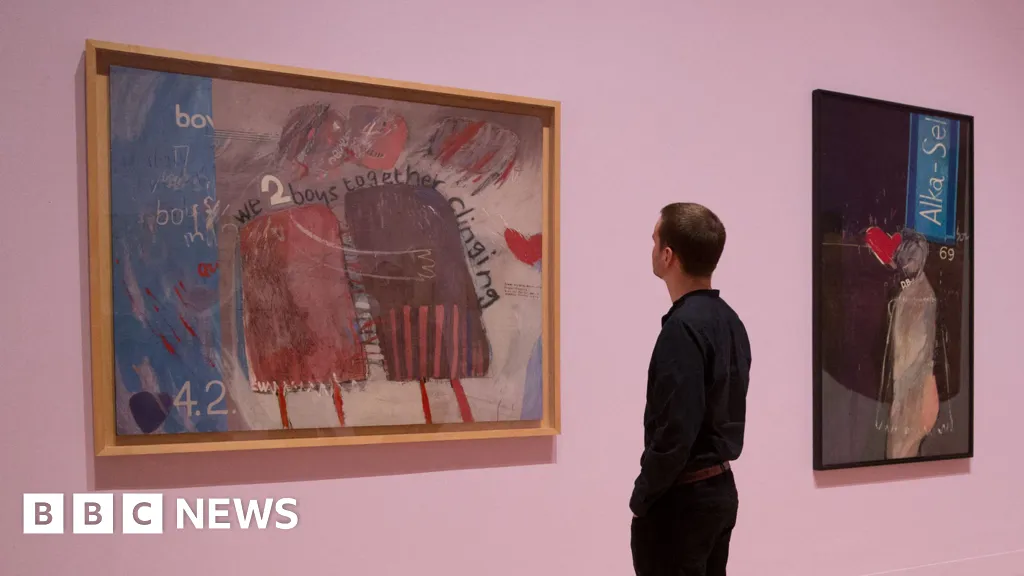
There is an underground quality to some of Hockney's early work. His pictures are reminiscent of graffiti: spiky, expressive and defiant, rendered in bold lines and block colours."He was really pioneering as somebody who was unashamedly proud of his queerness before the legalisation of homosexuality in '67," says Dominic James Bilton, the co-leader of the Queer British Art Network.In these early paintings, Hockney "showed and made work on same-sex relationships and desire and sexuality" at a time when "not a lot of people were doing that".Hockney's style changed radically a few years later, after he travelled to California for the first time in 1964. There he painted his famous swimming pool pictures.In one 1966 painting, Peter Getting Out of Nick's Pool, a nude man climbs from the water of a swimming pool, his back to the viewer, head turned as though in conversation with someone just out of frame.The 1963 painting Domestic Scene, Los Angeles shows one man in a shower while another man washes his back."Those works are so queer, so sensual and sexy and playful and joyous," Bilton says, adding they also show the "domesticity" and "dull aspects of gay relationships".Hockney was "normalising same-sex relationships... that we take for granted", Bilton suggests, adding the artist showed that gay people "are just normal people... doing normal stuff, looking at our partners and thinking: 'oh, you're beautiful'".
SRCBBC News - World
LANGEN
LEANCenter
WORDS227
ENT8
SAT · 2026-06-13 · 01:14 GMTBRIEF NSR-2026-0613-84097
NSR-2026-0613-84097News Report·EN·Human Interest
David Hockney depicted a 'peaceful, gay paradise' when homosexuality was a crime
David Hockney's early art depicted same-sex relationships and desire at a time when homosexuality was illegal in Britain. His work, described as spiky and expressive, celebrated the quiet, everyday moments of gay domestic life, breaking social taboos.
9 hours agoShareSaveAdd as preferred on GoogleAnna LamcheandJosh Parry,LGBT and identity reporterBBC News - WorldFiled 2026-06-13 · 01:14 GMTLean · CenterRead · 1 min
BBC News - WorldFIG 01
Reading time
1min
Word count
227words
Sources cited
1cited
Entities identified
8entities
Quality score
100%
§ 01
Briefing Summary
AI-generatedNEWSAR · AI
David Hockney's early art depicted same-sex relationships and desire at a time when homosexuality was illegal in Britain. His work, described as spiky and expressive, celebrated the quiet, everyday moments of gay domestic life, breaking social taboos. After traveling to California in 1964, his style evolved, leading to famous swimming pool paintings that also conveyed sensuality and domesticity. Art experts suggest Hockney's art normalized same-sex relationships by portraying gay individuals as ordinary people engaged in everyday activities.
Confidence 0.90Sources 1Claims 5Entities 8
§ 02
Article analysis
Model · rule-basedFraming
Human Interest
Social Justice
Tone
Measured
AI-assessed
CalmNeutralAlarmist
Factuality
0.40 / 1.00
Mixed
LowHigh
Sources cited
1
Limited
FewMany
§ 03
Key claims
5 extracted01
Hockney's style changed radically after he travelled to California for the first time in 1964.
factualarticle
Confidence
0.90
02
In these early paintings, Hockney 'showed and made work on same-sex relationships and desire and sexuality' at a time when 'not a lot of people were doing that'.
quoteDominic James Bilton
Confidence
0.90
03
Hockney was pioneering as somebody who was unashamedly proud of his queerness before the legalisation of homosexuality in '67.
quoteDominic James Bilton
Confidence
0.90
04
Those works are so queer, so sensual and sexy and playful and joyous, and also show the 'domesticity' and 'dull aspects of gay relationships'.
quoteDominic James Bilton
Confidence
0.80
05
David Hockney depicted a 'peaceful, gay paradise' when homosexuality was a crime.
factualarticle
Confidence
0.80
§ 04
Full report
1 min read · 227 words§ 05
Entities
8 identifiedKey playerOppositionContextPositiveNeutralNegative
Organizations1
Locations1
§ 06
Keywords & salience
9 termsdavid hockney
1.00
homosexuality
0.90
queerness
0.80
same-sex relationships
0.80
gay paradise
0.70
early work
0.60
california
0.50
swimming pool pictures
0.50
normalising
0.40
§ 07
Topic connections
Interactive graph Network visualization showing 3 related topics
View Full Graph Person Organization Location Event|Click node to navigate|Edge numbers = shared articles