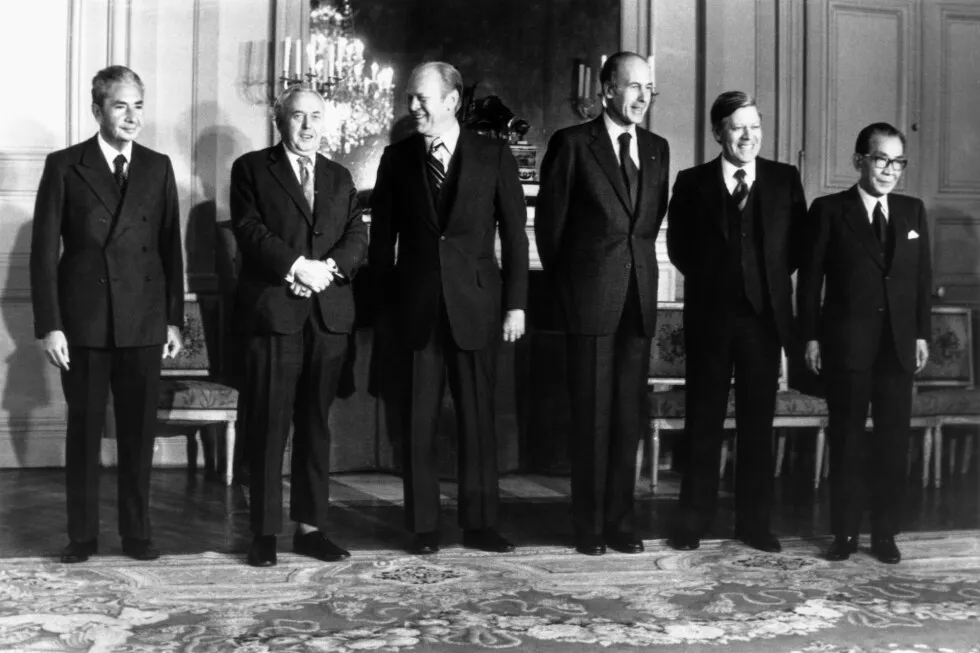
AP Was There: 1975 summit at French castle plants seed for future G7 club of wealthy nations 1 of 2 | From left: Premier Aldo Moro of Italy, Premier Harold Wilson of the Great Britain, President Gerald Ford of the United States, President Valery Giscard d’Estaing of France, Chacellor Helmut Schmidt of West Germany and Premier Takeo Miki of Japan, the six heads of state and government, pose for a group portrait during the Economic and Monetary summit meeting at the Chateau de Rambouillet, West of Paris, Nov. 17, 1975. (AP Photo, File) 2 of 2 | West German Chancellor Helmut Schmidt is met by French protocol chief Mr. Angles, left, as he arrives at the Chateau de Rambouillet, west of Paris on Nov. 15, 1975 for the Economic and Monetary summit meeting. (AP Photo/Michel Lipchitz, file) 1 of 2 | From left: Premier Aldo Moro of Italy, Premier Harold Wilson of the Great Britain, President Gerald Ford of the United States, President Valery Giscard d’Estaing of France, Chacellor Helmut Schmidt of West Germany and Premier Takeo Miki of Japan, the six heads of state and government, pose for a group portrait during the Economic and Monetary summit meeting at the Chateau de Rambouillet, West of Paris, Nov. 17, 1975. (AP Photo, File) 1 of 2 From left: Premier Aldo Moro of Italy, Premier Harold Wilson of the Great Britain, President Gerald Ford of the United States, President Valery Giscard d’Estaing of France, Chacellor Helmut Schmidt of West Germany and Premier Takeo Miki of Japan, the six heads of state and government, pose for a group portrait during the Economic and Monetary summit meeting at the Chateau de Rambouillet, West of Paris, Nov. 17, 1975. (AP Photo, File) Add AP News on Google Add AP News as your preferred source to see more of our stories on Google. Share 2 of 2 | West German Chancellor Helmut Schmidt is met by French protocol chief Mr. Angles, left, as he arrives at the Chateau de Rambouillet, west of Paris on Nov. 15, 1975 for the Economic and Monetary summit meeting. (AP Photo/Michel Lipchitz, file) 2 of 2 West German Chancellor Helmut Schmidt is met by French protocol chief Mr. Angles, left, as he arrives at the Chateau de Rambouillet, west of Paris on Nov. 15, 1975 for the Economic and Monetary summit meeting. (AP Photo/Michel Lipchitz, file) Add AP News on Google Add AP News as your preferred source to see more of our stories on Google. Share Updated [hour]:[minute] [AMPM] [timezone], [monthFull] [day], [year] EDITOR’S NOTE: When U.S. President Gerald Ford and leaders of five other leading democracies gathered for talks at a castle outside Paris on Nov. 15, 1975, they planted the seed for what subsequently became the Group of Seven nations. The initial six industrial powers that huddled at the Château de Rambouillet for three days of brainstorming about fixes for the global economy became the G7 the following year when Canada joined the elite club.During and after the Cold War, the G7 became a powerful tool of influence, enabling Western allies and Japan to hammer out common positions not only on economic issues but also their foreign policy and security priorities. The combined economic, industrial, military, and diplomatic strength of G7 nations ensures the summits they hold annually, rotating hosting duties, are always major news events. The next G7 summit is in France next week. As part of its coverage, The Associated Press is republishing extracts of the story that AP correspondent Arthur L. Gavshon wrote on the first day of the inaugural summit in 1975, hosted by French President Valéry Giscard d’Estaing and also including the leaders of West Germany, the U.K., Italy and Japan, as well as Ford.
SRCAssociated Press (AP)
LANGEN
LEANCenter
WORDS623
ENT12
SAT · 2026-06-13 · 09:23 GMTBRIEF NSR-2026-0613-84099
NSR-2026-0613-84099News Report·EN·Diplomatic
AP Was There: 1975 summit at French castle plants seed for future G7 club of wealthy nations
In November 1975, leaders from six major industrial democracies—France, the United States, West Germany, the United Kingdom, Italy, and Japan—convened at the Château de Rambouillet in France for an Economic and Monetary summit. Hosted by French President Valéry Giscard d’Estaing, the meeting aimed to address the global economic slump, inflation, unemployment, and declining world trade.
By
THE ASSOCIATED PRESSAssociated Press (AP)Filed 2026-06-13 · 09:23 GMTLean · CenterRead · 3 min
Associated Press (AP)FIG 01
Reading time
3min
Word count
623words
Sources cited
0cited
Entities identified
12entities
Quality score
100%
§ 01
Briefing Summary
AI-generatedNEWSAR · AI
In November 1975, leaders from six major industrial democracies—France, the United States, West Germany, the United Kingdom, Italy, and Japan—convened at the Château de Rambouillet in France for an Economic and Monetary summit. Hosted by French President Valéry Giscard d’Estaing, the meeting aimed to address the global economic slump, inflation, unemployment, and declining world trade. U.S. President Gerald Ford urged the leaders to set a goal of transforming the economic slump into prosperity by 1977. This summit planted the seed for what would become the Group of Seven (G7) nations, with Canada joining the following year. The G7 has since evolved into a significant forum for coordinating economic and foreign policy among leading industrialized democracies.
Confidence 0.90Claims 4Entities 12
§ 02
Article analysis
Model · rule-basedFraming
Diplomatic
Economic Impact
Tone
Measured
AI-assessed
CalmNeutralAlarmist
Factuality
0.90 / 1.00
Factual
LowHigh
Sources cited
0
No named sources
FewMany
§ 03
Key claims
4 extracted01
Canada joined the group the following year, making it the G7.
factual
Confidence
1.00
02
The initial six industrial powers that met were Italy, Great Britain, the United States, France, West Germany, and Japan.
factual
Confidence
1.00
03
The 1975 summit at the Chateau de Rambouillet planted the seed for what became the Group of Seven (G7) nations.
factual
Confidence
1.00
04
The G7 became a powerful tool of influence during and after the Cold War.
factual
Confidence
0.90
§ 04
Full report
3 min read · 623 words§ 05
Entities
12 identifiedKey playerOppositionContextPositiveNeutralNegative
People6
§ 06
Keywords & salience
10 termseconomic and monetary summit
1.00
g7 club
1.00
wealthy nations
0.90
chateau de rambouillet
0.80
1975 summit
0.80
heads of state
0.70
international relations
0.60
diplomacy
0.50
gerald ford
0.40
helmut schmidt
0.40
§ 07
Topic connections
Interactive graph No topic relationship data available yet. This graph will appear once topic relationships have been computed.