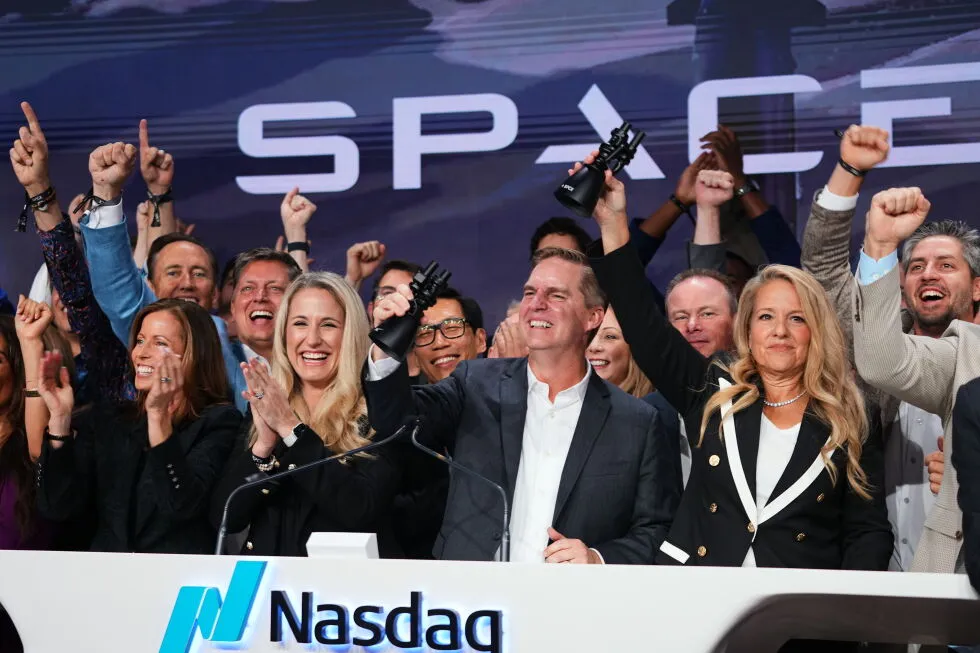
You can ignore AI giants like SpaceX, but your 401(k) won’t 1 of 2 | Gwynne Shotwell, President and COO of SpaceX, right, celebrates with colleagues during a bell ringing ceremony for the IPO of SpaceX at the Nasdaq MarketSite in New York, Friday, June 12, 2026, in New York. (AP Photo/Frank Franklin II) 2 of 2 | SpaceX’s Starship rocket lifts off during a test flight from Starbase, Texas, Friday, May 22, 2026. (AP Photo/Eric Gay, File) By STAN CHOE Updated 2:01 PM MESZ, June 13, 2026 Add AP News on Google Add AP News as your preferred source to see more of our stories on Google. Share Share Facebook Copy Link copied Print Email X LinkedIn Bluesky Flipboard Pinterest Reddit New York (AP) — While you might want to ignore all the hubbub around SpaceX, Elon Musk and IPOs, your 401(k) likely can’t. SpaceX is now worth $2.1 trillion after its stock launched 19.2% higher in its debut on Wall Street. Whether or not you believe it deserves to be worth more than Exxon Mobil, Bank of America and Coca-Cola combined, the collective market does. And if SpaceX maintains that big a value, it will join some high-profile stock indexes. Many of these indexes don’t care about how realistic a company’s growth plans are or who its CEO is. They’re simply trying to show how slices of the market, or the whole thing, are performing. And if SpaceX is big enough to meet the qualifications to join those indexes, whether it’s in a few weeks or a year, it will gain entry. That matters for investors and their 401(k) accounts because they’re depending more than ever on funds that simply mimic these indexes. It’s a lower-cost way to invest, allowing savers to keep more of their investments. Partly because of that, such index funds have usually proven to be better performers than funds that try to pick and choose individual stocks. Just one in five actively managed U.S. stock funds survived and beat their average index peer over the last decade, at 21%, according to Morningstar’s data through 2025. Such disparities in performance meant investors had more money invested in U.S. index funds than actively managed ones beginning in 2024, and the gap has only grown since then. Here’s a look at what’s going on: From rockets to brain implants, here’s a look at Elon Musk’s vast empire 3 MIN READ What Elon Musk’s trillion means in real terms 3 MIN READ 250 SpaceX stock soars in debut and makes Elon Musk the first trillionaire 5 MIN READ 667 What indexes are They’re things the investment industry has created to answer the question: What is the market doing? It’s otherwise tough to answer quickly when the U.S. market has thousands of stocks moving in different directions at any moment. The S&P 500 is perhaps the most famous and influential index. It tracks 500 of the biggest U.S. stocks, and trillions of dollars in investments are either directly mimicking it or at least benchmarking themselves against it. The Dow Jones Industrial Average is well known because it’s been around since the 19th century, but it tracks only 30 big stocks so Wall Street pays it little attention. Because index funds are the way so many investors put money into the stock market, companies want to be part of indexes. Stocks can see a big jump in their prices after S&P Dow Jones Indices, Nasdaq, FTSE Russell or other companies announce they’ll be joining their indexes. The investment industry has created funds, including both traditional mutual funds and exchange-traded funds, to track almost every kind of index. More than 1,000 index funds were available at the end of last year, according to the Investment Company Institute. Of them, 185 tracked the S&P 500. Nasdaq changed its rules to allow some huge companies to join its Nasdaq 100 index after just 15 trading days. That’s a break from the past, where it would wait until each December to add new members in an annual reconstitution to make sure it includes the 100 largest non-financial companies on the Nasdaq. Some popular funds track the Nasdaq 100 index, including the QQQ exchange-traded fund from Invesco that has roughly $477 billion in total investments. That means QQQ holders could soon own shares of SpaceX, without doing anything on their own. Anthropic and OpenAI are two other huge AI-related companies looking to sell their own stocks soon on a U.S. exchange for the first time. Their IPOs could potentially make each worth close to $1 trillion. It used to be that companies would have an IPO long before they got that big. But SpaceX, Anthropic and OpenAI swelled to tremendous sizes thanks to dollars from private investors, including pension funds, companies and rich investors, away from the public market. That’s forcing the reconsideration for the investment industry about how quickly to add companies to indexes that they say track the biggest companies. Not every index is making changes to fast-track big IPOs The company behind the S&P 500 is not making changes to allow SpaceX and other “mega” IPOs faster entry into the index. For it, a stock needs to trade on an eligible exchange for at least 12 months before it can join the index. Not only that, S&P Dow Jones Indices also requires companies to have made a profit in its most recent quarter and over the sum of its last four quarters. SpaceX lost $4.9 billion last year and another $4.3 billion through the first three months of 2026. It acknowledges that it “may not achieve profitability in the future.” Over the long term, a stock’s price tends to track with how much profit the company is making. Not everyone is happy about SpaceX’s IPO entry to indexes Officials from pension funds for firefighters, teachers and other workers in California and New York sent a letter to SpaceX last month decrying its corporate governance, including how much power Musk will hold over the company through his ownership of a special class of stock with more voting power. They said they could become owners of SpaceX stock because they hold index funds. If Musk is able to control so much of the voting power on the board of directors, it would make him tremendously powerful atop SpaceX, “essentially making him unfireable without his own consent,” the CEO of California Public Employees’ Retirement System, the New York state comptroller and the New York City comptroller wrote in their letter. If an investor doesn’t like certain companies in the index Index funds track indexes. And if a stock is in an index, the index fund will buy it, even if investors may not like it. Tesla has remained in the S&P 500 even though critics called it overvalued for years, for example, and Musk’s electric-vehicle company has grown to become one of Wall Street’s 10 biggest companies. Some indexes say they will not include companies that have poor corporate governance standards or other narrowed criteria, but investors need to look for them. The S&P 500 ESG index famously kicked Tesla out in 2022, for example.
SRCAssociated Press (AP)
LANGEN
LEANCenter
WORDS1 190
ENT12
SAT · 2026-06-13 · 14:53 GMTBRIEF NSR-2026-0613-84155
NSR-2026-0613-84155News Report·EN·Economic Impact
You can ignore AI giants like SpaceX, but your 401(k) won’t
SpaceX's recent IPO, valuing the company at $2.1 trillion, means it is likely to be included in major stock indexes like the Nasdaq 100. This inclusion is significant for investors, particularly those with 401(k) accounts, as many rely on low-cost index funds that mirror these indexes.
Associated Press (AP)Filed 2026-06-13 · 14:53 GMTLean · CenterRead · 5 min
Associated Press (AP)FIG 01
Reading time
5min
Word count
1 190words
Sources cited
1cited
Entities identified
12entities
Quality score
100%
§ 01
Briefing Summary
AI-generatedNEWSAR · AI
SpaceX's recent IPO, valuing the company at $2.1 trillion, means it is likely to be included in major stock indexes like the Nasdaq 100. This inclusion is significant for investors, particularly those with 401(k) accounts, as many rely on low-cost index funds that mirror these indexes. Nasdaq has adjusted its rules to allow large companies to join its Nasdaq 100 index more quickly. However, the S&P 500 index has different criteria and will not fast-track SpaceX's entry due to its lack of profitability. Some investors, like pension funds, have expressed concerns about SpaceX's corporate governance, which could impact their holdings through index funds. Other AI companies like Anthropic and OpenAI are also expected to have large IPOs.
Confidence 0.90Sources 1Claims 5Entities 12
§ 02
Article analysis
Model · rule-basedFraming
Economic Impact
Technology
Tone
Mixed Tone
AI-assessed
CalmNeutralAlarmist
Factuality
0.70 / 1.00
Factual
LowHigh
Sources cited
1
Limited
FewMany
§ 03
Key claims
5 extracted01
Just one in five actively managed U.S. stock funds survived and beat their average index peer over the last decade (21%).
statisticMorningstar
Confidence
0.95
02
SpaceX is now worth $2.1 trillion after its stock launched 19.2% higher in its debut on Wall Street.
statistic
Confidence
0.95
03
Investors had more money invested in U.S. index funds than actively managed ones beginning in 2024.
factual
Confidence
0.90
04
Index funds have usually proven to be better performers than funds that try to pick and choose individual stocks.
factual
Confidence
0.90
05
If SpaceX maintains that big a value, it will join some high-profile stock indexes.
prediction
Confidence
0.80
§ 04
Full report
5 min read · 1 190 words§ 05
Entities
12 identifiedKey playerOppositionContextPositiveNeutralNegative
Organizations4
Locations5
§ 06
Keywords & salience
10 terms401(k) accounts
1.00
spacex ipo
1.00
stock market
0.90
index funds
0.90
investment performance
0.80
elon musk
0.70
market capitalization
0.60
passive investing
0.50
actively managed funds
0.50
stock indexes
0.40
§ 07
Topic connections
Interactive graph Network visualization showing 51 related topics
View Full Graph Person Organization Location Event|Click node to navigate|Edge numbers = shared articles