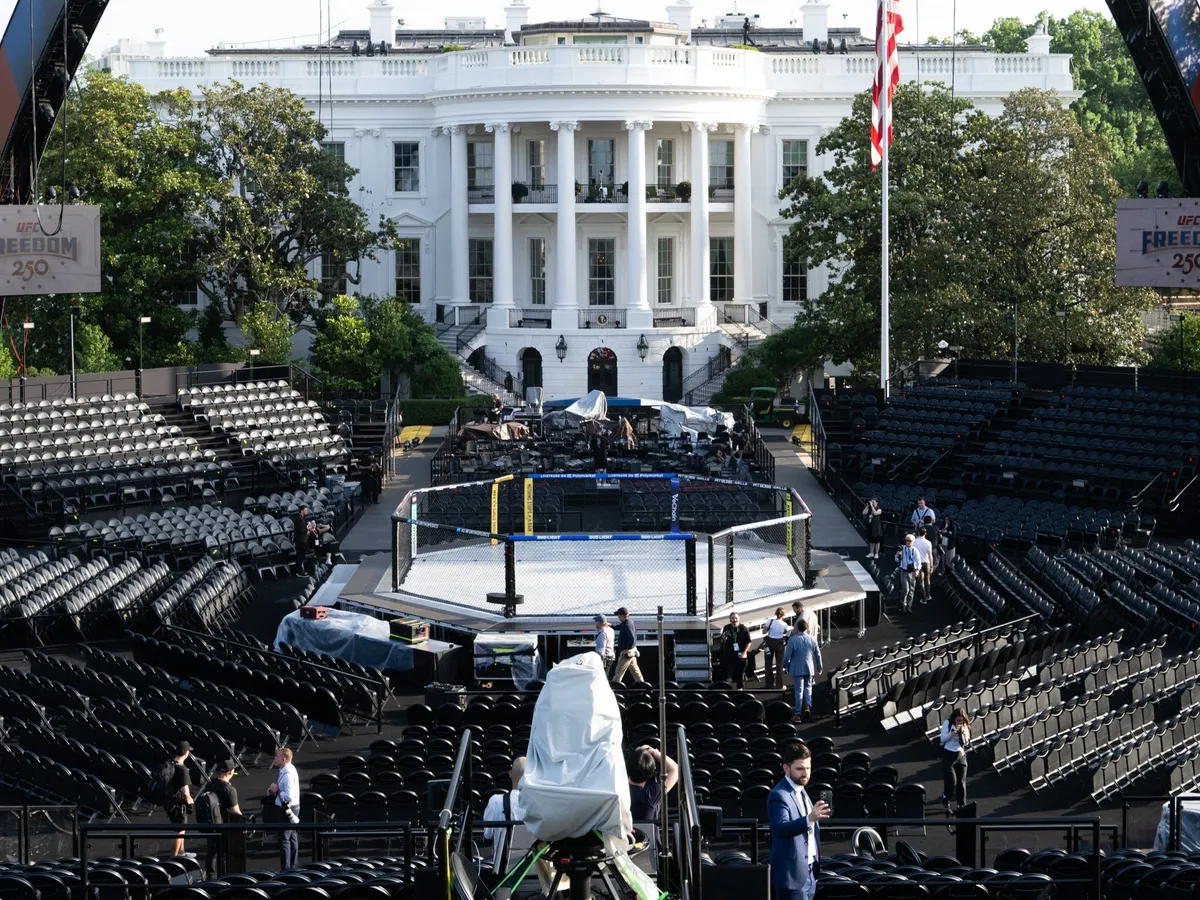
MMA event reflects career deeply interwined with professional fighting, but risks political fallout.'The Octagon' fighting enclosure ready at the White House for the UFC fight night on Sunday [AFP]Published On 13 Jun 2026Washington, DC – Fists will fly and blood will be spilt at the White House for US President Donald Trump’s 80th birthday.The Ultimate Fighting Championship (UFC) event on Sunday, which will also mark next month’s 250th anniversary of the signing of the Declaration of Independence, will bring 14 Mixed Martial Arts (MMA) fighters to “The Octagon” cage constructed on the White House South Lawn.Recommended Stories list of 3 itemslist 1 of 3Conor McGregor to fight Max Holloway in UFC return on July 11list 2 of 3White House prepares for UFC showdown for Trump’s 80th birthdaylist 3 of 3Lawsuit seeks to stop Trump’s planned White House UFC matchend of listAs many as 4,000 invite-only attendees will watch the bouts, which will include two title fights, in an unprecedented display of a sport that has lingered on the fringes but has, nevertheless, been a potent political medium for the president.Trump, a former television personality, real estate heir and hotel owner, has hewed closely to combat sports, dating back to his scene-stealing embrace of professional wrestling in the late 1980s.Al Jazeera spoke to experts who study the intersection of sport and society about what the UFC match both reflects and projects of Trump’s pugilistic political career, and how it could be received in the current political moment.From ‘baby face’ to political ‘heel’In the 1980s, Trump was solidifying his place as a nationally known real-estate developer, casino magnate, and tabloid-ready socialite. World Wrestling Entertainment (WWE) and its flamboyant entertainment-first style of choreographed wrestling was on a “cultural upswing”, according to Lowery Woodall, a professor at Millersville University in Pennsylvania who studies wrestling.It was a fast business pairing, beginning with Trump promoting the WWE’s flagship event, Wrestlemania, at a venue near to his Trump Plaza Hotel and Casino in Atlantic City, New Jersey in 1988 and 1989.But Trump’s affinity for the sport and the kindred spirit he appeared to find with WWE co-founder Vince McMahon extended beyond business, into his own nascent personal myth-building.Trump began regularly appearing as an exaggerated version of himself on the WWE’s flagship events. He and McMahon eventually took part in the so-called “Battle of Billionaires” in 2007, backing opposing fighters while inflating their net worths for maximum entertainment value.“We see a long history in wrestling of promoting things that aren’t entirely accurate to the fans, for example, taking someone who might have been born and raised in Minnesota and saying that they’re Russian because we need a Russian adversary,” Woodall explained.Trump raises the arm of wrestler Bobby Lashley after he defeated Umaga at Wrestlemania 23 in 2007 at Ford Field in Detroit, Michigan [Carlos Osorio/The Associated Press]“I might argue that the very liberal relationship that professional wrestling has with the truth might in fact be one of the things that attracts Trump to it,” he said.“The truth, as is told to the audience, becomes whatever is needed within that moment… which feels quite frankly very much aligned with Trump’s own political messaging outside of the world of professional wrestling.”Some have argued that Trump’s foray into politics has been, in part, aided by the ease of playing the “heel”, or antagonist, in the wider American narrative, dominating headlines by regularly riling political friends and foes alike.But the WWE days saw him instead representing the “baby-face”, an industry term for the classic “good guy”. His character even dipped into the anti-corruption, “drain the swamp” populism that helped carry Trump to the White House in his unlikely 2016 election victory.“If anything, he is seen as the sort of corrective measure against the corrupting force of the Mr McMahon character who is doing dastardly things every week on television to all of your favourite wrestling superstars,” Woodall explained.“Someone else who has a similar level of wealth and power to you steps into the situation and says, ‘no, no, this is all wrong, we can’t continue to do this. I have the power to usurp your authority and overcome you, ” he said.Political utilityUpon moving into the White House, first in 2017 and again in 2025, traces of Trump’s television career endured.During his first term, he appointed Omarosa Manigault Newman, a contestant on the first season of his reality television show, “The Apprentice”, to his White House staff. He tapped WWE co-founder Linda McMahon, Vince McMahon’s wife, as the Administrator of the Small Business Administration.Linda McMahon is currently in Trump’s second term as education secretary, a cabinet position from which she has overseen several of Trump’s initiatives, including efforts to limit transgender individuals from competing in college athletics and supporting crackdowns on pro-Palestine advocates.But while WWE lore may have helped to shape Trump’s public persona, his embrace of UFC, beginning with hosting events at his hotel in the early 2000s, may have been more helpful to his unlikely political comeback ahead of the 2024 presidential victory: helping him to tap into otherwise unengaged young, male voters.“Trump is very good at putting on shows and entertaining people, but it’s more than just the theatrics,” Aaron Ettinger, a professor of international relations at Carleton University in Ottawa, Canada, told Al Jazeera. “There’s a political agenda underpinning all of this.”“UFC is aggressive in a way that appeals to that Trumpian sense of masculinity,” he said. “It’s violent. There’s nothing soft about it. It can’t be construed as lefty, social activist-y.”Journalists get a preview of the UFC fight night at the White House [Chip Somodevilla/Getty Images via AFP]Both UFC and WWE merged under the TKO Holdings company in 2023.They boast the same flair for the dramatic, with fighters cultivating personas often based on ethnicity or political affiliations, even if the two sports are separated by a defining difference: WWE is heavily scripted, whereas UFC fights are traditional sporting contests with the winner decided in the match, either via knockout, submission or points.Average UFC fights get between 300,000 and 2 million views, according to the sports betting site BetMGM, with the audience skewing heavily towards young, male viewers.The UFC culture is also deeply intertwined with the influential world of podcasting. Joe Rogan, one of the sport’s staunchest supporters, averages about 11 million listeners per podcast episode.“The audience for this is predominantly young men, and young men in America are some of the most apolitical parts of the population,” Ettinger said. “So it’s a very effective way of mobilising a segment of the electorate.”Rogan, who endorsed Trump ahead of the 2024 vote, is set to commentate on Sunday’s event.Nevertheless, he has criticised holding official UFC title bouts in an outside setting that could affect the fights’ outcomes. He has also questioned holding the event amid the ongoing US-Israeli war with Iran.A very domestic audienceThe White House fight night comes just days after kick off of the FIFA World Cup 2026, the most-watched sporting event in the world, across the US, Canada and Mexico.The UFC event, whose viewers are predominantly based in the US, with other market hubs, including Brazil, China, Russia and the UK, is charting a different path.Kyle Kusz, a professor at the University of Rhode Island, said the event appears to be an attempt by Trump to project a “warrior-style sporting masculinity”, what he described as Trump’s “sporting vision of an ideal nation”.
SRCAl Jazeera
LANGEN
LEANCenter
WORDS1 226
ENT12
SAT · 2026-06-13 · 16:25 GMTBRIEF NSR-2026-0613-84167
NSR-2026-0613-84167Analysis·EN·Political Strategy
Oval Office octagon: How Trump turned combat sports into a political weapon
The White House is hosting a UFC Mixed Martial Arts event on Sunday, June 13, 2026, on the South Lawn, coinciding with President Donald Trump's 80th birthday and the 250th anniversary of the Declaration of Independence. This event features 14 MMA fighters and is an unprecedented display of the sport at the White House, attended by 4,000 invite-only guests.
Joseph StepanskyAl JazeeraFiled 2026-06-13 · 16:25 GMTLean · CenterRead · 5 min
Al JazeeraFIG 01
Reading time
5min
Word count
1 226words
Sources cited
1cited
Entities identified
12entities
Quality score
100%
§ 01
Briefing Summary
AI-generatedNEWSAR · AI
The White House is hosting a UFC Mixed Martial Arts event on Sunday, June 13, 2026, on the South Lawn, coinciding with President Donald Trump's 80th birthday and the 250th anniversary of the Declaration of Independence. This event features 14 MMA fighters and is an unprecedented display of the sport at the White House, attended by 4,000 invite-only guests. The article highlights Trump's long-standing connection to combat sports, dating back to his promotion of WWE events in the late 1980s and his participation in the "Battle of Billionaires" in 2007. Experts suggest Trump's affinity for professional wrestling, with its flexible relationship with truth, aligns with his political messaging. His past involvement with WWE, where he played a "baby-face" character, is seen as potentially influencing his political persona. The article also notes his appointments of individuals from his television career and the WWE to White House positions.
Confidence 0.90Sources 1Claims 5Entities 12
§ 02
Article analysis
Model · rule-basedFraming
Political Strategy
Human Interest
Tone
Measured
AI-assessed
CalmNeutralAlarmist
Factuality
0.40 / 1.00
Mixed
LowHigh
Sources cited
1
Limited
FewMany
§ 03
Key claims
5 extracted01
Trump's involvement with WWE included promoting Wrestlemania and participating in the 'Battle of Billionaires' event.
factual
Confidence
0.90
02
Donald Trump has a long history of involvement with combat sports, dating back to professional wrestling in the late 1980s.
factual
Confidence
0.90
03
The UFC event will take place on the White House South Lawn in a constructed 'Octagon' cage.
factual
Confidence
0.90
04
The White House will host a UFC event on Sunday for US President Donald Trump’s 80th birthday.
factual
Confidence
0.90
05
Experts study the intersection of sport and society to understand what the UFC match reflects and projects of Trump’s political career.
factualAl Jazeera (reporting on experts)
Confidence
0.80
§ 04
Full report
5 min read · 1 226 words§ 05
Entities
12 identifiedKey playerOppositionContextPositiveNeutralNegative
People4
Organizations5
§ 06
Keywords & salience
10 termsdonald trump
1.00
mixed martial arts
0.90
ufc
0.90
political weapon
0.80
white house
0.70
combat sports
0.70
political career
0.60
professional wrestling
0.50
wwe
0.50
political fallout
0.40
§ 07
Topic connections
Interactive graph Network visualization showing 51 related topics
View Full Graph Person Organization Location Event|Click node to navigate|Edge numbers = shared articles