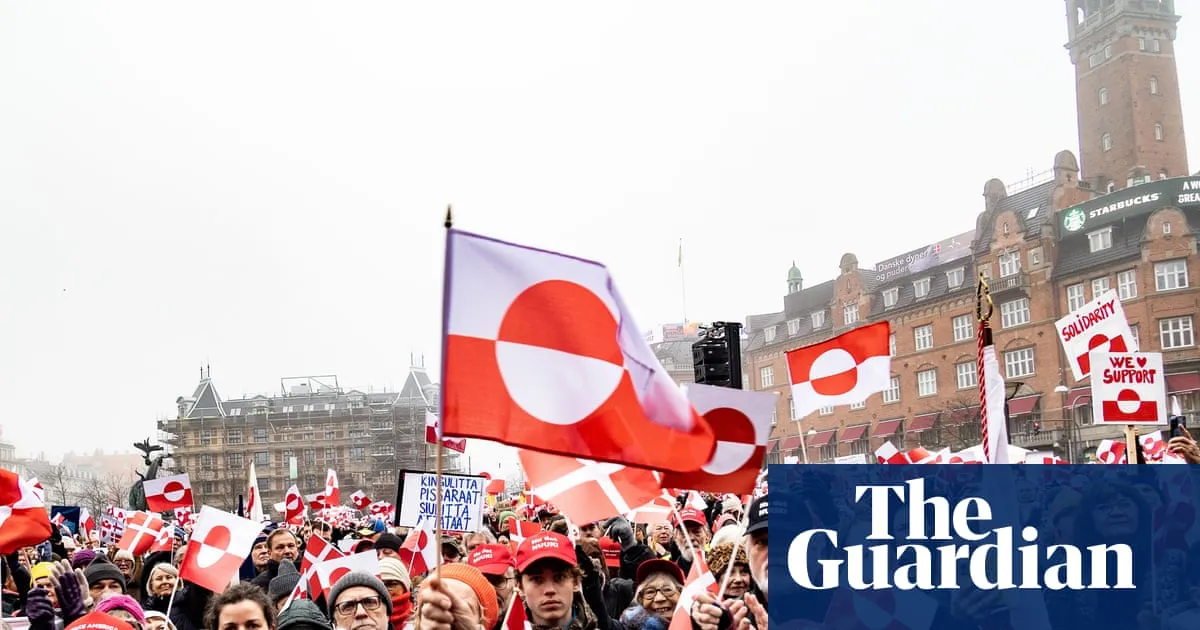
Senior European diplomats are due to hold crisis talks after Donald Trump said he was targeting eight European nations with tariffs over their opposition to his attempt to annex Greenland.Italy’s prime minister, Giorgia Meloni, said Trump’s tariffs would be a mistake, and the Dutch foreign minister, David van Weel, described the US president’s threats to allies as “blackmail”, as reaction from European leaders continued to pile up.The French president, Emmanuel Macron, will urge the EU to use its powerful anti-coercion instrument if the US goes ahead with the tariffs in the standoff over Greenland, Agence France-Presse reported on Sunday, citing his team.The anti-coercion law, which has so far never been used, enables the EU to impose punitive economic measures on a country seeking to force a policy change.The ambassadors of the EU’s 27 member states will meet later on Sunday in an emergency session after Trump announced tariffs on Denmark, Norway, Sweden, France, Germany, the UK, the Netherlands and Finland.Trump accused the countries, which have all deployed troops to Greenland in the last week, of playing “a very dangerous game” and said they would be subject to 10% tariffs from 1 February, increasing to 25% from 1 June.In a Truth Social post on Saturday, Trump said the tariffs would be levied “until such time as a Deal is reached for the Complete and Total purchase of Greenland”, a largely autonomous territory that is part of Denmark.The threats to Greenland have cast a long shadow over Nato and thrown into doubt the EU-US trade deal that the bloc signed with Trump last August. The leader of the European parliament’s largest group, the centre-right European People’s party, Manfred Weber, tweeted on Saturday that “approval is not possible at this stage”, a conclusion Socialist and Green MEPs had already reached.Ratification of the deal, which would reduce EU tariffs on some US goods to zero, had been expected by February.Macron said on Saturday that Europe would not change course in its opposition to a US takeover of Greenland, declaring: “No intimidation or threat will influence us – neither in Ukraine, nor in Greenland, nor anywhere else in the world when we are confronted with such situations.”In a joint statement, the EU leaders Ursula von der Leyen and António Costa said tariffs would “undermine transatlantic relations and risk a dangerous downward spiral”. The pair, who had been in Paraguay signing a trade deal with four South American countries in the Mercosur bloc, are understood to have been blindsided by Trump’s latest threats.Meloni, one Trump’s strongest EU allies, told journalists in Seoul that she had spoken to him “and told him what I think”, describing the proposed sanctions as a “mistake”.The Finnish president, Alexander Stubb, who bonded with Trump over their shared love of golf, said European countries stood united in support of Denmark and Greenland. “Tariffs would undermine the transatlantic relationship and risk a dangerous downward spiral,” he wrote on X.Spain’s leader, Pedro Sánchez, said a US invasion of Greenland would make Vladimir Putin “the happiest man on Earth” by legitimising the Russian president’s attempted invasion of Ukraine and sounding the “death knell for Nato”.Sánchez’s interview to La Vanguardia, published on Sunday but apparently conducted before Trump’s latest threat, reflects the broad European support for the Danish territory.After the Trump broadside, the EU’s top diplomat, Kaja Kallas, tweeted: “China and Russia must be having a field day.” She went on: “If Greenland’s security is at risk, we can address this inside Nato. Tariffs risk making Europe and the United States poorer and undermine our shared prosperity.”Kallas warned against the dispute “distract[ing] us from the our core task of helping to end Russia’s war against Ukraine”.Denmark’s foreign minister, Lars Løkke Rasmussen, who was in Washington last week for talks about Greenland, said Trump’s announcement came as a surprise, after the “constructive” talks held with the vice-president, JD Vance, and the secretary of state, Marco Rubio. “The purpose of the increased military presence in Greenland, to which the president refers, is to enhance security in the Arctic,” Rasmussen wrote.Trump’s latest threat underscores allies’ seemingly impossible job to appease Trump without ceding Greenland to the US. Trump criticised the motives of countries that deployed troops to Greenland in the name of enhanced security while also mocking Denmark for not doing enough to defend the territory. “China and Russia want Greenland, and there is not a thing that Denmark can do about it. They currently have two dogsleds as protection, one added recently,” he wrote.Denmark announced last week that it was increasing its military presence on the island, while troops from the seven other countries targeted with tariffs went to Greenland on a short scoping mission designed in part to show the US that European Nato members were serious about Arctic security.The threats represent an “existential crisis” for Nato, said one former official at the transatlantic alliance. Robert Pszczel, now a senior fellow at the Centre for Eastern Studies in Warsaw, wrote on X: “Pretending that we are not dealing with an existential crisis for Nato is no longer possible nor desirable.“Threats made by the current US administration towards allies of the [US] and the use of economic blackmail are direct violations of article one and two of the North Atlantic Treaty,” he wrote, referencing parts of the agreement on peaceful settlement of disputes among allies and promoting “peaceful and friendly international relations”.The head of the European parliament’s trade committee, Bernd Lange, said the EU needed to activate its anti-coercion instrument, a law that allows wide-ranging economic sanctions in response to hostile actions from another state.The anti-coercion instrument, originally conceived in response to China, allows the EU to take wide-ranging punitive measures against a country seeking to use economic coercion, such as tariffs or investment restrictions.Lange, a German Social Democrat, said Trump was using trade as an instrument of political coercion, adding: “The EU cannot simply move on to business as usual.”
SRCThe Guardian - World News
LANGEN
LEANCenter-Left
WORDS983
ENT11
SUN · 2026-01-18 · 13:35 GMTBRIEF NSR-2026-0118-8425
NSR-2026-0118-8425News Report·EN·Diplomatic
EU diplomats to hold crisis talks over Trump Greenland tariff ‘blackmail’
EU diplomats are holding emergency talks after former U.S. President Trump threatened tariffs on eight European nations (Denmark, Norway, Sweden, France, Germany, the UK, the Netherlands, and Finland) due to their opposition to his renewed attempt to purchase Greenland.
Jennifer Rankin in BrusselsThe Guardian - World NewsFiled 2026-01-18 · 13:35 GMTLean · Center-LeftRead · 4 min
The Guardian - World NewsFIG 01
Reading time
4min
Word count
983words
Sources cited
11cited
Entities identified
11entities
Quality score
100%
§ 01
Briefing Summary
AI-generatedNEWSAR · AI
EU diplomats are holding emergency talks after former U.S. President Trump threatened tariffs on eight European nations (Denmark, Norway, Sweden, France, Germany, the UK, the Netherlands, and Finland) due to their opposition to his renewed attempt to purchase Greenland. Trump stated the tariffs, starting at 10% in February and increasing to 25% in June, would remain until a deal for Greenland's purchase is reached. European leaders, including Macron, Meloni, and van Weel, have condemned the tariffs as "blackmail" and a mistake, with Macron urging the EU to consider using its anti-coercion instrument. The EU-US trade deal, expected to be ratified in February, is now in doubt, with key figures in the European Parliament withdrawing their support. EU leaders von der Leyen and Costa warned the tariffs would damage transatlantic relations.
Confidence 0.90Sources 11Claims 5Entities 11
§ 02
Article analysis
Model · rule-basedFraming
Diplomatic
Economic Impact
Tone
Mixed Tone
AI-assessed
CalmNeutralAlarmist
Factuality
0.70 / 1.00
Factual
LowHigh
Sources cited
11
Well sourced
FewMany
§ 03
Key claims
5 extracted01
Meloni described the proposed sanctions as a “mistake”.
quoteGiorgia Meloni
Confidence
1.00
02
The anti-coercion law enables the EU to impose punitive economic measures on a country seeking to force a policy change.
factualArticle
Confidence
1.00
03
The ambassadors of the EU’s 27 member states will meet later on Sunday in an emergency session.
factualArticle
Confidence
1.00
04
Trump accused the countries of playing “a very dangerous game” and said they would be subject to 10% tariffs from 1 February.
quoteTrump
Confidence
1.00
05
Trump said he was targeting eight European nations with tariffs over their opposition to his attempt to annex Greenland.
factualArticle
Confidence
1.00
§ 04
Full report
4 min read · 983 words§ 05
Entities
11 identifiedKey playerOppositionContextPositiveNeutralNegative
People5
Organizations1
§ 06
Keywords & salience
9 termstariffs
1.00
greenland
0.90
eu
0.80
us
0.70
trade deal
0.60
transatlantic relations
0.50
anti-coercion instrument
0.50
blackmail
0.40
crisis talks
0.40
§ 07
Topic connections
Interactive graph Network visualization showing 51 related topics
View Full Graph Person Organization Location Event|Click node to navigate|Edge numbers = shared articles