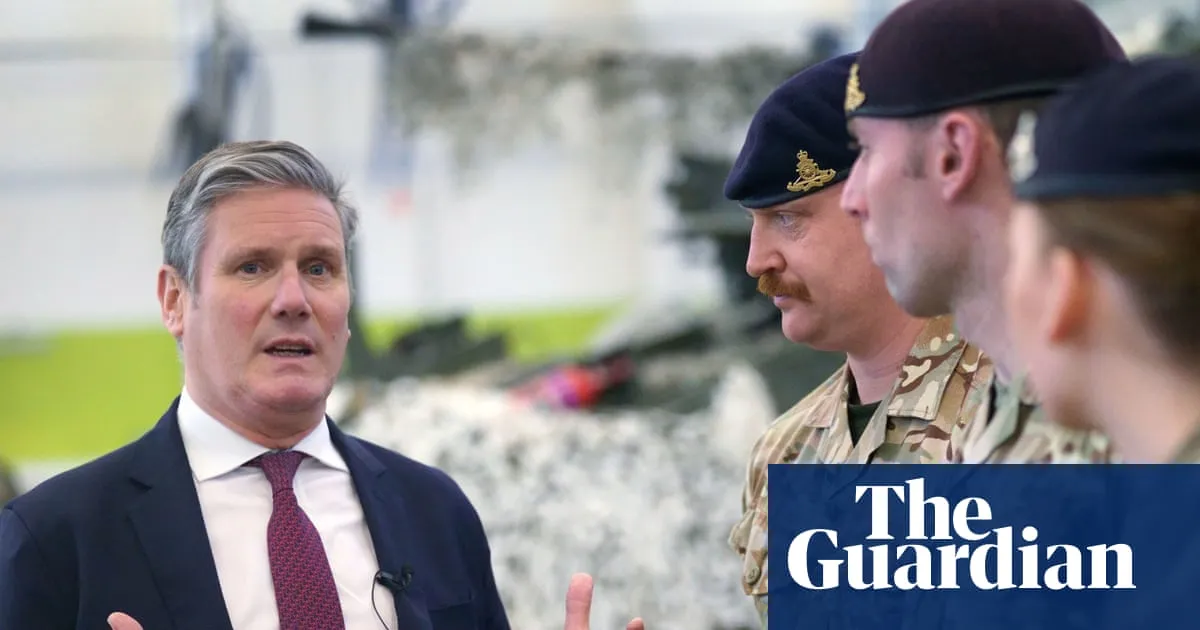
Keir Starmer with British troops during a 2022 visit to Estonia. Photograph: Victoria Jones/PA View image in fullscreen Keir Starmer with British troops during a 2022 visit to Estonia. Photograph: Victoria Jones/PA Tuesday briefing: How the UK’s military spending row exposes Starmer’s defence dilemma In today’s newsletter: An argument about money has also spotlighted questions about Britain’s place in the world and the changing face of warfare Good morning. What conflict has raged longer than the hundred years war? The fight between the Ministry of Defence and the Treasury over defence spending. I’d love to claim this as my own, but avoid patter theft this early in the day. So I’ll credit my colleague Dan Sabbagh, the Guardian’s defence and security editor, who spoke to me ahead of this week’s G7 meeting, in France, where Keir Starmer arrived yesterday for what could be his final international summit. The prime minister can anticipate candid discussions about international partnerships in conflicts in Ukraine and the Middle East, both of which may soon demand increased involvement from the British military. The political row over whether the UK government is spending enough to keep Britain safe and fulfil its international commitments broke into the public sphere with the resignation of defence minister John Healey last Thursday. It continues today as Al Carns, who resigned from his post as armed forced minister on the same day, tells the Guardian in an exclusive interview about “unbelievable” waste at the MoD, and suggests mismanaged programmes such as tanks investment should be scrapped in favour of new technology. The resignation of two highly respected ministers, only one of whom reportedly fancies a shot in Downing Street, further weakens the prime minister’s position ahead of Andy Burnham’s return to the Commons if he is victorious in this week’s Makerfield byelection. I spoke to Dan about how an argument about money exposes domestic and international uncertainties around Starmer’s leadership, Britain’s place in the world and the changing face of warfare. Middle East | Donald Trump has declared that the strait of Hormuz will be “completely open” from Friday, as western leaders gathering at the G7 summit in Évian-les-Bains battled to prevent the fragile US deal with Iran from almost immediately unravelling. UK politics | Political hatred and division in the UK is probably worse now than during the Brexit referendum, when Jo Cox was murdered, says Kim Leadbeater, Cox’s sister who is now also a Labour MP. Crime | A schoolteacher described as a “serial manipulator and a serial liar” has been found guilty of sexually abusing and murdering a baby he and his partner had adopted. Environment | Half of the world’s children are exposed to at least three overlapping climate hazards threatening their health, education and survival, according to a Unicef report. US news | Eight people are presumed dead after a B-52 bomber crashed shortly after takeoff on Monday morning at a US air force base in California’s Mojave Desert, officials said. In depth: Starmer’s defence-spending ‘rhetoric-to-reality gap’ View image in fullscreen Prime minister Keir Starmer and his wife, Victoria, arriving in Geneva before the G7 meeting. Photograph: Simon Dawson/No 10 Downing Street There isn’t a lot of agreement about what Starmer has got right in government, but our lobby team will tell you that some MPs remain swayed by his record on the international stage. He got two things right, says Dan: support for Ukraine and keeping Britain largely out of the US-Israel war on Iran. “He’s also weathered the sheer difficulty of being a British Labour prime minister when a turbulent Republican in the White House is shifting position daily between being your friend and trying to destabilise you.” But where Starmer has failed to shift the dial is on the strategic problem of Britain’s place in the world during a volatile time. He spoke to this at the Munich Security Conference in February, suggesting that – as the Trump administration disengaged with former allies – it provided an opportunity for “radical renewal” and a more European Nato able to “stand on our own feet”. Taken together, these factors point to the need to progressively spend more on defence to meet Nato’s target – which Starmer has signed up to, of 3.5% of GDP by 2035. Instead, Dan explains, “we’ve got a modest step up to 2.6% by 2027 and then ‘a big blank’”. Here the essential criticism that Healey and others are making kicks in, says Dan, with “this rhetoric-to-reality gap”. Healey resigned on a point of principle about long-term defence spending, but he also quit because the prime minister is weak, Dan says bluntly. Circumscribed by Rachel Reeves’s much maligned fiscal rules, the Treasury has limited room for manoeuvre beyond further reallocation of spending from other parts of government, and Starmer has scant goodwill among remaining ministers. The trouble, Dan reminds me, is that Starmer’s dilemma is not only about cash that may be spent on future projects, but it is also about honouring the international commitments Britain already has signed up to. If you’ll indulge me a tangent: spending is often presented as a zero-sum scenario between welfare and defence, and not only in the rightwing media. In April, Lord Robertson, who led the government’s Strategic Defence Review in 2025, said: “We cannot defend Britain with an ever-expanding welfare budget.” But as the Resolution Foundation’s Ruth Curtice said recently, the peace dividend – the uptick in available funding for other departments from the declining defence spend after the end of the cold war – has been spent on the entire welfare state, with the most dramatic increases in health spending, not just working-age social security. According to latest Ipsos polling, British voters are pretty evenly split on whether they favour an increase in defence spending or keeping it the same, although they are cautious about the tax-and-spend trade-offs. The case for increased defence spending is harder to make with a population who experience no direct threat while bombs continue to drop elsewhere. This is despite the general acceptance in military circles that Britain is already under threat on home soil, be that electoral interference from foreign agents, targeting of synagogues by Iranian state proxies. Only yesterday a handler with ties to Russia appeared to have directed arson attacks on property connected to Starmer. But the problem is that the prime minister had already – very publicly – argued for that increase, warning voters to beware “peddlers of easy answers” such as Reform UK and the Greens risking national security. A more effective narrative-builder than Starmer could have made the argument stick with voters – and his own cabinet. Starmer’s words at Munich about rebalancing the relationship between Europe and the US is a thread likely to be picked up by Canadian prime minister, Mark Carney, who pledged en route to the G7 meeting that “the new world order will be built starting with Europe”. “Do not underestimate how many European countries, particularly smaller ones and those to the east, now look to Britain, as well as to France and Germany, and want leadership,” says Dan. While initially encouraged by Starmer’s rhetoric, Dan says some Baltic states most exposed to Russian aggression are now asking: “Is Britain for real?” As he puts it: “They want nothing more than Britons to be strong and engaged, but suspect we haven’t really got the capability we say we have.” Britain’s reliability in a moment of crisis was exposed at the start of the Iran conflict in March, when it took three weeks to deploy a warship from Portsmouth to bolster security at the British RAF base in Cyprus after a drone attack. There has been a “huge shift” in British military thinking, says Dan, even in the past year, as regards the type of future investment our armed forces need and one directly influenced by Ukraine’s success in transforming itself into a “drone superpower”. When the Guardian interviewed Volodymyr Zelenskyy last week, just after his Downing Street meeting with Starmer, he was upbeat, saying the military situation was the most promising it had been for Kyiv for two and a half years. Having dramatically built up Ukraine’s drone capability – with the help of US technology – long-range strikes on Russian oil refineries, runways and military installations are now affecting the country’s economy and wartime logistics, and – in what Zelenskyy said was a very deliberate tactic – bringing the conflict home to ordinary Russians. Many military analysts argue that this techno-centric warfare is likely to become the model for 21st-century conflicts. But Dan offers a caution “against simplifications, that war is about one technology or another. Israel bombed Gaza quite effectively without drones; Iranian drones or missiles did not knock out US warships”. “Neither Russia or Ukraine has sufficient combat air power, or ability to mass force numbers – meaning that in Ukraine drones have become the weapon of choice,” he adds. “Drones are additive in a modern military, not a replacement for other weapons.” What else we’ve been reading View image in fullscreen David Hockney in East Yorkshire in 2006. Photograph: Jean-Pierre Gonçalves de Lima Jonathan Jones has written this heartfelt piece about his email exchanges and intimate dinners with the late David Hockney when the artist returned to Yorkshire from LA. Sinéad Campbell, newsletters team I enjoyed this Science Weekly episode on the evidence for a social media ban for under-16s and how we make the online world a better place for all ages (clue: hold big tech to account). Libby Zoe Williams has a moving interview with the actor Laverne Cox about how her identity as a transgender woman has become a challenge to the politics around her. Sinéad World Cup 2026 View image in fullscreen Players of Cape Verde celebrate. Photograph: Xinhua/Shutterstock Spain 0-0 Cape Verde | No, that’s not a typo – the 64th-ranked World Cup debutants really did hold the perennial favourites to a no-score draw. “Wow, just wow”, Sid Lowe’s match report begins. Belgium 1-1 Egypt | Romelu Lukaku’s threat on the pitch drew two defenders on to his first run into the box, which resulted in an equalising own goal to salvage a point from a closely fought contest. Saudi Arabia 1-1 Uruguay | Maximiliano Araújo scored a late equaliser in Miami as Uruguay battled back for a 1-1 draw against Saudi Arabia. Iran 2-2 New Zealand | Iran did not seem bogged down by political baggage as they let their football do the talking in an entertaining 2-2 draw against New Zealand. England | Reporting from the Three Lions camp in Kansas City, Jacob Steinberg reveals how Jordan Henderson’s changing room leadership could make the difference after the veteran midfielder was dropped from the Euro 2024 side. My World Cup | Live in an America, Canadian or Mexican host city? The Guardian community team want to hear from you on what the mood’s like in your city right now. The front pages View image in fullscreen Photograph: The Guardian “Social media firms hit back as PM vows to ban under-16s”, is the Guardian’s front page today. The Times runs “Age checks on phones to access social media”, The Telegraph says “Starmer’s social media ban ‘a rush job’” and Metro has “PM: My ban will keep our kids safe”. The FT leads with “Arson attacks on Starmer properties were run by pro-Kremlin hacktivists”, on the same story the Independent runs “Arson attack on Starmer linked to Russia”, and the i Paper also says “Plot to burn down Starmer’s home linked to Russian mastermind”. The Mirror splashes “In their name” in memory of murdered MPs Jo Cox and David Amess. And the Express says “Our hope has been restored” on the assisted dying bill. Today in Focus: The Latest Photograph: the Guardian The US and Iran have reached a tentative deal to end the conflict in the Middle East, but competing claims from Donald Trump and Tehran have left the details shrouded in uncertainty. Questions remain over the reopening of the strait of Hormuz, Israel’s withdrawal from Lebanon, and the future of Iran’s nuclear programme. Nosheen Iqbal speaks to Julian Borger, the Guardian’s senior international correspondent – watch the episode on YouTube here. Cartoon of the day | Ben Jennings View image in fullscreen Illustration: Ben Jennings/The Guardian The Upside A bit of good news to remind you that the world’s not all bad View image in fullscreen Nick Dowling, with his dog Rosie and cat Tigger. Photograph: Jill Mead/The Guardian Nick Dowling worked for decades in manufacturing and consultancy but when he saw a poster advertising voluntary work for the ambulance service, he signed up immediately. Soon after, the pandemic hit. Dowling’s work went online. “Suddenly, you’re just talking to a screen,” he says. “You’re getting nothing back from it … I got bored quickly.” Meanwhile, volunteering with the ambulance service became more vital, and it led to a change of heart about his career goals. Now, at 60, Dowling has undertaken an apprenticeship and hopes to qualify as a registered nursing associate. He’s never been one to stick to a career path. “I value learning,” he says. “And I think learning and change are synonymous.” And finally, the Guardian’s puzzles are here to keep you entertained throughout the day. Until tomorrow. Explore more on these topics Dan Jarvis First Edition newsletter Defence policy Ministry of Defence Labour Keir Starmer Military John Healey newsletters Share Reuse this content
SRCThe Guardian - World News
LANGEN
LEANCenter-Left
WORDS2 241
ENT12
TUE · 2026-06-16 · 05:44 GMTBRIEF NSR-2026-0616-84787
NSR-2026-0616-84787Analysis·EN·Political Strategy
Tuesday briefing: How the UK’s military spending row exposes Starmer’s defence dilemma
A public dispute over UK defense spending has highlighted questions about Britain's global role and evolving warfare, coinciding with Keir Starmer's attendance at the G7 summit. The argument intensified with the resignations of defense ministers John Healey and Al Carns, who cited concerns about Ministry of Defence waste and the need for investment in new technology over existing programs.
Libby BrooksThe Guardian - World NewsFiled 2026-06-16 · 05:44 GMTLean · Center-LeftRead · 9 min
The Guardian - World NewsFIG 01
Reading time
9min
Word count
2 241words
Sources cited
3cited
Entities identified
12entities
Quality score
100%
§ 01
Briefing Summary
AI-generatedNEWSAR · AI
A public dispute over UK defense spending has highlighted questions about Britain's global role and evolving warfare, coinciding with Keir Starmer's attendance at the G7 summit. The argument intensified with the resignations of defense ministers John Healey and Al Carns, who cited concerns about Ministry of Defence waste and the need for investment in new technology over existing programs. This internal conflict exposes a perceived gap between Starmer's rhetoric on strengthening Britain's international partnerships and his government's actual defense spending plans, which fall short of NATO targets. Starmer has faced challenges in navigating international relations, particularly with the US, and is constrained by fiscal rules.
Confidence 0.90Sources 3Claims 5Entities 12
§ 02
Article analysis
Model · rule-basedFraming
Political Strategy
National Security
Tone
Measured
AI-assessed
CalmNeutralAlarmist
Factuality
0.40 / 1.00
Mixed
LowHigh
Sources cited
3
Well sourced
FewMany
§ 03
Key claims
5 extracted01
The political row over whether the UK government is spending enough to keep Britain safe and fulfil its international commitments broke into the public sphere with the resignation of defence minister John Healey last Thursday.
factual
Confidence
0.95
02
Half of the world’s children are exposed to at least three overlapping climate hazards threatening their health, education and survival.
statisticUnicef report
Confidence
0.90
03
The argument about money has spotlighted questions about Britain’s place in the world and the changing face of warfare.
factual
Confidence
0.90
04
Al Carns suggests mismanaged programmes such as tanks investment should be scrapped in favour of new technology.
quoteAl Carns
Confidence
0.85
05
Political hatred and division in the UK is probably worse now than during the Brexit referendum.
quoteKim Leadbeater
Confidence
0.70
§ 04
Full report
9 min read · 2 241 words§ 05
Entities
12 identifiedKey playerOppositionContextPositiveNeutralNegative
People4
Organizations3
§ 06
Keywords & salience
10 termsmilitary spending
1.00
keir starmer
0.90
defence dilemma
0.90
uk politics
0.80
changing face of warfare
0.70
international commitments
0.60
g7 meeting
0.50
ukraine
0.40
middle east
0.40
new technology
0.40
§ 07
Topic connections
Interactive graph Network visualization showing 51 related topics
View Full Graph Person Organization Location Event|Click node to navigate|Edge numbers = shared articles