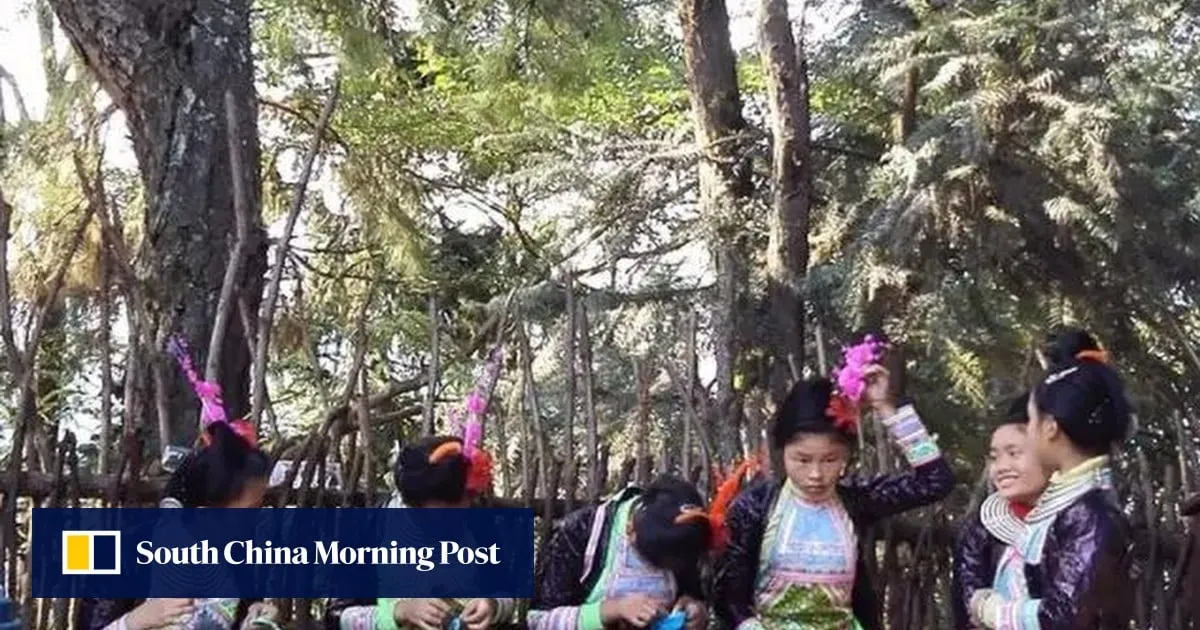
China’s Miao ethnic group reveres trees, believing that they symbolise the life of humans; they also worship vegetation at important stages of life.The Miao people, whose population numbers over 10 million, inhabit central and southern China’s Guizhou, Yunnan, Guangxi provinces, and have a traditional Flower-Jump Festival every year.At this time, people gather around a 10-metre-tall flower tree made by the revered elderly in the village with evergreen tree branches, and dance around it on every sixth day of the first lunar month.Trees play a central role in the lives of China’s Miao people. Photo: ZhihuThe Miao people believe that the maple tree is the origin of their life. They believe that such a tree bred the butterfly mother, who gave birth to 12 life eggs, and a human was born in one of the eggs.When they build new villages, they would first plant a maple tree. If the tree does not like the place, they would seek another spot.In some villages, people celebrate the life of their mother tree once a year.They worship sacrifices and burn joss paper, asking for another year’s protection from the tree, before snapping some branches to take home.People from the Miao ethnic minority perform a traditional ritual as villagers look on. Photo: ZhihuEach home would worship the branches, hanging 12 little glutinous rice cakes on them, to symbolise that all the 12 months in the following year would be smooth.In a 2,000-people Miao village called Biasha, which in the local language means “verdant lands”, people believe that a person’s life has three trees.The first tree represents birth, which is planted when a person is born, and made into their coffin when they die.The second tree is for a person to worship for health and peace when they encounter illness or difficulties in life, designated by the village’s revered elderly.Members of the Miao community place joss sticks under a tree. Photo: ZhihuThe third tree is an evergreen tree planted by a person’s family on their grave after they die, suggesting that they never really leave the world.Further ReadingA Biasha villager reportedly said that they do not allow the use of carts to carry the chopped branches, and only carry them on their own backs, to prevent unlawful felling.People who secretly fell trees or saplings are penalised by the villagers and asked to plant twice the number of trees that they cut.In some Miao villages, when people, especially children, get sick, their family would “plant” a small flower tree at home, to pray to the deities and their ancestors to restore the patients’ spirits and health.The flower tree is like an altar, featuring branches arranged among four staircases, each representing a generation of the family.This “Memorial Pavilion” honours the 1,000-year-old camphor tree donated by Biasha residents for the construction of the Chairman Mao Memorial Hall in Beijing in 1976. To show their respect, locals kept one piece to commemorate here. Photo: ZhihuThey would also sacrifice pig’s bone to the tree for boys, and duck’s feather for girls.People also decorate the tree with a bag of rice they asked for from other village households, a silver bracelet funded by 12 male relatives, and a bundle of white threads that symbolises longevity.Although the Miao people’s tree-worshipping rituals are not shared across the nation, Chinese people generally revere giant trees hundreds of years old, believing they are sacred.In recent years, the practice of literally embracing trees went viral among urban youngsters in China, who believe it will relieve their intense life pressure.
SRCSouth China Morning Post
LANGEN
LEANCenter-Right
WORDS582
ENT10
TUE · 2026-06-16 · 06:00 GMTBRIEF NSR-2026-0616-84807
NSR-2026-0616-84807News Report·EN·Human Interest
China’s Miao people believe human life symbolised by trees, depicting birth, hardship, death
China's Miao ethnic group, numbering over 10 million and residing in central and southern China, deeply revere trees, believing they symbolize human life and worshipping vegetation at significant life stages. Their traditions include the annual Flower-Jump Festival, where they gather around a large flower tree.
Fran LuSouth China Morning PostFiled 2026-06-16 · 06:00 GMTLean · Center-RightRead · 3 min
South China Morning PostFIG 01
Reading time
3min
Word count
582words
Sources cited
0cited
Entities identified
10entities
Quality score
100%
§ 01
Briefing Summary
AI-generatedNEWSAR · AI
China's Miao ethnic group, numbering over 10 million and residing in central and southern China, deeply revere trees, believing they symbolize human life and worshipping vegetation at significant life stages. Their traditions include the annual Flower-Jump Festival, where they gather around a large flower tree. The Miao believe maple trees are the origin of their life, with one village stating a person's life is represented by three trees: one for birth and death, another for seeking health and peace, and a third evergreen planted on graves. They also plant trees when building new villages and perform rituals for protection and well-being, such as hanging rice cakes on branches to symbolize smooth years. In some instances, small flower trees are "planted" at home to pray for the recovery of the sick.
Confidence 0.90Claims 5Entities 10
§ 02
Article analysis
Model · rule-basedFraming
Human Interest
Environmental
Tone
Measured
AI-assessed
CalmNeutralAlarmist
Factuality
0.80 / 1.00
Factual
LowHigh
Sources cited
0
No named sources
FewMany
§ 03
Key claims
5 extracted01
Penalties for unlawful tree felling among the Miao include being asked to plant twice the number of trees cut.
factual
Confidence
0.90
02
In some Miao villages, a person's life is represented by three trees: one for birth and coffin, one for worship during hardship, and one planted on a grave after death.
factual
Confidence
0.90
03
The Miao people believe that trees symbolise human life, depicting birth, hardship, and death.
factual
Confidence
0.90
04
When children get sick in some Miao villages, families "plant" a small flower tree at home to pray for their recovery.
factual
Confidence
0.80
05
The Miao people believe the maple tree is the origin of their life, from which a butterfly mother bred 12 life eggs, leading to human birth.
factual
Confidence
0.80
§ 04
Full report
3 min read · 582 words§ 05
Entities
10 identifiedKey playerOppositionContextPositiveNeutralNegative
Organizations1
Locations5
§ 06
Keywords & salience
10 termstrees symbolism
1.00
miao people
1.00
human life cycle
0.90
birth
0.80
death
0.80
worship
0.70
vegetation
0.60
maple tree
0.50
flower-jump festival
0.50
ethnic minority
0.40
§ 07
Topic connections
Interactive graph No topic relationship data available yet. This graph will appear once topic relationships have been computed.