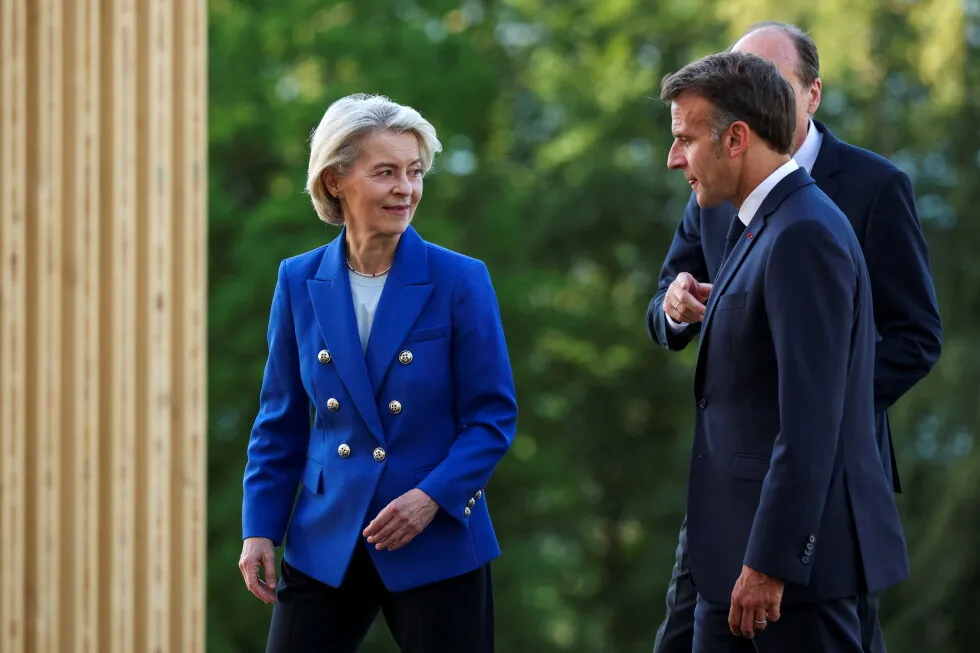
China-shock" class="entity-link entity-event" data-entity-id="121504" data-entity-type="event">China Shock 2.0: Surging Chinese exports threaten Europe’s economy, raising concern at G7 summit 1 of 5 | French President Emmanuel Macron walks with European Commission President Ursula von der Leyen during the G7 summit in Evian-les-Bains, France, Monday, June 15, 2026. (Isabel Infantes/Pool Photo via AP) 2 of 5 | French President Emmanuel Macron, right, speaks with European Commission President Ursula von der Leyen during the G7 summit in Evian-les-Bains, France, Monday, June 15, 2026. (Isabel Infantes/Pool Photo via AP) 3 of 5 | French President Emmanuel Macron, left, greets European Commission President Ursula von der Leyen during the G7 summit in Evian-les-Bains, France, Monday, June 15, 2026. (Isabel Infantes/Pool Photo via AP) 4 of 5 | French President Emmanuel Macron, right, and his wife Brigitte Macron, left, pose with European Commission President Ursula von der Leyen and her husband Heiko von der Leyen during the G7 summit in Evian-les-Bains, France, Monday, June 15, 2026. (Isabel Infantes/Pool Photo via AP) 5 of 5 | French President Emmanuel Macron, right, and his wife Brigitte Macron, second right, pose with Germany’s Chancellor Friedrich Merz and his wife Charlotte Merz during the G7 summit in Evian-les-Bains, France, Monday, June 15, 2026. (Isabel Infantes/Pool Photo via AP) By PAUL WISEMAN, ELAINE KURTENBACH and DAVID MCHUGH Updated 6:01 AM MESZ, June 16, 2026 Add AP News on Google Add AP News as your preferred source to see more of our stories on Google. Share Share Facebook Copy Link copied Print Email X LinkedIn Bluesky Flipboard Pinterest Reddit WASHINGTON (AP) — For eight years, the United States has waged economic war on China, slapping big taxes on Chinese products before they enter America. But the campaign hasn’t dented China’s industrial prowess. The world’s second biggest economy is exporting more products than ever. It’s just redirecting them away from the U.S. tariff wall and toward more open markets in Europe and elsewhere in Asia. The shift in Chinese trade risks creating a European sequel to the China-shock" class="entity-link entity-event" data-entity-id="121504" data-entity-type="event">China Shock that wiped out hundreds of thousands of factory jobs in the American heartland in the 2000s and contributed to the political upheaval that put Donald Trump in the White House twice. Despite U.S. sanctions, China last year notched a record global trade surplus — an astonishing $1.2 trillion. Earlier this year, French President Emmanuel Macron warned that Chinese exports are “literally killing a large part of the European industry’’ and admitted that Europe was “slow to see that.’’ The Europeans are clear-eyed now. China’s trade practices will be near the top of the agenda this week as leaders of the G7 rich democracies gather in Évian-les-Bains, France. In briefings last week, French officials indicated that they hope to come out of the summit with a plan to tackle the China threat. Iran war is a ‘wake-up call’ for Southeast Asia’s energy sector, report says 2 MIN READ Canadian Prime Minister Mark Carney says US AI restrictions underscore risks of dependence 2 MIN READ 32 Ahead of G7, Canada’s Carney softens tone toward Trump with trade talks at stake 3 MIN READ 72 One possibility is that the European Union and others will build a higher tariff wall of their own against Chinese imports. Currently, the EU imposes relatively low tariffs on China under World Trade Organization rules — though it hits specific Chinese products with higher ones (up to 35% on electric vehicles, for example). “China’s export surge, unless its leaders rein it in, will provoke a protectionist wave against Chinese imports worldwide,’’ said Maurice Obstfeld, senior fellow at the Peterson Institute for International Economics and former chief economist at the International Monetary Fund. “All the more so if the current disruptions around the Iran war persist and cause a sharper global slowdown.’’ Economist Taylor Wang at HSBC warned this month that a China-EU trade dispute could threaten Chinese exports; Europe accounted for a big share of China’s exports of electric vehicles, solar panels and lithium-ion batteries. The Europeans also hope to persuade Trump to stop targeting U.S. allies like the European Union and Canada with punitive tariffs and to start working with them instead to counter China. China-shock" class="entity-link entity-event" data-entity-id="121504" data-entity-type="event">China Shock 2.0 is different — and more disruptive The first China-shock" class="entity-link entity-event" data-entity-id="121504" data-entity-type="event">China Shock started around 2001 when the Chinese joined the World Trade Organization and gained low-tariff access to the lucrative markets of the United States and Europe. In the United States, many factories couldn’t compete with low-cost Chinese textiles, furniture, electronics and other manufactured goods. Economists David Autor of the Massachusetts Institute of Technology, David Dorn of the University of Zurich and Gordon Hanson, now at Harvard, found that competition from China had led to the loss of 2.4 million American jobs. China-shock" class="entity-link entity-event" data-entity-id="121504" data-entity-type="event">China Shock 2.0, as it’s come to be known, is playing out differently. The first time around China was still emerging as a major player in global commerce. Now it dominates world trade and manufacturing. China accounted for just 4% of global goods exports in 2000. Now its share is 16% — the highest in the world — making Beijing’s trade policies far more consequential. China has also upped its game, exporting sophisticated products like EVs and batteries, advanced machinery, software, scientific instruments and putting it in direct competition with the richest countries in the world. For example, Chinese exports now compete with nearly 58% of the exports from the 21 European countries that share the euro currency, up from 46% in 2000, according to a paper last month by researchers at the Federal Reserve and the Federal Reserve Bank of St. Louis. “The second China-shock" class="entity-link entity-event" data-entity-id="121504" data-entity-type="event">China Shock is characterized by its companies running the board on manufacturing exports -- from low-tech, low-wage to high-tech high value-added industries,” said economist Eswar Prasad of Cornell University. “This is directly hitting advanced economies where it now hurts the most″ — high tech industries such as EVs and high-end robotics that many countries “had been counting on for a manufacturing revival.’’ Germany has been hit hard. German companies once grew fat on exports to China but the situation has reversed: China now sells more goods to Germany than it buys. And German companies are struggling to compete with the Chinese rivals in industrial machinery, construction equipment, cars and chemicals – all mainstays of Germany’s export-oriented economy. Partly because of the competition from China, Germany’s economy has stagnated, shrinking in 2023 and 2024 and growing just 0.2% last year. The United States is less vulnerable than it was in the 2000s. Trump’s tariffs have kept out a lot of Chinese products. Exports of Chinese goods to the United States dropped 37% from January through April this year, versus the same period of 2025, the U.S. Commerce Department reports. The United States is also in a stronger economic position because it produces its own energy — unlike the EU and Japan — and is enjoying a boom in productivity and investment in artificial intelligence. Despite Trump’s tariffs and diminished sales to the United States, China is benefiting from soaring demand for its low-cost EVs and from AI investment, which generates sales of Chinese electrical components and machinery for data centers. Exports from China to the 27-nation EU climbed 16.4% in January to May from a year earlier. For France, that meant that its trade deficit with China, according to Beijing’s customs statistics, rose to $5.3 billion from $3.3 billion a year earlier. Economists say China’s policies encourage factories to overproduce and consumers to underspend. For example, state-run Chinese banks pay low interest rates to savers but offer cheap loans to government-owned manufacturers. A flimsy social safety net pressures Chinese families to save, not spend, to build a financial buffer against old age and medical problems. Obstfeld said the policies are partly meant to keep factories busy and workers employed. “The result is an excess domestic supply of manufactured products, which must be exported abroad,’’ he said. So low-priced Chinese products flood world markets and threaten to put European and other factories out of business. Beijing also has encouraged companies to compete ruthlessly against each other at home. “The rest of the world is ill prepared to compete with these apex predators,’’ Autor and Hanson wrote in a New York Times column last year. China has repeatedly promised to rein in overproduction and encourage consumer spending – as the United States and other countries have urged for decades. That would make its economy less reliant on exports and its consumers better off. It would also give U.S. and European an expanding market to sell into. “The leadership has long said this is a goal,’’ Obstfeld said, “but they have been slow to act as if they mean it.’’ “Beijing has been relying on the rest of the world to address its overcapacity problem,” said former U.S. trade negotiator Wendy Cutler, now senior vice president at the Asia Society Policy Institute. “However, this unsustainable situation may soon change if the EU and others take steps to halt Chinese imports, following the U.S. lead.’’ AP Business Writer Chan Ho-him in Hong Kong, AP Chief Correspondent John Leicester and Sylvie Corbet in Paris contributed. Kurtenbach reported from Bangkok and McHugh from Frankfurt, Germany ELAINE KURTENBACH Based in Bangkok, Kurtenbach is the AP’s business editor for Asia, helping to improve and expand our coverage of regional economies, climate change and the transition toward carbon-free energy. She has been covering economic, social, environmental and political trends in China, Japan and Southeast Asia throughout her career. twitter mailto
SRCAssociated Press (AP)
LANGEN
LEANCenter
WORDS1 578
ENT12
TUE · 2026-06-16 · 06:23 GMTBRIEF NSR-2026-0616-84815
NSR-2026-0616-84815News Report·EN·Economic Impact
China Shock 2.0: Surging Chinese exports threaten Europe’s economy, raising concern at G7 summit
Surging Chinese exports, despite U.S. tariffs, are now targeting European markets, raising concerns of a "China Shock 2.0" that could harm European industries.
Associated Press (AP)Filed 2026-06-16 · 06:23 GMTLean · CenterRead · 7 min
Associated Press (AP)FIG 01
Reading time
7min
Word count
1 578words
Sources cited
3cited
Entities identified
12entities
Quality score
100%
§ 01
Briefing Summary
AI-generatedNEWSAR · AI
Surging Chinese exports, despite U.S. tariffs, are now targeting European markets, raising concerns of a "China Shock 2.0" that could harm European industries. This issue is a primary focus at the G7 summit in France, where leaders are discussing plans to address the threat. Unlike the first "China Shock" which impacted manufacturing jobs in the U.S., the current situation involves China exporting sophisticated products like electric vehicles and advanced machinery, directly competing with developed economies. European nations, particularly Germany, are already experiencing economic strain due to this influx. The G7 leaders are considering measures such as imposing higher tariffs on Chinese imports to counter this trend.
Confidence 0.90Sources 3Claims 5Entities 12
§ 02
Article analysis
Model · rule-basedFraming
Economic Impact
Political Strategy
Tone
Mixed Tone
AI-assessed
CalmNeutralAlarmist
Factuality
0.70 / 1.00
Factual
LowHigh
Sources cited
3
Well sourced
FewMany
§ 03
Key claims
5 extracted01
French President Emmanuel Macron warned that Chinese exports are 'literally killing a large part of the European industry'.
quoteEmmanuel Macron
Confidence
1.00
02
China last year notched a record global trade surplus of $1.2 trillion.
statistic
Confidence
0.90
03
China is redirecting exports away from the U.S. tariff wall toward more open markets in Europe and Asia.
factual
Confidence
0.85
04
Surging Chinese exports threaten Europe's economy, raising concern at the G7 summit.
factual
Confidence
0.80
05
China's industrial prowess has not been dented by the U.S. economic war.
factual
Confidence
0.70
§ 04
Full report
7 min read · 1 578 words§ 05
Entities
12 identifiedKey playerOppositionContextPositiveNeutralNegative
People6
§ 06
Keywords & salience
8 termseurope's economy
1.00
chinese exports
1.00
china shock
0.90
g7 summit
0.80
trade surplus
0.70
economic war
0.60
industrial prowess
0.50
tariff wall
0.40
§ 07
Topic connections
Interactive graph Network visualization showing 51 related topics
View Full Graph Person Organization Location Event|Click node to navigate|Edge numbers = shared articles