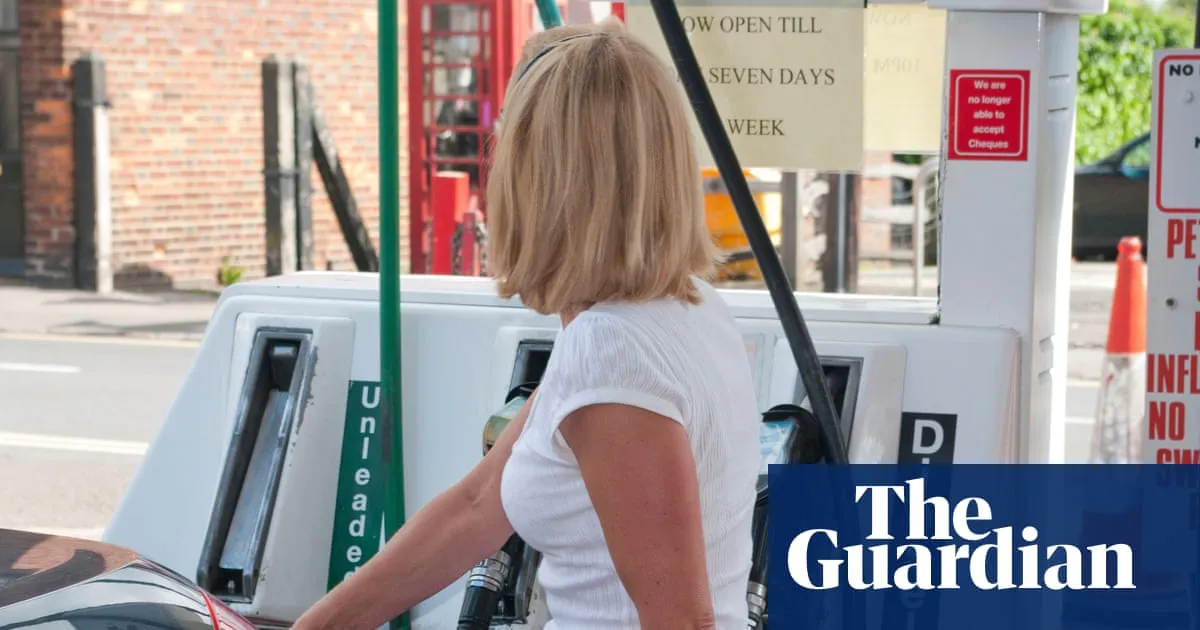
UK inflation unexpectedly remained at 2.8% last month as higher transport and fuel costs were offset by slower food price rises.May’s annual price rise reading recorded by the Office for National Statistics (ONS) came despite economists’ forecasts of a rise to 3% as the Middle East restricted global energy flows.The flatlining figure came after a decline in the consumer prices index to 2.8% in April, as cuts to domestic gas and electricity bills announced by the chancellor, Rachel Reeves, at last year’s budget took effect.Grant Fitner, chief economist at the ONS, said: “inflation held steady in May as various price movements offset each other. The main upward movement came from transport, with air fares, vehicle taxes and petrol prices all pushing up inflation.“These were offset by lower food prices, with decreases in inflation seen across a range of meat, dairy and vegetable items compared to last month, as well as the cost of domestic heating oil, which fell back after climbing in recent months.”Reeves said: “While the war in the Middle East pushes prices up globally, we have got the right economic plan and inflation has held steady.“We’re protecting families and businesses from rising costs, with cuts in energy bills and freezes in fuel duty and rail fares. This is the right economic plan to build a stronger more secure Britain.”In a boost for UK borrowing costs, the yield (or interest rate) on the 10-year UK government bond dropped almost four basis points on Wednesday morning after the inflation reading to 4.75% – the lowest in a month.The reading is still above the government’s 2% target for England" class="entity-link entity-organization" data-entity-id="2477" data-entity-type="organization">Bank of England policymakers, who are preparing to set interest rates on Thursday. Markets are betting it is a near certainty they will leave borrowing costs on hold at 3.75% for now, as they assess the impact of the conflict.The closure of the Strait of Hormuz to shipping has driven up oil prices over the past three months, with knock-on effects for the cost of fuel products, chemicals and fertiliser.Economists hope the agreement reached between Donald Trump and the Iranian regime at the start of the week will reopen the maritime choke point in the coming weeks, helping to ease price pressures.Suren Thiru, chief economist at the England-and-wales" class="entity-link entity-organization" data-entity-id="129838" data-entity-type="organization">Institute of Chartered Accountants in England and Wales, said a US-Iran peace deal could help to stop inflation rising further, although supply chains and energy prices would take several months to normalise.“Although the US-Iran peace deal has arrived too late to stop higher energy bills and food costs triggering a summer inflation spike, if oil prices continue sinking then a peak well below 4% is becoming increasingly plausible,” he said.Core inflation, which strips out more volatile measures such as energy and food, was 2.6% last month, up slightly from 2.5% in April. Transport costs made the largest contribution to the inflation rate, rising at a rate of 6.8% in May, up from 4.5% in April, the highest since December 2022.Air fares rose by 10.3% between April and May, compared with a 5% fall between the same two months in 2025. This may have been influenced by the timing of Easter, which fell in early April this year, and school holidays. European flights in particular rose in price.Higher prices at the petrol pumps as well as the cost of ferry tickets also contributed to the increase in transport costs.Increased transport costs were offset by easing food inflation to 2.2%, the lowest since December 2024. Despite this, analysts are warning that food inflation could still move higher in the coming months, as the increased costs faced by farmers, processors and manufacturers often take several months to filter through to higher prices on supermarket shelves.
SRCThe Guardian - World News
LANGEN
LEANCenter-Left
WORDS616
ENT12
WED · 2026-06-17 · 06:00 GMTBRIEF NSR-2026-0617-85101
NSR-2026-0617-85101News Report·EN·Economic Impact
UK inflation stays at 2.8% as slowing food prices offset rising transport costs
UK inflation remained unexpectedly steady at 2.8% in May, defying economists' forecasts of a rise to 3%. This stability was due to slower food price increases offsetting higher transport and fuel costs.
Heather Stewart and Joanna PartridgeThe Guardian - World NewsFiled 2026-06-17 · 06:00 GMTLean · Center-LeftRead · 3 min
The Guardian - World NewsFIG 01
Reading time
3min
Word count
616words
Sources cited
3cited
Entities identified
12entities
Quality score
100%
§ 01
Briefing Summary
AI-generatedNEWSAR · AI
UK inflation remained unexpectedly steady at 2.8% in May, defying economists' forecasts of a rise to 3%. This stability was due to slower food price increases offsetting higher transport and fuel costs. The Office for National Statistics (ONS) reported that while air fares, vehicle taxes, and petrol prices pushed inflation up, decreases in meat, dairy, vegetable, and heating oil prices helped to balance the figures. This reading comes as the Bank of England prepares to announce its interest rate decision, with markets anticipating rates will be held at 3.75%. The ONS noted that core inflation, excluding volatile energy and food prices, rose slightly to 2.6%. Analysts warn that food inflation could still increase in the coming months as higher farming costs filter through to consumers.
Confidence 0.90Sources 3Claims 5Entities 12
§ 02
Article analysis
Model · rule-basedFraming
Economic Impact
Conflict
Tone
Measured
AI-assessed
CalmNeutralAlarmist
Factuality
0.80 / 1.00
Factual
LowHigh
Sources cited
3
Well sourced
FewMany
§ 03
Key claims
5 extracted01
Core inflation, excluding energy and food, was 2.6% in May, up from 2.5% in April.
statisticnull
Confidence
1.00
02
The yield on the 10-year UK government bond dropped to 4.75% after the inflation reading.
statisticnull
Confidence
1.00
03
Higher transport and fuel costs were offset by slower food price rises.
quoteGrant Fitner (ONS Chief Economist)
Confidence
1.00
04
UK inflation remained at 2.8% in May, defying economists' forecasts of a rise to 3%.
statisticOffice for National Statistics (ONS)
Confidence
1.00
05
A US-Iran peace deal could help stop inflation rising further, but normalization will take months.
quoteSuren Thiru (Institute of Chartered Accountants in England and Wales)
Confidence
0.90
§ 04
Full report
3 min read · 616 words§ 05
Entities
12 identifiedKey playerOppositionContextPositiveNeutralNegative
People4
Organizations4
Locations3
§ 06
Keywords & salience
10 termsuk inflation
1.00
transport costs
0.90
food prices
0.80
energy prices
0.70
economic plan
0.60
interest rates
0.50
borrowing costs
0.50
supply chains
0.40
government bond
0.40
middle east
0.40
§ 07
Topic connections
Interactive graph Network visualization showing 51 related topics
View Full Graph Person Organization Location Event|Click node to navigate|Edge numbers = shared articles