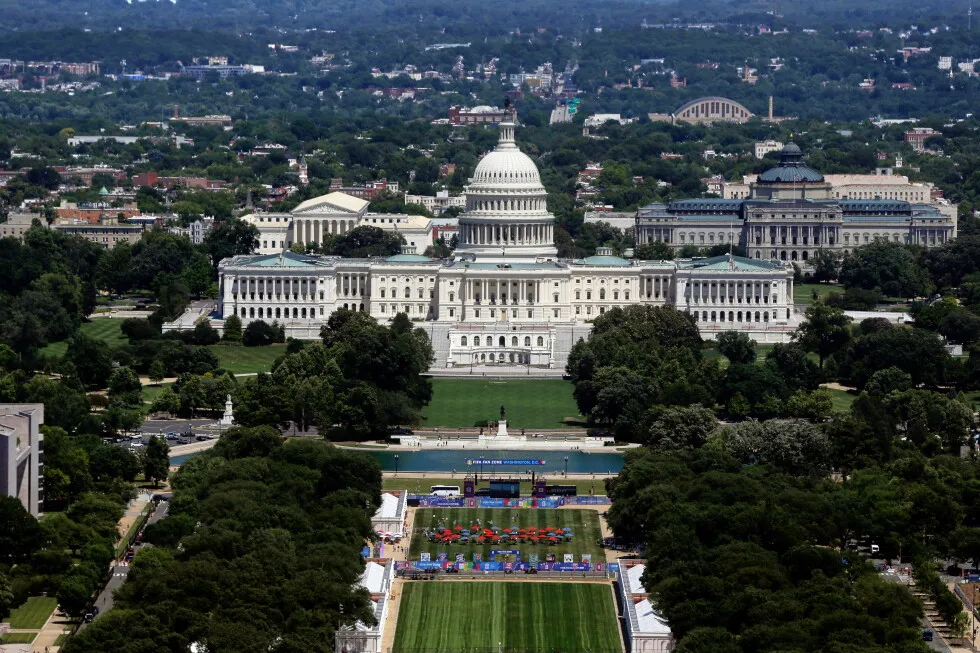
Most Americans see freedoms under threat but core to nation’s identity, AP-NORC poll finds 1 of 3 | The U.S. Capitol and National Mall are seen as the set up for the America 250 celebration, in Washington, Saturday, June 13, 2026. (AP Photo/Rahmat Gul) 2 of 3 | People cast their vote during D.C. primary election at Shepard Park Elementary, Tuesday, June 16, 2026, in Washington. (AP Photo/Jose Luis Magana) 3 of 3 | The Supreme Court is seen in Washington, Monday, May 18, 2026. (AP Photo/J. Scott Applewhite) 1 of 3 | The U.S. Capitol and National Mall are seen as the set up for the America 250 celebration, in Washington, Saturday, June 13, 2026. (AP Photo/Rahmat Gul) 1 of 3 The U.S. Capitol and National Mall are seen as the set up for the America 250 celebration, in Washington, Saturday, June 13, 2026. (AP Photo/Rahmat Gul) Add AP News on Google Add AP News as your preferred source to see more of our stories on Google. Share 2 of 3 | People cast their vote during D.C. primary election at Shepard Park Elementary, Tuesday, June 16, 2026, in Washington. (AP Photo/Jose Luis Magana) 2 of 3 People cast their vote during D.C. primary election at Shepard Park Elementary, Tuesday, June 16, 2026, in Washington. (AP Photo/Jose Luis Magana) Add AP News on Google Add AP News as your preferred source to see more of our stories on Google. Share 3 of 3 | The Supreme Court is seen in Washington, Monday, May 18, 2026. (AP Photo/J. Scott Applewhite) 3 of 3 The Supreme Court is seen in Washington, Monday, May 18, 2026. (AP Photo/J. Scott Applewhite) Add AP News on Google Add AP News as your preferred source to see more of our stories on Google. Share Updated [hour]:[minute] [AMPM] [timezone], [monthFull] [day], [year] Washington (AP) — Most Americans believe civil liberties like the right to vote are under threat, according to a new AP-NORC poll, while also continuing to agree that the rights expressed in the nation’s founding documents are still core to American identity.The survey from The Associated Press-NORC Center for Public Affairs Research finds that most Americans across demographics believe the right to vote, the right to free speech and freedom of religion are integral to the country. But they were more divided on the importance of the right to bear arms, and few — about one-third or less — saw those rights as safe from threats.The survey, which was conducted April 16-20 — before the Supreme Court’s recent ruling that winnowed a section of the Voting Rights Act — highlights an enduring consensus among Americans that personal freedoms are vital to the country’s national identity. But it also reveals deep anxieties about the nation’s trajectory on the cusp of a summer filled with celebrations of the country’s semi-quincentennial birthday.“Our idea of rights has been very consistent in this country until the last few years,” said Louise Rochon, 85, of Connecticut. “Now, they’re all under threat. Every single last one of them.” Americans see rights as vital, but threatened About 9 in 10 Americans say the right to vote is “extremely” or “very” important to the United States’ identity, the poll found. About the same proportion of Americans consider freedom of speech to be highly important to the country’s identity. Meanwhile, about 8 in 10 Americans consider freedom of religion to be core to the national identity, while about 6 in 10 Americans consider the right to keep or bear arms as highly important to the nation’s identity. 6 MIN READ 3 MIN READ 5 MIN READ But many in the country see those same principles as imperiled today. About two-thirds of Americans view the right to vote as under some threat, with about one-third saying voting rights are under “major threat” while about 3 in 10 said they faced a “minor threat.” Only about one-third of Americans said voting rights faced “no threat at all.” Additionally, nearly half of Americans say freedom of speech is under major threat, followed by about 3 in 10 who said the same about gun rights and religious freedom. The country is going “down the drain,” said Tracy Gonzales, an independent from San Antonio, Texas. Americans of all stripes, she said, have “thrown religion to the side at the moment” and allowed for other civil liberties to be eroded amid fierce debates over immigration and the economy.“Given everything going on with our president, you really don’t have time to think of anything else,” said Gonzales, 37, of President Donald Trump’s immigration crackdowns. “There are so many other crimes that are being committed and people that actually need help, and you’re focused on the ones that are trying to get it together.” Vast majority of Black Americans see threat to voting rightsThe poll’s results also surfaced complicated opinions about democracy and identity among Black Americans. Those are likely rooted, at least in part, in the country’s history of denying voting rights and full citizenship to people of African descent for centuries. Black Americans are less likely than white Americans to say the right to vote is “extremely” or “very important” to American identity, with about three-quarters agreeing with the sentiment compared to about 9 in 10 white Americans. But about 4 in 10 Black Americans say that the right to vote is facing a “major” threat in the country today, higher than any other racial group.“You cannot feel like you are a total and full part of the American experiment unless you have the right to vote,” said Antonio Williams, a school administrator in Dallas, Texas, who is Black. “And African Americans didn’t fully get to enjoy the right to vote until about 60 years ago, and I feel like it’s under threat right now.”Younger adults see the right to vote as less importantIndependents and younger adults are less likely than Americans overall to say voting and freedom of speech are central to American identity. “My age group has grown up a lot more with social media as part of their existence in life and the microcosms that that creates in politics,” said Julian Goodwin-Ferris, 28, a professional dancer from New Jersey.“I think we feel more like our voice doesn’t matter as much because it feels like we’ve grown up with our rights sort of being more ignored,” said Goodwin-Ferris. Democrats and Republicans are divided on magnitude of threatAmericans at times diverged along partisan lines in their view of the threats to rights, with Democrats seeing a greater threat to freedom of speech, while Republicans were more worried about the right to keep and bear arms. While Democrats and Republicans are similarly likely to say freedom of speech is at least “very important” to the nation’s identity, about 6 in 10 Democrats say freedom of speech is facing a “major threat” compared to about 4 in 10 independents and roughly one-third of Republicans. Similarly, while most Americans believe the right to bear arms is at least “very” important to the nation’s identity, about 8 in 10 Republicans agree with that sentiment, compared to only about 4 in 10 Democrats. About half of independents shared that view. And about 4 in 10 Republicans found that the right to bear firearms was under threat, an increase from October 2025 not reflected among either Democrats or independents. “We have the Bill of Rights for a reason,” said Nuri Simmons, a warehouse worker in New York and a registered Democrat. Simmons, 31, said that threats to different rights “bleed into each other” and that while he was most concerned about threats to voting rights today, he understood that others may feel differently.“Like when people try to bring some gun control into it, I think some people look at that as an attack on their rights. I guess that all depends on your politics,” he said.___The AP-NORC poll of 2,596 adults was conducted April 16-20 using a sample drawn from NORC’s probability-based AmeriSpeak Panel, which is designed to be representative of the U.S. population. The margin of sampling error for adults overall is plus or minus 2.6 percentage points. Brown covers national politics, federal policy and democracy issues for The Associated Press. Sanders is a polls and surveys analyst for The Associated Press. She develops and writes about AP-NORC polls, works on the AP Voter Poll and covers shifts in public opinion.
SRCAssociated Press (AP)
LANGEN
LEANCenter
WORDS1 397
ENT12
WED · 2026-06-17 · 09:53 GMTBRIEF NSR-2026-0617-85153
NSR-2026-0617-85153News Report·EN·Human Rights
Most Americans see freedoms under threat but core to nation’s identity, AP-NORC poll finds
A recent AP-NORC poll conducted April 16-20 reveals that most Americans believe fundamental civil liberties, such as the right to vote, free speech, and religious freedom, are crucial to the nation's identity. However, a significant majority also perceive these rights as being under threat.
By
MATT BROWN and LINLEY SANDERSAssociated Press (AP)Filed 2026-06-17 · 09:53 GMTLean · CenterRead · 6 min
Associated Press (AP)FIG 01
Reading time
6min
Word count
1 397words
Sources cited
1cited
Entities identified
12entities
Quality score
100%
§ 01
Briefing Summary
AI-generatedNEWSAR · AI
A recent AP-NORC poll conducted April 16-20 reveals that most Americans believe fundamental civil liberties, such as the right to vote, free speech, and religious freedom, are crucial to the nation's identity. However, a significant majority also perceive these rights as being under threat. While about nine in ten Americans consider voting and free speech rights extremely or very important, roughly two-thirds believe voting rights are under some threat, with one-third seeing a "major threat." Similarly, nearly half of Americans feel freedom of speech is under major threat. The poll highlights a consensus on the importance of these freedoms but also deep anxieties about their current state.
Confidence 0.90Sources 1Claims 5Entities 12
§ 02
Article analysis
Model · rule-basedFraming
Human Rights
Social Justice
Tone
Measured
AI-assessed
CalmNeutralAlarmist
Factuality
0.80 / 1.00
Factual
LowHigh
Sources cited
1
Limited
FewMany
§ 03
Key claims
5 extracted01
Americans' idea of rights has been consistent until the last few years, and now they are all under threat.
quoteLouise Rochon
Confidence
0.90
02
Most Americans believe the right to vote, free speech, and freedom of religion are integral to the country.
statisticAP-NORC poll
Confidence
0.90
03
Most Americans agree that rights expressed in the nation's founding documents are core to American identity.
statisticAP-NORC poll
Confidence
0.90
04
Most Americans believe civil liberties like the right to vote are under threat.
statisticAP-NORC poll
Confidence
0.90
05
Few Americans (about one-third or less) see rights like the right to bear arms as safe from threats.
statisticAP-NORC poll
Confidence
0.80
§ 04
Full report
6 min read · 1 397 words§ 05
Entities
12 identifiedKey playerOppositionContextPositiveNeutralNegative
Organizations3
Locations4
§ 06
Keywords & salience
10 termsfreedoms under threat
1.00
civil liberties
1.00
american identity
0.90
ap-norc poll
0.80
right to vote
0.80
founding documents
0.70
freedom of religion
0.60
free speech
0.60
voting rights act
0.50
supreme court
0.40
§ 07
Topic connections
Interactive graph Network visualization showing 51 related topics
View Full Graph Person Organization Location Event|Click node to navigate|Edge numbers = shared articles