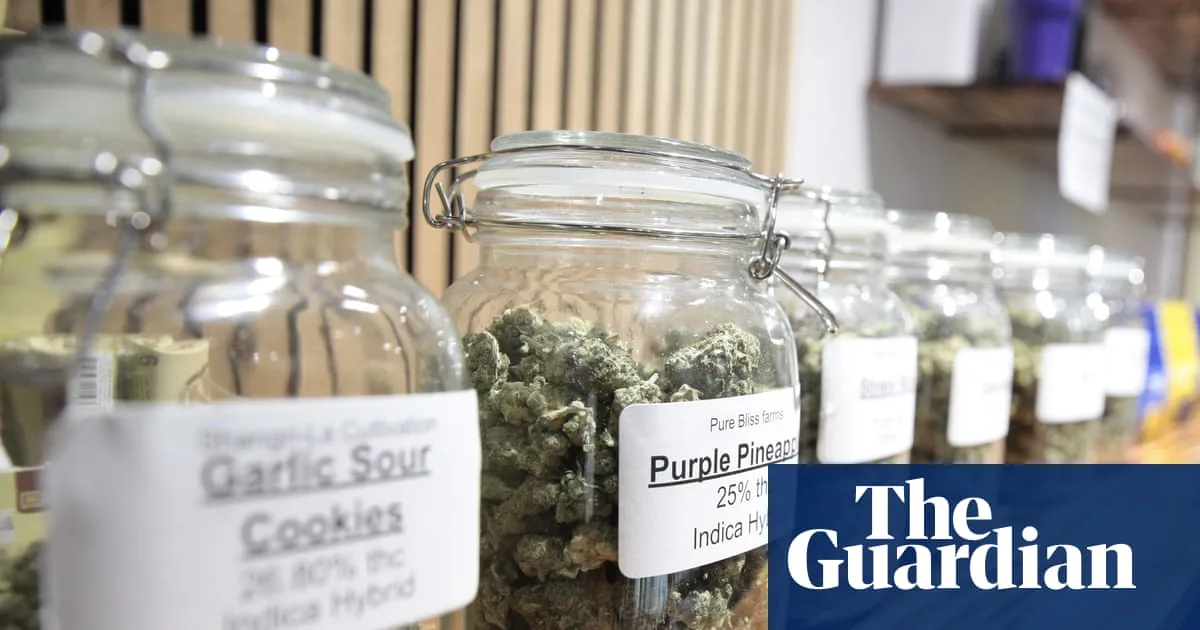
Decriminalising the possession of cannabis or strictly regulating access to the drug do not appear to drive up usage, but when the drug is sold commercially the number of users increases and more mental health problems are seen, a review has found.An international team analysed the dramatic shift in policies on cannabis between 2000 and 2025, including how the numbers of people taking the drug, its potency, and rates of psychosis changed after new rules came in.In places that opened up commercial markets for cannabis, such as the US and Canada, researchers saw more users and increases in drug potency. More people also visited hospital with psychosis and other mental health issues linked to the drug, they found.Where cannabis was decriminalised in Europe, Africa, Oceania and Asia, there was little evidence of any change in usage or psychiatric illness. The experience was similar in Uruguay, where cannabis has been legalised but is tightly controlled by the state.“When we look globally, there’s been a rapid shift towards more liberal cannabis policies,” said Tom Freeman, professor of psychology at the University of Bath and first author on the review. “That gives us a chance to evaluate what happened from before to after, in terms of cannabis use, cannabis addiction and psychiatric disorders related to cannabis.”Freeman said the findings, published in Lancet Psychiatry, were “encouraging” for policymakers who were considering decriminalising cannabis or strictly regulating the drug in legal markets. The impact of an open market, where the drug is sold in a similar way to alcohol and tobacco, was very different, however.“It’s still very early days for any of these policy changes when we consider the long history of alcohol and tobacco use, but this is the way it’s unfolding,” he said.“When there’s a for-profit industry, particularly for an addictive product, there’s an incentive to sell cheaper products, and high potency products, because they know that the more they sell, the more money they’ll make, and that can increase use,” Freeman added. “We have a long history of the tobacco and alcohol industries being difficult to regulate and increased sales resulting in greater harms for those who use those products.”In the UK, cannabis is a class B drug with possession carrying a maximum penalty of up to five years in prison, an unlimited fine, or both. Last year, a report by the London Drugs Commission, commissioned by the mayor of London, Sadiq Khan, argued that the sanctions were unjustified and proposed decriminalising possession for recreational use. The report found that black people were five times more likely to be subjected to being stopped and searched on suspicion of drug-related offences than white people.Uruguay became the first country to fully legalise cannabis in 2013, but the market is strictly controlled by the state. Adults who register can buy the drug from a pharmacy, through a cannabis social club, or grow it at home. It allows the state to control the size of the market and also the safety of the products.Sir Robin Murray, professor of psychiatric research at King’s College London, said it was early days in understanding the full effects of global cannabis policies, but added that there was now a consensus that commercialisation of supply rather than simple legislation for recreational use was “the critical factor”.“Unfortunately, in North America, legalisation has been followed by rampant commercialisation facilitated by advertising from companies which would like to sell as much cannabis as tobacco at its peak,” he said. “Is it possible to legalise without commercialising in western capitalist countries? It should be possible, but so far no country has managed this because of the growing power of the multibillion cannabis industry.”Alex Stevens, professor of criminology at the University of Sheffield, said the review was “absolutely essential” for policymakers who were exploring ways to deal with drug use. “We’re getting a fairly consistent message from the research that restricted models of regulation and decriminalisation for possession don’t necessarily lead to increases in use,” he said. “That is what the opponents of these reforms always say: that if you let people use it, then usage will go sky high, but that’s not what we see in any of the countries that have done it.”
SRCThe Guardian - World News
LANGEN
LEANCenter-Left
WORDS699
ENT12
WED · 2026-06-17 · 22:30 GMTBRIEF NSR-2026-0618-85333
NSR-2026-0618-85333News Report·EN·Public Health
Cannabis commercialisation not decriminalisation drives up usage, study finds
A recent international review of cannabis policies between 2000 and 2025 found that commercializing cannabis sales, rather than decriminalizing possession or strictly regulating access, leads to increased usage and higher rates of psychosis. Researchers observed more users and higher potency cannabis in countries with commercial markets, like the US and Canada, alongside an increase in mental health issues linked to the drug.
Ian Sample Science editorThe Guardian - World NewsFiled 2026-06-17 · 22:30 GMTLean · Center-LeftRead · 3 min
The Guardian - World NewsFIG 01
Reading time
3min
Word count
699words
Sources cited
3cited
Entities identified
12entities
Quality score
100%
§ 01
Briefing Summary
AI-generatedNEWSAR · AI
A recent international review of cannabis policies between 2000 and 2025 found that commercializing cannabis sales, rather than decriminalizing possession or strictly regulating access, leads to increased usage and higher rates of psychosis. Researchers observed more users and higher potency cannabis in countries with commercial markets, like the US and Canada, alongside an increase in mental health issues linked to the drug. Conversely, decriminalization in Europe, Africa, Asia, and Oceania, and tightly state-controlled legal markets like Uruguay's, showed little evidence of increased usage or psychiatric illness. The study suggests that for-profit industries have an incentive to sell cheaper, high-potency products, potentially leading to greater harms, similar to historical patterns with alcohol and tobacco.
Confidence 0.90Sources 3Claims 5Entities 12
§ 02
Article analysis
Model · rule-basedFraming
Public Health
Legal & Judicial
Tone
Measured
AI-assessed
CalmNeutralAlarmist
Factuality
0.70 / 1.00
Factual
LowHigh
Sources cited
3
Well sourced
FewMany
§ 03
Key claims
5 extracted01
A for-profit cannabis industry has an incentive to sell cheaper and high-potency products, which can increase use and harms.
quoteTom Freeman
Confidence
0.90
02
Commercialisation of cannabis, not decriminalisation or strict regulation, drives up usage and mental health problems.
factualInternational team of researchers
Confidence
0.90
03
In places with commercial cannabis markets (US, Canada), more users, higher potency, and increased psychosis were observed.
factualInternational team of researchers
Confidence
0.85
04
Black people are five times more likely to be stopped and searched for drug offences than white people in the UK.
statisticLondon Drugs Commission report
Confidence
0.80
05
Decriminalisation of cannabis in Europe, Africa, Oceania, and Asia showed little evidence of increased usage or psychiatric illness.
factualInternational team of researchers
Confidence
0.80
§ 04
Full report
3 min read · 699 words§ 05
Entities
12 identifiedKey playerOppositionContextPositiveNeutralNegative
Organizations3
§ 06
Keywords & salience
9 termscannabis policy
1.00
commercialisation
0.90
decriminalisation
0.80
cannabis usage
0.80
mental health
0.70
drug potency
0.60
psychosis
0.60
for-profit industry
0.50
regulation
0.40
§ 07
Topic connections
Interactive graph No topic relationship data available yet. This graph will appear once topic relationships have been computed.