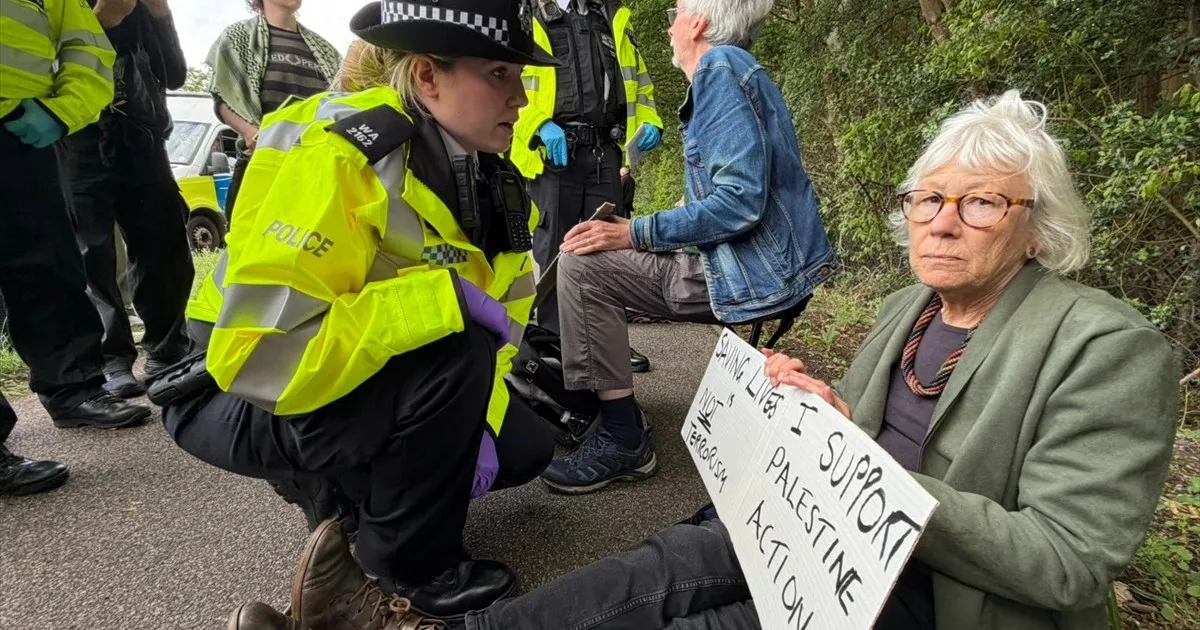
The Filton 4 case reveals a democracy more frightened of protesters than of the destruction they protest against.Palestinian political analyst and playwright.Published On 18 Jun 2026Police officers stand outside Woolwich Crown Court as protesters gather on June 12, 2026, in support of four activists appearing for sentencing over a 2024 protest at an Elbit Systems facility in Bristol, London, United Kingdom [Aysu Bicer/Anadolu]At a moment when Israel and its leaders stand accused before international courts of genocide, war crimes and crimes against humanity, Britain has chosen to direct some of its most powerful legal tools not at those enabling the destruction of Gaza, but at activists protesting against it.The sentencing of the Filton 4, therefore, raises questions that extend far beyond the fate of four individuals. Whatever one’s view of their actions, the case forces Britain to confront an uncomfortable contradiction: why does opposition to Israel’s actions increasingly attract the language of extremism and terrorism, while support for those actions remains firmly within the bounds of respectable politics?For more than two and a half years, the world has witnessed the destruction of Gaza on a scale unprecedented in Palestinian history. What began in October 2023 has evolved into what growing numbers of legal scholars, United Nations experts, human rights organisations and genocide scholars have described as a genocide. Entire neighbourhoods have disappeared. Hospitals, schools and universities have been destroyed. Aid has been obstructed. Starvation has been weaponised. Much of Gaza has been rendered uninhabitable.Yet in Britain, an increasing share of the political conversation appears to focus not on the genocide itself, but on those opposing it.The Filton 4 case centres on damage to property. Gaza has witnessed the destruction of an entire society. Yet it is the former that is increasingly discussed through the language of terrorism.That contrast lies at the heart of this case.terrorism legislation occupies a unique place within any democratic legal system. It exists to address conduct regarded as posing an exceptional threat to public safety and national security. The deployment of such legislation carries significance beyond the punishment of any individual. It sends a signal about what the state considers dangerous and what it regards as legitimate political concern.The question is not whether activists should be above the law. Nobody is arguing that they should.The question is why opposition to Israel’s actions in Gaza is increasingly being viewed through a security lens while support for those actions remains politically protected.The case did not emerge in isolation. It forms part of a broader pattern that has characterised Britain’s debate on Palestine since the start of Israel’s war on Gaza. Over time, criticism of Israel has become increasingly controversial. Palestine solidarity has become suspect. Allegations of anti-Semitism have increasingly been attached to opposition to Israeli policy. Activists have found themselves subjected to extraordinary scrutiny. The language of extremism has become commonplace. Now, terrorism legislation has entered the conversation.Each step has moved public debate further away from Gaza itself and closer towards those speaking about Gaza.Of course, anti-Semitism exists and should be confronted wherever it appears. Any hostility directed at Jewish people because they are Jewish is morally wrong and has no place in a democratic society. Jewish communities deserve the same protection and security afforded to every other minority.But criticism of a government is not the same thing as hatred of a people. Democracies depend upon maintaining that distinction.Nobody assumes that criticism of Vladimir Putin is hatred of Russians. Condemnation of the Chinese government’s treatment of Uighurs is not generally interpreted as hostility towards Chinese people. Opposition to the Iranian regime is not understood as prejudice against Iranians.Yet criticism of Israel is frequently subjected to a standard that is rarely applied to any other state, with opposition to government policy often blurred into hostility towards an entire people. The result is a political atmosphere in which support for Palestinian rights is increasingly viewed through a lens of suspicion.That atmosphere matters because it shapes the boundaries of acceptable political expression. Once criticism becomes suspect, suspicion can evolve into allegations of extremism. Once activism is viewed through the prism of extremism, it becomes easier to justify treating it as a matter of security. The danger lies not simply in any individual prosecution but in the cumulative effect such developments have on democratic culture.The context of the Filton 4 case is also important.The activists were not protesting against an abstract foreign policy disagreement. They were targeting facilities linked to Elbit Systems, Israel’s largest weapons manufacturer, a company whose products and technologies have been used by the Israeli military during the destruction of Gaza. Whether one agrees with their methods or not, their actions were explicitly connected to opposition to Britain’s relationship with companies involved in supplying the machinery of a war that many legal experts, human rights organisations and genocide scholars have described as genocidal.That distinction matters because it goes to the heart of what motivated the protest. The issue was not random vandalism. It was a political act directed at a company associated with the military infrastructure of a state accused of committing some of the gravest violations of international law.It is entirely legitimate to debate whether such actions should result in criminal penalties. But it is equally legitimate to ask why the political and legal focus increasingly falls on those attempting to disrupt the supply chain of a genocide rather than on the supply chain itself.What makes the use of terrorism legislation particularly striking is the contrast it exposes.Britain continues to maintain military, diplomatic and economic relations with a state accused before international courts of committing genocide. Political support continues. Military cooperation continues. Arms exports continue.At the same time, some of the strongest legal tools available to the British state are increasingly directed at those protesting against that relationship.This inversion should trouble anyone who believes in democratic accountability.A society reveals its values not only through what it condemns but through what it chooses to tolerate. When activists opposing a genocide are discussed through the language of terrorism while those facilitating, defending or profiting from that genocide continue to enjoy political protection, many people will inevitably conclude that something has gone badly wrong.Britain appears more concerned with those who interfere with the machinery of destruction than with the destruction itself.The issue is not whether one agrees with every tactic employed by every activist. The issue is proportionality. The issue is political priorities.For Palestinians, the implications are difficult to ignore.For decades, Palestinians have been told to pursue change through peaceful and democratic means. They have appealed to international law, documented abuses, lobbied governments, organised campaigns, spoken to journalists and participated in public debate. They have been repeatedly instructed that democracy, law and diplomacy offer the path to justice.Yet, as the destruction of Gaza has intensified, many Palestinians have watched the political space available for opposing that destruction shrink rather than expand. The more severe the suffering becomes, the more intense the scrutiny directed at those attempting to stop it.
SRCAl Jazeera
LANGEN
LEANCenter
WORDS1 158
ENT12
THU · 2026-06-18 · 13:19 GMTBRIEF NSR-2026-0618-85487
NSR-2026-0618-85487Opinion·EN·Social Justice
In Britain, resisting a genocide is now treated as terrorism
The Filton 4 case in Britain highlights a trend where activists protesting against Israel's actions in Gaza are increasingly being subjected to terrorism legislation. Four activists are facing sentencing for a 2024 protest at an Elbit Systems facility in Bristol.
Ahmed NajarAl JazeeraFiled 2026-06-18 · 13:19 GMTLean · CenterRead · 5 min
Al JazeeraFIG 01
Reading time
5min
Word count
1 158words
Sources cited
5cited
Entities identified
12entities
Quality score
100%
§ 01
Briefing Summary
AI-generatedNEWSAR · AI
The Filton 4 case in Britain highlights a trend where activists protesting against Israel's actions in Gaza are increasingly being subjected to terrorism legislation. Four activists are facing sentencing for a 2024 protest at an Elbit Systems facility in Bristol. The article argues that this approach contrasts sharply with the international accusations of genocide against Israel, suggesting Britain is more focused on prosecuting protesters than addressing the destruction in Gaza. This pattern, the article contends, blurs criticism of Israeli government policy with hostility towards Jewish people, narrowing the scope of acceptable political discourse and potentially impacting democratic culture by treating legitimate protest as a security matter.
Confidence 0.90Sources 5Claims 5Entities 12
§ 02
Article analysis
Model · rule-basedFraming
Social Justice
Legal & Judicial
Tone
Sensational
AI-assessed
CalmNeutralAlarmist
Factuality
0.30 / 1.00
Opinion-Heavy
LowHigh
Sources cited
5
Well sourced
FewMany
§ 03
Key claims
5 extracted01
Terrorism legislation exists to address conduct posing an exceptional threat to public safety and national security.
factual
Confidence
1.00
02
Growing numbers of legal scholars, UN experts, human rights organizations, and genocide scholars describe the situation in Gaza as genocide.
factualvarious scholars and organizations
Confidence
0.90
03
The Filton 4 case involves activists protesting property damage, while Gaza has seen the destruction of an entire society.
factual
Confidence
0.90
04
Britain is treating resistance to genocide as terrorism, while support for actions in Gaza remains politically respectable.
factual
Confidence
0.80
05
Criticism of Israel has become increasingly controversial and Palestine solidarity has become suspect in Britain.
factual
Confidence
0.70
§ 04
Full report
5 min read · 1 158 words§ 05
Entities
12 identifiedKey playerOppositionContextPositiveNeutralNegative
Organizations3
§ 06
Keywords & salience
10 termsterrorism
1.00
genocide
1.00
filton 4 case
0.90
gaza
0.80
activists
0.70
protesters
0.70
democracy
0.60
legal tools
0.50
destruction of gaza
0.50
elbit systems
0.40
§ 07
Topic connections
Interactive graph No topic relationship data available yet. This graph will appear once topic relationships have been computed.