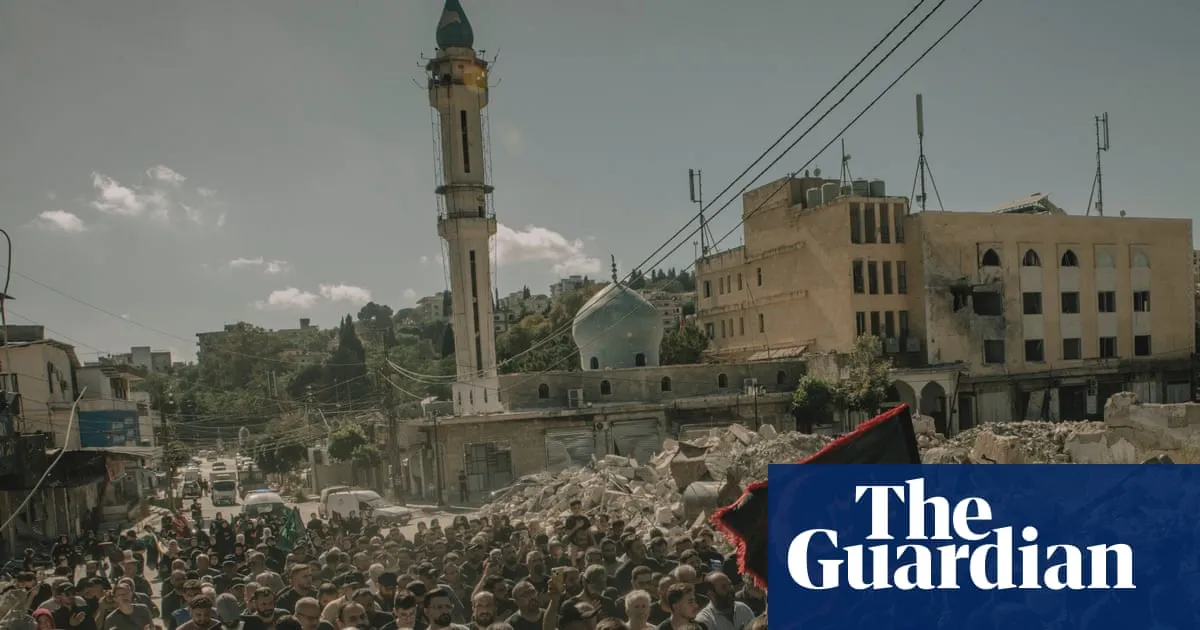
As the procession wound its way through mounds of rubble, the crowd chanted and beat their chests, their lamentations echoed by the dull thud of shelling in the foothills just beyond the city.“This is the tragedy of Karbala, O Imam Hussein, look. This is the tragedy of Karbala,” the crowd cried in the opening procession of Ashura, in the city of Nabatieh, southern Lebanon.The religious ceremony of Ashura mourns the slaying of the holy figure Imam Hussein in the battle of Karbala in 680; today, it is a symbol for Shia Muslims of resistance against oppression. In normal times, the annual commemoration is the pride of Nabatieh, drawing crowds of up to 30,000 people who march through the streets and fill them with a collective cry of grief.This year, the story of Karbala took on a renewed meaning for attenders because of the Hezbollah-Israel-war" class="entity-link entity-event" data-entity-id="149118" data-entity-type="event">Hezbollah-Israel war, which killed more than 3,900 people in Lebanon, most of whom were Shia Muslims. Nabatieh was one of the hardest-hit by bombings during the war, and much of it was levelled.On Wednesday, the cries of sorrow were muffled by the mounds of earth and snarled metal that had been cleared from the roads two days earlier. The 200 or so people could not fill the silence that hung over the city, its streets empty and its buildings shattered after 100 days of war.Israeli bombings and forced evacuation orders displaced almost all of the city’s population of 80,000. Photograph: Alessio Mamo/The GuardianNabatieh was mourning its recent dead on this Ashura, the tears shed by worshippers recounting the war that had displaced most of the city and killed many who did not have the chance to escape.Martyr posters dotted the streets: at the roundabout at the entrance to the neighbouring village of Harouf, a 3-metre poster displayed the faces of 50 young Hezbollah fighters killed in that village alone.“This year Ashura has a special meaning to us. We have lived the battle of Karbala every day during this war,” said Ismail Yaghi, a 50-year-old at the ceremony. As he spoke, he looked over at the posters of young men who had been killed, their faces hung on the walls of the mosque and printed on T-shirts and buttons worn by attenders.“There is sadness in our hearts and a pride at the same time for our martyrs. But we believe that just because someone died, it doesn’t mean that their life has ended. Their eternal life has just begun,” said Yaghi.People in Nabatieh take part in the Ashura commemorations. Photograph: Alessio Mamo/The GuardianThe city’s residents had not expected to commemorate Ashura in Nabatieh this year; almost all of the 80,000 residents had been displaced by Israeli bombings and forced evacuation orders. A ceasefire announced on Monday between the US and Iran had unexpectedly stopped the war in Lebanon, and had halted the advance of Israeli forces who were on the verge of taking the entire city.Civil defence crews quickly began to prepare for the religious ceremony. The volunteers in the Nabatieh ambulance service put down their medical kits and picked up brooms as they set about clearing rubble from the city’s central mosque, hanging black banners to mask the gaping holes in its walls caused by an airstrike.“Usually we take the entire month to prepare for Ashura. This time we just had two days,” said Mehdi Sadek, the 45-year-old head of the ambulance service, as he stirred a large pot of onions and spices.He stopped stirring to look outside as the sound of Israeli artillery shook the building. Smoke rose above the hills ringing Nabatieh.Despite a ceasefire, Israel and Hezbollah had continued firing on one another in the so-called “security zone” that Israel occupied, comprising hundreds of square miles of southern Lebanon. Israeli troops were just beyond the Ali Taher hill on the edge of the city.On Friday morning, fighting intensified. Hezbollah fired on Israeli troops, killing four soldiers, and in response, Israel carried out a wave of airstrikes around Nabatieh and in the city itself, killing 18 people and wounding 33.“There were more people here yesterday, but it was a hard night. There was lots of shelling,” Sadek said. The Lebanese army had blocked off entrances to the upper part of the city and to villages bordering Israeli positions after Israel fired on people returning on Tuesday. Families had fled the renewed violence, fearful that this ceasefire would collapse as the last two had.Destruction in Nabatieh from Israeli airstrikes. Photograph: Alessio Mamo/The Guardian“We expected things to be better than they are now. We wanted a real ceasefire. We decided to do Ashura in Nabatieh because we wanted to create a reason for people to come back,” Sadek said.Despite the religious ceremony, not many people had returned to the city and the surrounding villages. A few people drove through the streets to check on their houses and then left again. It was a far cry from the November 2024 ceasefire that ended the last Hezbollah-Israel-war" class="entity-link entity-event" data-entity-id="149118" data-entity-type="event">Hezbollah-Israel war, when residents came back in droves and immediately set about rebuilding their shops and homes.Hussein Nahleh, a 33-year-old engineer who had been displaced to Beirut by the war, said his home had been destroyed but that he wanted to come back to Nabatieh anyway to attend Ashura. He was being hosted by people in the city whose homes were still standing.An Ashura gathering in the Dahieh area of Beirut. Photograph: Alessio Mamo/The GuardianA few men next to Nahleh turned their faces to the sky and pointed. High in the distance, an Israeli drone circled above them, watching the men gather for the ceremony.As mourners marched, civil defence crews worked to pull bodies from the rubble. They had marked the sites of airstrikes in previously inaccessible areas during the war and were now using the ceasefire to sift through the rubble for remains. Not all areas were reachable; the Israeli army had shelled near ambulances on Tuesday as they approached areas south of the city to put out a fire.“Here in Nabatieh, it still is the same; it’s even harder. It’s unclear whether there’s a ceasefire or not,” said Hussein Fakih, the regional head of the Nabatieh civil defence.He interrupted the interview to take a phone call. He returned, teary-eyed. “You will have to excuse me. I just got word from our daughter that our house was destroyed by the Israelis.”
SRCThe Guardian - World News
LANGEN
LEANCenter-Left
WORDS1 058
ENT10
FRI · 2026-06-19 · 08:05 GMTBRIEF NSR-2026-0619-85720
NSR-2026-0619-85720News Report·EN·Human Interest
Inside the city of grief hit hardest by Israel strikes on southern Lebanon
In Nabatieh, southern Lebanon, a somber Ashura commemoration took place amidst widespread destruction from Israeli strikes. The religious ceremony, usually a large event, was attended by only about 200 people due to the displacement of most of the city's 80,000 residents.
William Christou in NabatiehThe Guardian - World NewsFiled 2026-06-19 · 08:05 GMTLean · Center-LeftRead · 5 min
The Guardian - World NewsFIG 01
Reading time
5min
Word count
1 058words
Sources cited
1cited
Entities identified
10entities
Quality score
100%
§ 01
Briefing Summary
AI-generatedNEWSAR · AI
In Nabatieh, southern Lebanon, a somber Ashura commemoration took place amidst widespread destruction from Israeli strikes. The religious ceremony, usually a large event, was attended by only about 200 people due to the displacement of most of the city's 80,000 residents. The war, which killed over 3,900 in Lebanon, had heavily damaged Nabatieh, leaving streets empty and buildings shattered. Despite a recent ceasefire, fighting continued in the area, with Israeli airstrikes killing 18 people in Nabatieh just days before the ceremony. Residents returned to hold Ashura, hoping to encourage others to come back, but many were still displaced by the conflict.
Confidence 0.90Sources 1Claims 5Entities 10
§ 02
Article analysis
Model · rule-basedFraming
Human Interest
Conflict
Tone
Mixed Tone
AI-assessed
CalmNeutralAlarmist
Factuality
0.60 / 1.00
Mixed
LowHigh
Sources cited
1
Limited
FewMany
§ 03
Key claims
5 extracted01
“This year Ashura has a special meaning to us. We have lived the battle of Karbala every day during this war,” said Ismail Yaghi.
quoteIsmail Yaghi
Confidence
1.00
02
Nabatieh was one of the hardest-hit by bombings during the Hezbollah-Israel war, and much of it was levelled.
factual
Confidence
0.90
03
Israeli bombings and forced evacuation orders displaced almost all of the city’s population of 80,000.
factual
Confidence
0.90
04
The Hezbollah-Israel war killed more than 3,900 people in Lebanon, most of whom were Shia Muslims.
statistic
Confidence
0.80
05
A ceasefire announced on Monday between the US and Iran had unexpectedly stopped the war in Lebanon.
factual
Confidence
0.80
§ 04
Full report
5 min read · 1 058 words§ 05
Entities
10 identifiedKey playerOppositionContextPositiveNeutralNegative
Organizations1
Locations5
§ 06
Keywords & salience
10 termssouthern lebanon
1.00
nabatieh
1.00
israel strikes
1.00
ashura
0.90
hezbollah-israel war
0.90
grief
0.80
resistance against oppression
0.70
displacement
0.60
mourning
0.50
martyrs
0.40
§ 07
Topic connections
Interactive graph No topic relationship data available yet. This graph will appear once topic relationships have been computed.