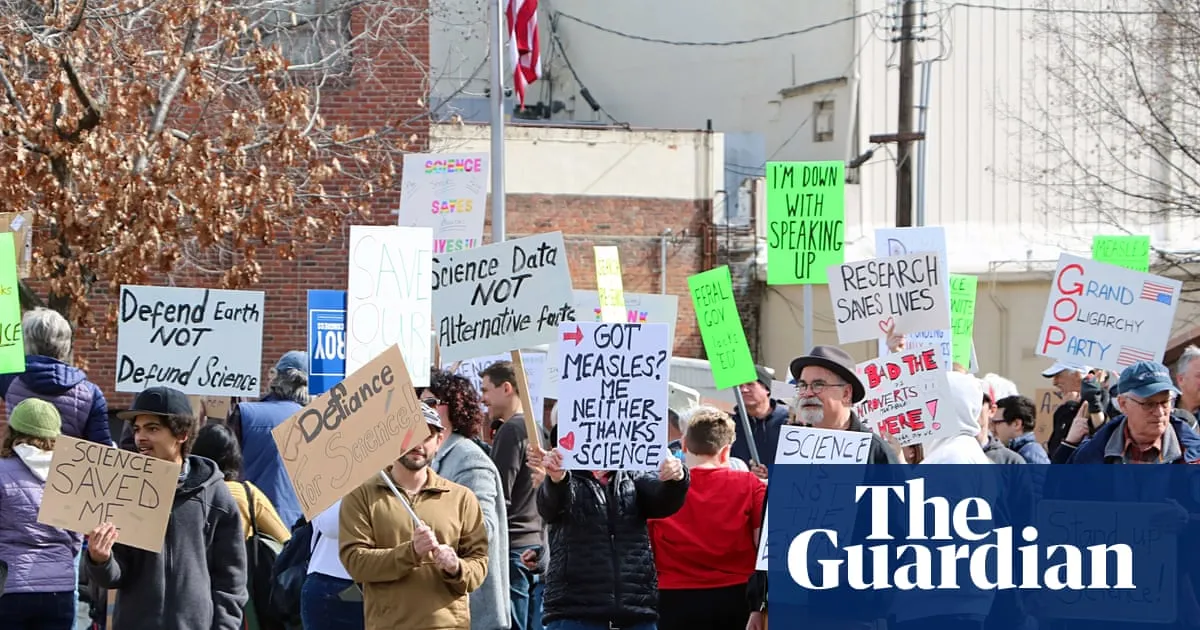
While waiting to board her flight home at Ronald Reagan Washington national airport recently, Colette Delawalla was reviewing a list of possible impacts from a proposed Trump administration rule on controlling federal money, including grants for research.Delawalla, the founder of the group Stand Up for Science, had just completed a three-day visit to Capitol Hill, where she met one by one with more than 30 members of Congress, part of a full-court press the organization has launched in recent weeks, sounding the alarm on the office of management and budget (OMB) proposal.A mother of a toddler, she stopped and thought about the listed example: a clinical trial under way meant to address the issue of parents who become suicidal after an infant death. The trial would likely be made illegal under the new rule, since it includes the sorts of international collaboration the rule prohibits.“I lost it,” she told the Guardian. “I have a two-and-a-half-year-old son at home and thought of what I would do if something happened to him. I just cried.”The rule, proposed by OMB director Russ Vought on 29 May, would place all research and other federal grants under the control of political appointees, rather than scientific or subject-matter experts.Writing on her Substack, former National Institutes of Health (NIH) program official Elizabeth Ginexi quoted the rule as prohibiting anything that “promote[s] anti-American values”.“The rule also requires that discretionary awards must ‘… demonstrably advance the president’s policy priorities,’” she added.In other words, said Delawalla, it would create a “$1.5tn slush fund” under Trump’s control. “The purpose of the rule is fascism,” she told the Guardian.“It would dismantle the US science ecosystem – but also all federal discretionary grants,” added Delawalla, on the phone from her home in Decatur, Georgia. “It’s huge.”The organization’s tactics include urging members of the public to post comments on the rule by the federal government’s 13 July deadline. Stand Up for Science has posted pointers on making comments on their website. There were nearly 31, left at the OMB’s page on the rule as of Thursday morning.Stand Up for Science is also exploring legal responses should the rule go through. Delawalla held a virtual meeting last Friday with some 50 attorneys across the US to discuss strategies.And how did her trip to Capitol Hill go? “I was flustered,” said Delawalla. Only one of the dozens she met with was “completely abreast of the [rule’s] 411 pages”, she said – Maryland Democratic senator Chris Van Hollen.One veteran Democrat in the House who she preferred not to name told her “you’re just protesters” and that “the executive branch should have the right to cancel grants”.Delawalla, 32, is actually a clinical psychologist and researcher at Atlanta’s Emory University; she founded Stand Up for Science last year to fight back against the Trump administration’s ideologically driven attacks on research.Her work with the organization has not gone unnoticed: this week, preeminent magazine Scientific American named her one of five “young scientists who are making waves in their own ways”. The magazine went on to say that Delawalla is “changing the field of science, particularly among young scientists, by showing them how to become participants in democracy”.Nonetheless, defeating the proposed OMB rule may be her stiffest challenge yet.Wading into politics on Capitol Hill has led her and colleagues at her organization to sharpen their skills at communicating about how research works and why it’s important. Thus the running list she was reviewing at Reagan airport.“We tweak the message according to who we’re talking to,” she said. With some members of Congress, she pointed out that “75 times a day, US and Chinese satellites have near misses crashing in to each other. There are offices in both countries that collaborate to avoid this. If this rule passes, within hours, there will be collisions – a forced error – because this kind of collaboration will be illegal.”“When you say this to certain members of Congress, they go: what?” she said.With others, she points out that everything from “grandma’s new wheelchair to veterans’ housing and small business funding comes from federal grants” – and could be disallowed under the new rule.One category of research that most people can relate to is clinical trials. Her organization analyzed about 10,000 National Institutes of Health (NIH)-funded trials this week and conservatively estimated that nearly half could be discontinued under the new rule, for reasons ranging from prohibited words such as “equity” to, again, the fact of including international collaboration.The discontinued trials could include “over 1,000 cancer-related trials, hundreds of pediatric studies, and hundreds of trials each studying veterans, suicide, heart disease, and diabetes”, according to Stand Up for Science.Ginexi resigned from the NIH last year after 22 years at the agency, when Doge dismissals “made it so I couldn’t do my job any more”. She called the rule “a multi-front assault unprecedented in my lifetime” and said Delawalla’s organization is “filling a gap”, since most scientists don’t tend to get involved in politics.“Non-scientists are easier to mobilize,” said Delawalla. “They’ve never been told they need to remain apolitical.”Another message she tries to bring across: “We’re advocating for democracy … If you tell people in a country they’re not allowed to study certain things with federal money, you’re not in a free country.”
SRCThe Guardian - World News
LANGEN
LEANCenter-Left
WORDS876
ENT12
FRI · 2026-06-19 · 12:00 GMTBRIEF NSR-2026-0619-85793
NSR-2026-0619-85793News Report·EN·Political Strategy
‘The purpose of the rule is fascism’: scientists fight back against planned Trump research cuts
Scientists are opposing a proposed Trump administration rule that would give political appointees control over federal research grants. Colette Delawalla, founder of Stand Up for Science, argues the rule would dismantle the US science ecosystem by prohibiting international collaboration and requiring grants to advance presidential policy priorities.
Timothy PrattThe Guardian - World NewsFiled 2026-06-19 · 12:00 GMTLean · Center-LeftRead · 4 min
The Guardian - World NewsFIG 01
Reading time
4min
Word count
876words
Sources cited
3cited
Entities identified
12entities
Quality score
100%
§ 01
Briefing Summary
AI-generatedNEWSAR · AI
Scientists are opposing a proposed Trump administration rule that would give political appointees control over federal research grants. Colette Delawalla, founder of Stand Up for Science, argues the rule would dismantle the US science ecosystem by prohibiting international collaboration and requiring grants to advance presidential policy priorities. This could halt numerous research projects, including those on cancer, pediatric studies, and mental health. Delawalla and her organization are lobbying Congress and encouraging public comments before the July 13 deadline, and are exploring legal challenges. The proposed rule, from the Office of Management and Budget, would significantly alter how federal research funding is allocated.
Confidence 0.90Sources 3Claims 5Entities 12
§ 02
Article analysis
Model · rule-basedFraming
Political Strategy
Human Interest
Tone
Sensational
AI-assessed
CalmNeutralAlarmist
Factuality
0.60 / 1.00
Mixed
LowHigh
Sources cited
3
Well sourced
FewMany
§ 03
Key claims
5 extracted01
The rule prohibits research that 'promote[s] anti-American values' and requires discretionary awards to 'demonstrably advance the president’s policy priorities'.
quoteElizabeth Ginexi (former NIH official, quoting the rule)
Confidence
0.95
02
A proposed Trump administration rule would place all research and other federal grants under the control of political appointees, rather than scientific experts.
factualOffice of Management and Budget (OMB) proposal
Confidence
0.90
03
Only one of the dozens of members of Congress met by Delawalla was fully aware of the rule's 411 pages.
factualColette Delawalla
Confidence
0.85
04
The rule would likely make clinical trials addressing parental suicide after infant death illegal due to prohibitions on international collaboration.
factualColette Delawalla
Confidence
0.85
05
The purpose of the rule is fascism.
quoteColette Delawalla (founder of Stand Up for Science)
Confidence
0.80
§ 04
Full report
4 min read · 876 words§ 05
Entities
12 identifiedKey playerOppositionContextPositiveNeutralNegative
People3
Organizations4
Locations3
Events1
§ 06
Keywords & salience
10 termsresearch funding
1.00
federal grants
0.90
trump administration
0.80
scientific research
0.80
political appointees
0.70
stand up for science
0.70
omb proposal
0.60
fascism
0.60
science ecosystem
0.50
international collaboration
0.40
§ 07
Topic connections
Interactive graph No topic relationship data available yet. This graph will appear once topic relationships have been computed.