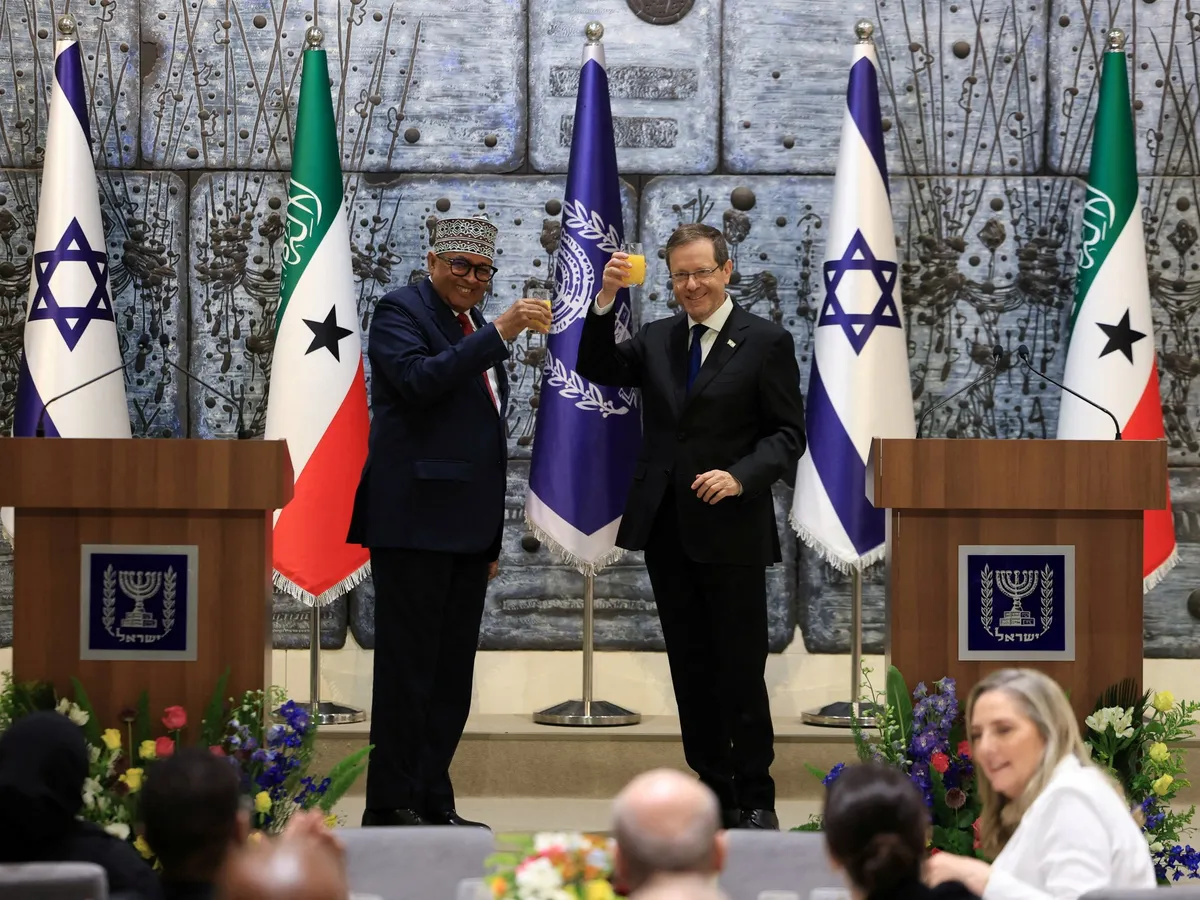
Six months after recognition, Israel and Somaliland say they are moving from symbolism to strategic cooperationIsrael's President Isaac Herzog and Somaliland's President Abdirahman Mohamed Abdullahi in Jerusalem. [File: Ronen Zvulun/Reuters]Published On 20 Jun 2026Mogadishu, Somalia – Israel rolled out a lavish state welcome for Somaliland’s president in Jerusalem, extending honours rarely accorded to the leader of a territory still unrecognised by any country other than Israel.President Abdirahman Mohamed Abdullahi, known as Cirro, arrived last Sunday for the first state visit by a Somaliland leader, six months after Israel became the first country to recognise the breakaway region’s independence from Somalia.Recommended Stories list of 3 itemslist 1 of 3Israel welcomes Somaliland president in ‘historic’ visitlist 2 of 3Somaliland president visits Israeli Knesset on tourlist 3 of 3The Horn of Africa needs reconciliation, not new bordersend of list“I am here as the president of Somaliland for the first state visit ever,” Abdullahi told Israeli Prime Minister Benjamin Netanyahu during a meeting. “For 35 years we have been asking the world to see us. And Israel and you yourself were the first to see us and recognise us.”Netanyahu framed the decision through the lens of Jewish history. “It is a very natural thing for us to do, because we remember as the Jewish people, a small people, who asked for the recognition of their rights from the world, so there is a natural sympathy to you,” he said.The visit combined high-profile ceremony with what officials said where substantive discussions. A strategic cooperation agreement was signed alongside a series of meetings, underscoring both sides’ ambition to turn diplomatic recognition into a broader partnership encompassing security, trade and regional strategy.Somaliland sits across the Gulf of Aden from Yemen and controls a long stretch of coastline overlooking one of the world’s busiest maritime corridors. As Netanyahu noted during a joint appearance with Abdullahi, its territory lies at the opposite end of the Red Sea, adjacent to the Bab al-Mandab Strait, the narrow gateway linking the Red Sea to the Indian Ocean and a critical artery for global trade.For Israel, which has spent the past two years exchanging fire with Yemen’s Houthis while watching Red Sea shipping repeatedly disrupted, the region has assumed growing strategic importance.The visit also came against the backdrop of US President Donald Trump’s memorandum of understanding with Iran, a move that has intensified pressure on Netanyahu from critics who argue it leaves many of Israel’s core security concerns unresolved.Yossi Mekelberg, a Middle East analyst at Chatham House, said Somaliland offered Israel a rare strategic opening at a time when it faces greater regional isolation after successive conflicts with Iran and its allies.“They’ve not got many friends, and Israel is more alone now too,” Mekelberg told Al Jazeera. “And if you look at the geography, it just makes a lot of sense.”Abdullahi was received by President Isaac Herzog at the presidential residence in Jerusalem, before meeting Prime Minister Benjamin Netanyahu and much of Israel’s political and security leadership.He also embraced the symbolism of a full state visit, laying a wreath at the grave of Theodor Herzl, the founder of modern Zionism, and received the Friends of Zion Award from the Friends of Zion Museum, an honour bestowed on foreign leaders regarded as strong supporters of Israel.Somaliland’s President Abdirahman Mohamed Abdullahi attends a memorial ceremony at Yad Vashem, Israel’s Holocaust memorial, in Jerusalem, June 14, 2026 [Ronen Zvulun/Reuters]During the visit, Somaliland formally opened its embassy in West Jerusalem at a ceremony attended by Israeli Foreign Minister Gideon Saar. The move departed from the practice of most countries, which maintain their embassies in Tel Aviv because Jerusalem’s status remains disputed and Israel’s claim to sovereignty over the entire city is not widely recognised internationally.The decision drew condemnation from Palestine, the Organisation of Islamic Cooperation (OIC) and the Arab League.“Israel and Somaliland are going into the consolidation phase of this relationship and obviously the pageantry with which Cirro has been received demonstrates that,” Moses Chrispus Okello, a senior researcher at the South Africa-based Institute for Security Studies, told Al Jazeera.“But Israel’s overall prize is not Somaliland, it is the Red Sea,” Okello added.Security questionAlthough Somaliland officials have expressed interest in cooperation with Israel across areas such as water management, health and agriculture, it is Israel’s security interests that have drawn the most attention, fuelling speculation about what Israel was gaining from the relationship.When Israel’s Foreign Minister, Gideon Saar, first visited Somaliland in January a month after recognition, he said at a meeting with Somaliland’s president and military chief of staff that Israel was seeking a “strategic partnership” and crucially defence cooperation.Somali officials, including the president, have alleged that Israel is interested in establishing a military facility potentially linked to operations against the Houthis in Yemen, allegations Somaliland officials have repeatedly refused to take a clear position on.In an interview with Israeli outlet i24, Somaliland’s president, Abdirahman Mohamed Abdullahi, said there is currently no plan for a military base, but when asked about the possibility, he added: “I cannot rule out.”Attention has largely centred on Berbera, Somaliland’s largest coastal city on the Gulf of Aden, where an airport originally constructed by the Soviet Union and later used by NASA—while nominally civilian—has been recently militarised, according to analysis by the International Institute for Strategic Studies think tank.During a meeting with Abdullahi, Israel’s Defence Minister, Israel Katz, said his country had cooperated for years “under the radar in a series of operations” with Somaliland, and added that he expected it would reach “new heights”.Ali Omar, Somalia’s State Minister for Foreign Affairs, told Al Jazeera, that his government’s “gravest fear” was that Somaliland would be drawn into Israel’s regional conflicts. “This interference imports conflict into a region that has already suffered enough,” he said.Omar told Al Jazeera that Somalia had repeatedly “offered [dialogue] on any issue”, except Somalia’s unity. “Our door remains open,” he added.Israel’s recognition of Somaliland internationalises what has been a frozen issue since 1991, when Somaliland declared independence as Somalia suffered a protracted civil war. Negotiations between Mogadishu and Hargeisa have failed to produce an outcome satisfactory for both sides.In an interview with local media last week, Somalia’s president, Hassan Sheikh Mohamud, said Israel had reached out on several occasions to his government after recognising it was facing danger across the region, but that Mogadishu had rejected the overtures.He added that Israel’s engagement with Somaliland meant “a very, very big problem is coming from it,” without elaborating.Critics against Israel’s decision growThough the decision to invest in ties with Israel has appeared largely popular in Somaliland, with an Israeli delegation participating in Somaliland’s May 18 independence day event, murmurings of dissent have been brewing.In a video in February, Muse Bihi Abdi, a former president generally seen as supportive of Israel’s recognition, called for the government to disclose the terms of any agreement with Israel. He expressed concern that Israel could potentially use Somaliland as a base against its regional adversaries.“Our constitution does not allow anything that harms Muslims or goes against our religion. Any such action would be unconstitutional, and we categorically reject it,” he said.Religious scholars in Somaliland, which is Muslim-majority, have also appeared divided on the issue, with some defending the government’s decision and others, including some prominent Islamic scholars, harshly criticising it.Though Somaliland officials initially said several countries would also recognise it, the US, which has been Somaliland’s main recognition target, has said its position remains unchanged, and no other state has followed.Israel’s move has also drawn opposition from several key regional countries. Saudi Arabia, Turkiye and Egypt have expressed concern over Israel’s unilateral recognition of Somaliland, alongside the African Union, the Organisation of Islamic Cooperation and the Arab League.The Houthis have been the most forceful in their opposition, warning that they would consider any Israeli presence in Somaliland a “military target” and, more recently, condemned Somaliland’s decision to open an embassy in Jerusalem.Jama Abdullahi Igal Gabuush, a close aide to Somaliland’s president and a lead negotiator in talks with Israel, acknowledged in a recent panel that building ties with Israel carries risks Somaliland is willing to accept. “Somaliland has to take the stage that it has to take, and you make enemies because of what you want and who you want to be,” he said. “And I think Somaliland is ready for that.”Both governments have nevertheless pressed ahead. Somaliland’s defence minister told Reuters that Israel was training parts of Somaliland’s military, although the defence ministry later denied it had made a statement.During his meeting with Netanyahu, Somaliland’s president announced the signing of a Strategic Cooperation Declaration, which Somaliland described as marking “the beginning of the most significant phase in diplomatic relations and strategic cooperation” between them.Chatham House expert Mekelberg told Al Jazeera that whilst the relationship offers some gains for both sides, it addresses neither of their core issues.“Netanyahu is seeking ways to continue to bypass addressing the Palestinian issue and reach out to other countries,” he said. “Somaliland is building too much into this too. Yes it is big for them and important for them but Israel can’t do everything.”
SRCAl Jazeera
LANGEN
LEANCenter
WORDS1 506
ENT12
SAT · 2026-06-20 · 04:30 GMTBRIEF NSR-2026-0620-85892
NSR-2026-0620-85892News Report·EN·Diplomatic
Israel fetes Somaliland’s leader as it seeks to expand Red Sea influence
Israel hosted Somaliland's President Abdirahman Mohamed Abdullahi in Jerusalem for a state visit, six months after Israel recognized the breakaway region's independence. The visit marked a shift from symbolism to strategic cooperation, with both nations signing a strategic agreement covering security, trade, and regional strategy.
Faisal AliAl JazeeraFiled 2026-06-20 · 04:30 GMTLean · CenterRead · 7 min
Al JazeeraFIG 01
Reading time
7min
Word count
1 506words
Sources cited
3cited
Entities identified
12entities
Quality score
100%
§ 01
Briefing Summary
AI-generatedNEWSAR · AI
Israel hosted Somaliland's President Abdirahman Mohamed Abdullahi in Jerusalem for a state visit, six months after Israel recognized the breakaway region's independence. The visit marked a shift from symbolism to strategic cooperation, with both nations signing a strategic agreement covering security, trade, and regional strategy. Somaliland's location on the Gulf of Aden, overlooking a vital maritime corridor, is of significant strategic importance to Israel, particularly given recent disruptions in Red Sea shipping. The visit included high-level meetings, the opening of Somaliland's embassy in West Jerusalem, and symbolic gestures. While Somaliland seeks cooperation in various sectors, Israel's primary interest appears to be security and expanding its influence in the Red Sea region.
Confidence 0.90Sources 3Claims 5Entities 12
§ 02
Article analysis
Model · rule-basedFraming
Diplomatic
Political Strategy
Tone
Measured
AI-assessed
CalmNeutralAlarmist
Factuality
0.70 / 1.00
Factual
LowHigh
Sources cited
3
Well sourced
FewMany
§ 03
Key claims
5 extracted01
For Israel, the region has assumed growing strategic importance due to Red Sea shipping disruptions.
factual
Confidence
1.00
02
Somaliland sits across the Gulf of Aden from Yemen and controls a long stretch of coastline overlooking one of the world’s busiest maritime corridors.
factual
Confidence
1.00
03
A strategic cooperation agreement was signed alongside a series of meetings.
factual
Confidence
1.00
04
Israel became the first country to recognize the breakaway region’s independence from Somalia.
factual
Confidence
1.00
05
Israel rolled out a lavish state welcome for Somaliland’s president in Jerusalem.
factual
Confidence
1.00
§ 04
Full report
7 min read · 1 506 words§ 05
Entities
12 identifiedKey playerOppositionContextPositiveNeutralNegative
People4
Organizations1
§ 06
Keywords & salience
10 termsred sea influence
1.00
strategic cooperation
0.90
somaliland independence
0.80
israel recognition
0.80
maritime corridors
0.70
bab al-mandab strait
0.60
regional strategy
0.50
president abdirahman mohamed abdullahi
0.40
president isaac herzog
0.40
prime minister benjamin netanyahu
0.40
§ 07
Topic connections
Interactive graph No topic relationship data available yet. This graph will appear once topic relationships have been computed.