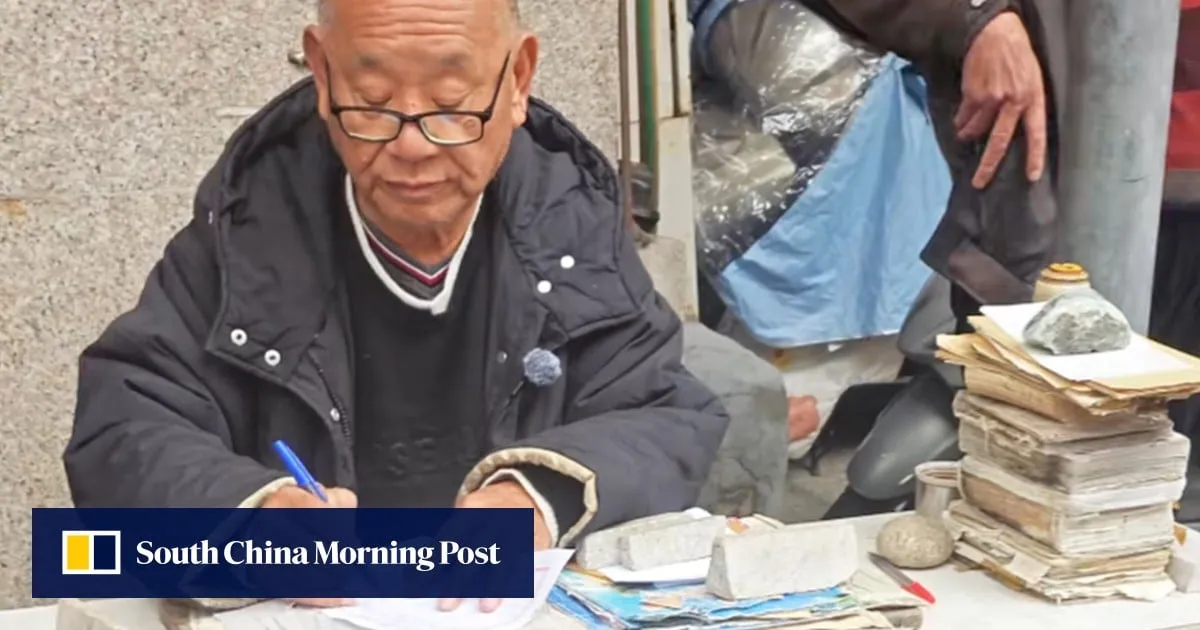
A 77-year-old man in southeastern China has spent nearly six decades turning homesickness, hardship and family duty into letters sent across the sea.Jiang Mingdian, from Quanzhou in Fujian province, is regarded as one of China’s last active professional letter writers, though no public figures show how many still practise the trade.Over 59 years, he has reportedly written more than 100,000 letters for local families to relatives overseas, reaching countries including the Philippines, Singapore, Malaysia, Thailand and Indonesia.Professional letter writer Jiang Mingdian has been plying his trade since he was 18 years old. Photo: DouyinHe entered the trade at the age of 18 with his parents’ encouragement. His father was among China’s earliest professional letter writers, while his mother, a primary school teacher, helped nurture his early education.The profession grew out of Fujian’s long history of emigration.From the 1840s, waves of young people, driven abroad by war and poverty, left the province in search of work. They sent home letters and remittances, but many relatives, constrained by dialect and illiteracy, could not read or reply.Professional letter writers emerged to bridge that divide.Jiang’s work often required turning local dialects into polished written Chinese, while addresses usually had to be translated into foreign languages with meticulous accuracy.A customer looks on as Jiang goes through some documents with him. Photo: DouyinHe began teaching himself languages in primary school, using tapes and dictionaries to learn English, German, Spanish and Vietnamese, among others.In his early years, Jiang cycled from village to village, reading letters and composing replies for the families of overseas Chinese. He later set up a modest street-side stall in the city.At a time when classmates in regular jobs earned 12 yuan (US$2) a month, Jiang could reportedly make two yuan a day from letter writing, an income that helped him raise his three sons.For Jiang, a good letter was never merely a matter of translation. It had to convey emotion, circumstance and dignity.Jiang, above, concentrates as he looks through some old letters and documents. Photo: DouyinHe told Fujian Television that many Chinese migrants who ventured overseas endured profound hardship.Further ReadingWhen relatives asked for more financial support, Jiang would soften their complaints and recast the request with tact, citing illness or other family difficulties.Among the stories that affected him most were those of left-behind wives known locally as fanke shen, whose husbands left for Southeast Asia while they stayed behind to shoulder family responsibilities.A stack of very old documents and letters written by Jiang are held down by a large paperweight. Photo: DouyinJiang recalled one woman who married at 14, gave birth at 15, and remained widowed until she died at 96 after her husband died overseas.Another, worn down by years of loneliness, often complained about her absent husband, but Jiang recast her grievances into lyrical lines and sent them across the sea.“For these fanke shen, a whole life could be contained in just a few letters,” Jiang told the media.By the late 20th century, he was encouraging such women to reunite with their husbands abroad and translating the documents they needed to leave China.As mobile phones and social media have transformed communication, Jiang’s clientele has steadily dwindled, and many elderly regulars have died. But he takes comfort in the fact that some people still turn to handwritten words to express love, longing and regret.Since 2025, after he began sharing his work on social media, young visitors have travelled to Quanzhou to ask him to write letters for them.Many address the letters to themselves, their parents or their partners, though most are never sent and are instead kept as a personal ritual.“I am happy to tell young people about Chinese migration history,” Jiang told Daxiang News.“I hope they will remember the loyalty, filial piety, benevolence and honesty of the older generation of overseas Chinese, as well as their love for their country and hometowns.”The above image shows an old handwritten letter penned by Jiang. Photo: DouyinHis work has since expanded to document translation and the drafting of legal papers, wills, contracts and other materials.Quanzhou is one of China’s best-known ancestral homes of overseas Chinese. Over 10 million people with roots in the city are reportedly spread across more than 170 countries and regions.Known as Qiaopi, the letters and remittances sent home by overseas Chinese were added to Unesco’s Memory of the World Register in 2013. They are recognised as rare evidence of Chinese international migration history.One letter from 1927 contains only a single Chinese character, nan, meaning “hardship,” while another, written in 1957, runs to more than 3,000 characters.
SRCSouth China Morning Post
LANGEN
LEANCenter-Right
WORDS755
ENT12
SAT · 2026-06-20 · 08:00 GMTBRIEF NSR-2026-0620-85939
NSR-2026-0620-85939News Report·EN·Human Interest
Last professional letter writer in Chinese city pens 100,000 missives over 59 years
Jiang Mingdian, a 77-year-old man in Quanzhou, Fujian province, is considered one of China's last professional letter writers. Over 59 years, he has written over 100,000 letters for local families to relatives overseas, bridging communication gaps due to dialect and illiteracy.
Zoey ZhangSouth China Morning PostFiled 2026-06-20 · 08:00 GMTLean · Center-RightRead · 4 min
South China Morning PostFIG 01
Reading time
4min
Word count
755words
Sources cited
1cited
Entities identified
12entities
Quality score
100%
§ 01
Briefing Summary
AI-generatedNEWSAR · AI
Jiang Mingdian, a 77-year-old man in Quanzhou, Fujian province, is considered one of China's last professional letter writers. Over 59 years, he has written over 100,000 letters for local families to relatives overseas, bridging communication gaps due to dialect and illiteracy. His profession emerged from Fujian's history of emigration, where letter writers translated local dialects into polished Chinese and addresses into foreign languages. Jiang's work often involved conveying emotions and circumstances with dignity, particularly for women left behind by husbands working abroad. While technology has reduced demand, he now shares his work on social media, attracting young visitors who ask him to write letters, often for personal reflection, and he educates them about Chinese migration history.
Confidence 0.90Sources 1Claims 5Entities 12
§ 02
Article analysis
Model · rule-basedFraming
Human Interest
Social Justice
Tone
Measured
AI-assessed
CalmNeutralAlarmist
Factuality
0.70 / 1.00
Factual
LowHigh
Sources cited
1
Limited
FewMany
§ 03
Key claims
5 extracted01
A good letter, according to Jiang, must convey emotion, circumstance, and dignity, not just translate words.
quoteJiang Mingdian
Confidence
1.00
02
The profession of letter writing in Fujian emerged from a history of emigration, with writers bridging communication gaps due to dialect and illiteracy.
factualarticle
Confidence
0.90
03
Jiang Mingdian, a 77-year-old man in Quanzhou, Fujian province, is considered one of China's last active professional letter writers.
factualarticle
Confidence
0.90
04
Jiang Mingdian began his career at 18, encouraged by his parents, and could earn two yuan a day, which helped him support his family.
factualarticle
Confidence
0.80
05
Over 59 years, Jiang Mingdian has reportedly written over 100,000 letters for local families to relatives overseas.
statisticarticle
Confidence
0.80
§ 04
Full report
4 min read · 755 words§ 05
Entities
12 identifiedKey playerOppositionContextPositiveNeutralNegative
Organizations1
§ 06
Keywords & salience
9 termsprofessional letter writer
1.00
overseas chinese
0.90
emigration history
0.80
communication bridge
0.70
dialect translation
0.60
homesickness
0.50
family duty
0.50
illiteracy
0.40
fujian province
0.40
§ 07
Topic connections
Interactive graph No topic relationship data available yet. This graph will appear once topic relationships have been computed.