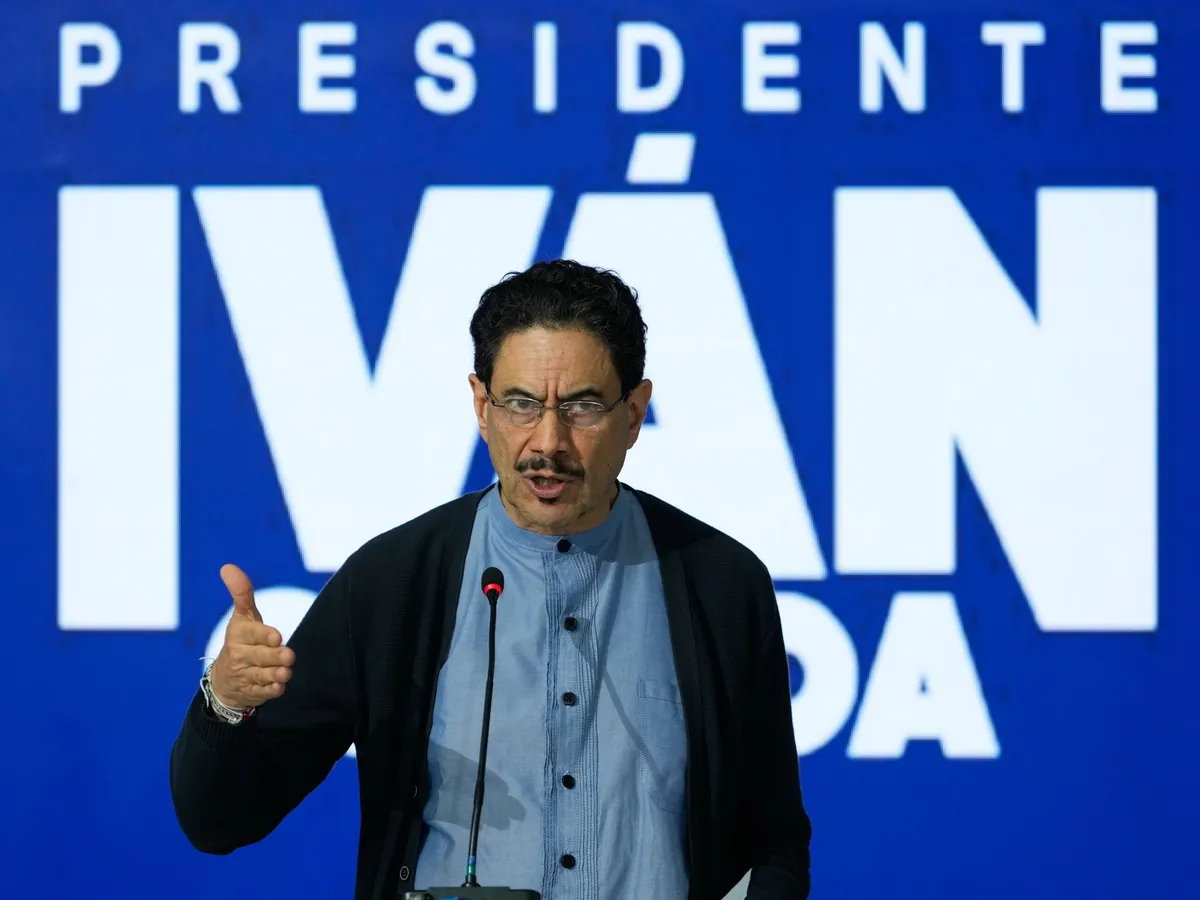
A soft-spoken senator, Cepeda spent years advocating for victims of state crimes. But critics say taking on a president made him a 'hero to the left'.Senator Ivan Cepeda holds a news conference in Bogota, Colombia, on June 16 [Fernando Vergara/AP Photo]Senator Ivan Cepeda holds a news conference in Bogota, Colombia, on June 16 [Fernando Vergara/AP Photo]Published On 20 Jun 2026Bogota, Colombia – He had the look of a middle-aged schoolteacher. His back seemed slightly sloped, a grey cardigan hung from his shoulders, and a pair of glasses were perched atop his nose.But as Ivan Cepeda waded through the crowds at a surprise rally on June 3 in downtown Bogota, young supporters thronged to see him."Se vive, se siente, Cepeda presidente!" they chanted. "We live it, we feel it, Cepeda for president!"Reserved and measured in his rhetoric, the 63-year-old senator may seem an unlikely candidate for Colombia’s highest office.But since he announced his candidacy in August last year, Cepeda has emerged as the new face of Colombia's increasingly powerful left wing.“Cepeda is a candidate who never set out to become president,” said Leon Valencia, a political analyst and author of the biography, Ivan Cepeda: A Life Against Forgetting.Observers have pointed to comments Cepeda made less than a year ago, expressing ambivalence about running for the presidency."Unlike others, this has not been my calling," Cepeda told the newspaper El Espectador in July, as rumours about his candidacy swirled. "I hadn't thought about running for president because I respect the office and recognise it as a massive responsibility."But Cepeda’s presidential bid is the latest turn in a life defined by politics and violence, placing him in the middle of one of Colombia's most intractable problems: its six-decade-long armed conflict.Ivan Cepeda speaks during his closing campaign rally in Bogota, Colombia, on June 13 [Sergio Acero/Reuters]Ivan Cepeda speaks during his closing campaign rally in Bogota, Colombia, on June 13 [Sergio Acero/Reuters]A surge on the leftIn Sunday's run-off election, Cepeda will face Abelardo de la Espriella, a far-right criminal defence lawyer backed by United States President Donald Trump.De la Espriella has capitalised on Colombia's security concerns by promising a hardline approach to crime and conflict. Despite having no political experience or party backing, he has emerged as the election's frontrunner, winning 43 percent of the vote in the first round.But Cepeda, who came in second place, has offered a radically different vision for Colombia, focusing instead on bolstering the country's social programmes and advancing agrarian reforms in a bid to reduce inequality.He has also promised continuity with the outgoing government of President Gustavo Petro, who has reached his term limit.Petro's Historic Pact, a left-wing party, has grown increasingly powerful since his election four years ago. In the March legislative elections, for instance, the group won 25 seats in the Senate and 42 in the House of Representatives — the most of any party in either chamber.Petro himself has been on an upswing.As Colombia's first left-wing president, Petro had seen his public approval ratings slump during much of his term. But in the final months of his presidency, his poll numbers have risen, with the newspaper El Tiempo estimating that 45 percent of Colombians hold a favourable view of him.“The government has managed to build support among some sectors of the Colombian population, through its social policies and Petro’s forceful rhetoric against the traditional elites,” said Yann Basset, a political analyst and professor at the Universidad del Rosario.But even as Colombia's left enjoys a moment of unprecedented strength, voters remain divided over whether to continue down the path Petro forged.Cepeda, the Historic Pact's presidential nominee, has acknowledged those concerns by promising more substantial change than Petro enacted."I want the reforms not only to be deepened and consolidated, but also for them to go further," Cepeda told journalist Maria Jimena Duzan on her podcast.Ivan Cepeda addresses a crowd in Bogota, Colombia, during a campaign-sponsored football match on June 7 [Ivan Valencia/AP Photo]Ivan Cepeda addresses a crowd in Bogota, Colombia, during a campaign-sponsored football match on June 7 [Ivan Valencia/AP Photo]A father's assassinationPublic security has remained a dominant concern in this year's presidential race, and it is a subject with which Cepeda is intimately familiar.Growing up in the 1960s and '70s, Cepeda came of age during a time when the Revolutionary Armed Forces of Colombia (FARC), a left-wing rebel group, was one of several factions fighting the government.Back then, Cepeda’s parents, Manuel Cepeda and Yira Castro, were both members of the Communist Party. As war raged in Colombia’s countryside, his father advocated for a negotiated solution.In 1985, peace talks between the FARC and Colombian government gave rise to the Patriotic Union (UP), a leftist party that brought together former fighters and members of the Communist Party. Cepeda’s father was elected as a senator for the UP in 1994.But less than a year into his term, he was assassinated. Other UP leaders were also killed, allegedly at the hands of state agents working in coordination with paramilitary groups.For Cepeda, his father’s death marked the beginning of a decades-long career advocating for the victims of the armed conflict."He became determined to find his father’s killers and, along that path, the search for the truth became an obsession and the fight for victims his main objective," said Valencia.Cepeda was eventually elected to Congress in 2010. On his first day, he arrived with a bucket and a mop, promising to clean up a legislature stained by corruption scandals and paramilitary ties.On the floor of Congress, he repeatedly confronted Alvaro Uribe, the two-time right-wing president whom Cepeda accused of collusion with paramilitary groups and drug cartels.A legal battle ensued, ending with Uribe convicted of bribery and witness tampering in July 2025. While the ruling was later overturned, the court case boosted Cepeda’s political standing.His name was soon among those floated as a possible candidate for the 2026 presidential race.Cepeda had achieved what no one had before, Valencia, his biographer, said.Uribe, who pushed a hardline security strategy during his presidency, had faced multiple investigations for alleged paramilitary ties and rights abuses. But he had never before been convicted."The only one who could defeat him in court was Ivan," Valencia said. "He ultimately became a hero to the left and emerged as [President Petro’s] successor after he won the first round of the legal battle against Uribe."A supporter waves a campaign poster for presidential candidate Ivan Cepeda and his running mate, Aida Quilcue, during a rally on June 12 [Christina Noriega/Al Jazeera]A supporter waves a campaign poster for presidential candidate Ivan Cepeda and his running mate, Aida Quilcue, during a rally on June 12 [Christina Noriega/Al Jazeera]Contending with Petro's legacyLast October, Cepeda won the primary to serve as the Historic Pact's nominee.As his campaign gained momentum, Cepeda consistently topped pre-election polls. He became the candidate to beat before the first round.But that also put a target on his back. De la Espriella branded him as “the heir of the FARC", accusing him, without evidence, of being a rebel fighter.His opponents have also used photographs showing Cepeda with former FARC members to suggest he has rebel sympathies.Cepeda, however, has explained that the photos come from government peace talks with the FARC in the mid-2010s, when he worked as an unofficial negotiator in Havana.But the challenges Cepeda faces go beyond accusations about his past. His candidacy as the Historic Pact nominee has also forced him to contend with Petro's legacy.Corruption scandals have dented Petro's reputation. In one high-profile case, funds intended to supply potable water to remote communities were reportedly embezzled by officials at Colombia’s disaster risk management agency.When questioned about the corruption allegations, Cepeda has acknowledged mistakes."We must address the issue with complete frankness and, above all, correct it going forward," he told Duzan in an interview.Some of the sharpest criticism against Cepeda has also been for his support of Petro's security strategy.Cepeda helped conceive “Total Peace", Petro's plan for negotiating ceasefires with the country's armed groups and criminal organisations. He also served as a government negotiator during talks with the National Liberation Army (ELN), Colombia’s largest remaining rebel group.But Petro's security strategy fell short of its mission, having failed to achieve a lasting peace deal with any major group in nearly four years.Instead, analysts say that armed groups expanded their power during Petro’s presidency, exacerbating Colombia's violence and insecurity.That has come at a political cost for Cepeda’s candidacy.Laura Bonilla, the deputy director of the Peace and Reconciliation Foundation (PARES), a research nonprofit, said that the Petro administration believed its economic and social gains would compensate for rising security concerns, which was ultimately proven wrong."The left essentially said, ‘The economy is doing well, social conditions have improved, and President Petro remains popular, so we can sideline security issues and focus on the social agenda,’" said Bonilla."But that only resonates with a limited part of the electorate. You are not going to broaden your support that way."Supporters wave a flag for the Historic Pact coalition at a rally for Ivan Cepeda in Bogota on June 12 [Christina Noriega/Al Jazeera]Ivan Cepeda rallies supporters of the left-wing Historic Pact coalition in Bogota on June 12 [Christina Noriega/Al Jazeera]'It will not be easy'So far, Cepeda has offered few details about how he would modify the strategy.But since the first round of voting, Cepeda has attempted to moderate his platform and distance himself from Petro, in an effort to court centrist and undecided voters. He has, for example, grown more critical of the "Total Peace" plan.In a recent interview with Caracol Radio, Cepeda said that, as president, he would refuse to negotiate with armed groups that attack the civilian population and social leaders."The [Total Peace] policy has had shortcomings, miscalculations and errors, and it will have to be reassessed," Cepeda said.He has also retreated from a controversial proposal to change Colombia's constitution in order to enact social reforms, an idea that Petro has pursued since 2024.But so far, Cepeda’s efforts have resulted in few political endorsements from centrist politicians.Claudia Lopez, a centrist candidate who finished fifth in the first round of voting, has publicly endorsed him, but her running mate announced he would back De La Espriella in the run-off. Sergio Fajardo, a centrist candidate who finished third, has declined to endorse either candidate."It has been difficult for Cepeda because [the shift in his platform] has put him somewhat at odds with President Petro’s rhetoric and positions, which dominated the first-round campaign,” said Basset.Cepeda’s sudden shift may have come “too late to seem credible", he added.Ivan Cepeda addresses his supporters following the first round of voting at his base in Tequendama Hotel in Bogota on May 31 [Christina Noriega/Al Jazeera]Basset also noted that Cepeda's camp made few attempts to court centrist politicians who had been critical of Petro's presidency before the first round of voting.As a result, he now has limited options to broaden his support, with centrists wary of joining his campaign."There have been political differences over whether to build coalitions with other political forces," Basset said. "Cepeda inherits Petro’s political base, but that base alone is insufficient to win an election, and I think the left realised that too late."According to the political analyst, de la Espriella enters Sunday's run-off election with the advantage, having succeeded in uniting much of the political right behind his candidacy.Paloma Valencia, a right-wing candidate who finished third in the first round of voting, publicly endorsed de la Espriella, with her supporters expected to shift their support to him.But Basset refuses to count Cepeda out. The left-wing candidate is trailing de la Espriella in the latest polls, but Cepeda could benefit from a higher turnout in urban neighbourhoods and rural areas where the left's support remains strongest."Cepeda's advantage may lie in the fact that the left has a more effective grassroots organisation than Abelardo de la Espriella has," Basset said."That means he could still reverse the current trend, but it will not be easy."
SRCAl Jazeera
LANGEN
LEANCenter
WORDS1 979
ENT10
SAT · 2026-06-20 · 16:04 GMTBRIEF NSR-2026-0620-86016
NSR-2026-0620-86016News Report·EN·Political Strategy
How Ivan Cepeda emerged a frontrunner in Colombia’s presidential election
Senator Ivan Cepeda has emerged as a frontrunner in Colombia's presidential election, representing the increasingly powerful left wing. His candidacy is seen as a continuation of the policies of outgoing President Gustavo Petro, Colombia's first left-wing president.
Christina NoriegaAl JazeeraFiled 2026-06-20 · 16:04 GMTLean · CenterRead · 8 min
Al JazeeraFIG 01
Reading time
8min
Word count
1 979words
Sources cited
2cited
Entities identified
10entities
Quality score
100%
§ 01
Briefing Summary
AI-generatedNEWSAR · AI
Senator Ivan Cepeda has emerged as a frontrunner in Colombia's presidential election, representing the increasingly powerful left wing. His candidacy is seen as a continuation of the policies of outgoing President Gustavo Petro, Colombia's first left-wing president. Cepeda, a soft-spoken senator, has focused his platform on strengthening social programs and advancing agrarian reforms to reduce inequality. His political journey is deeply intertwined with Colombia's long-standing armed conflict, with his father having been assassinated for advocating for a negotiated peace. Cepeda will face Abelardo de la Espriella in the run-off election, offering a contrasting vision for the country.
Confidence 0.90Sources 2Claims 5Entities 10
§ 02
Article analysis
Model · rule-basedFraming
Political Strategy
Human Interest
Tone
Measured
AI-assessed
CalmNeutralAlarmist
Factuality
0.60 / 1.00
Mixed
LowHigh
Sources cited
2
Limited
FewMany
§ 03
Key claims
5 extracted01
Petro's Historic Pact won 25 seats in the March legislative elections.
statistic
Confidence
0.90
02
Cepeda will face Abelardo de la Espriella in Sunday's run-off election.
factual
Confidence
0.90
03
Cepeda has promised continuity with the outgoing government of President Gustavo Petro.
factual
Confidence
0.80
04
De la Espriella is backed by United States President Donald Trump.
factual
Confidence
0.80
05
Ivan Cepeda has emerged as the new face of Colombia's increasingly powerful left wing.
factual
Confidence
0.80
§ 04
Full report
8 min read · 1 979 words§ 05
Entities
10 identifiedKey playerOppositionContextPositiveNeutralNegative
People4
Organizations1
§ 06
Keywords & salience
8 termsivan cepeda
1.00
colombian presidential election
1.00
left wing politics
0.90
armed conflict
0.80
victims of state crimes
0.70
political analyst
0.60
bogota
0.50
hardline approach
0.40
§ 07
Topic connections
Interactive graph No topic relationship data available yet. This graph will appear once topic relationships have been computed.