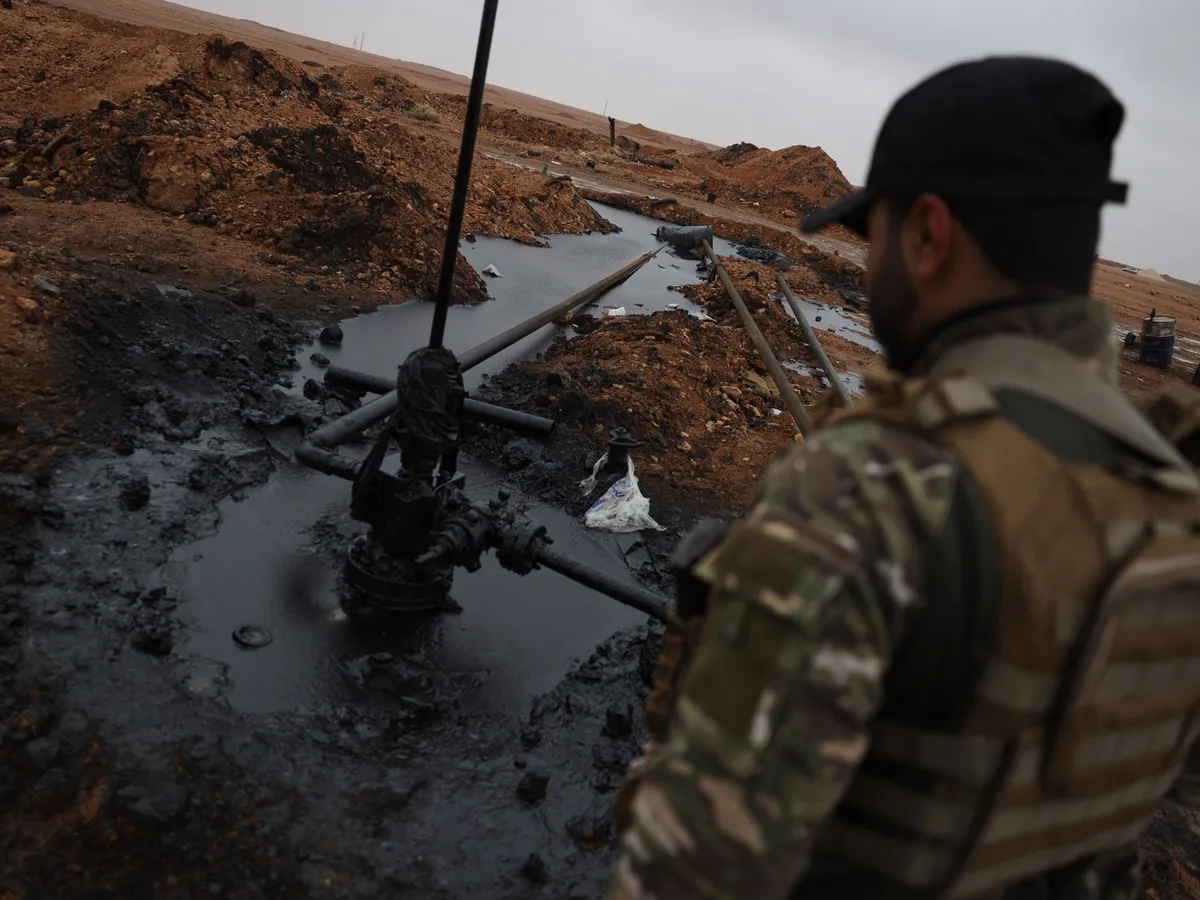
As the government takes control of resource-rich areas, rebuilding trust, maintaining support and navigating delicate dynamics will be key to achieving a united Syria.Published On 19 Jan 2026Deir Az Zor, Syria – On the broad, windswept plains through which the Euphrates River snakes, the land remembers every war that has passed across it. The oil-rich soil of al-Omar, the turbines of the Tabqa Dam and the cautious return of families to towns long abandoned tell a story as old as Syria itself: one of power, survival and the struggle to unify a fractured country.Over the weekend, Syrian government forces seized the al-Omar oilfield, the Conoco gas complex – both in Deir Az Zor governorate – and the Tabqa Dam, in Raqqa governorate. The operation was heralded as a military achievement, but its significance reaches far beyond maps and military lines. It touches the very structure of Syria’s political economy, the social contract between state and citizen and the fragile architecture of agreements meant to reconcile formerly hostile actors.And the Kurdish-led Syrian Democratic Forces (SDF), which previously controlled the areas as well as all of northeastern Syria, soon realised the situation they faced. By Sunday evening, Syrian President Ahmed al-Sharaa announced that a deal had been reached with the SDF.“State institutions will enter the three eastern and northeastern governorates – Hasakah, Deir Az Zor and Raqqa,” al-Sharaa said.Heartland scarred by warIn eastern Syria, hydrocarbons have long been both a lifeblood and a driver of economic leverage.Before the beginning of the conflict in 2011, oil and gas accounted for nearly 20 percent of Syria’s gross domestic product (GDP). During the war, these fields became the backbone of the fragmented war economy, exploited by armed groups and redirected to support local militias. Reclaiming these fields is therefore more than symbolic – it is a prerequisite for fiscal recovery.Labib al-Nahhas, director of the Syrian Association for Citizens’ Dignity, said the rapid territorial losses suffered by the SDF echo the fall of President Bashar al-Assad’s regime in December 2024.“SDF are collapsing in a similar way to [the] regime in Damascus,” he said, arguing that al-Omar, Tabqa and Tishreen are pivotal for economic recovery, not only in terms of recovering resources such as oil and gas, but “because they will have a huge impact on prices and living conditions”.Radwan Ziadeh, senior fellow at the Arab Center Washington DC (ACW), said controlling natural resources alone was not enough to help Syria move forward, but that it was a step in the right direction.“It is still very early to say that there are tangible benefits from this advance,” he said.“Oil- and gasfields require significant international investment to unlock their full potential. On their own, they cannot deliver recovery. [But] more importantly, this is a significant step towards unifying Syria. This is the first time the country has been unified under one government since 2013. Before that, Syria was divided between Free Syrian Army factions, the al-Assad government, and later ISIL [ISIS], which fragmented the country even further.”March agreementIn March 2025, Mazloum Abdi, the commander of the SDF who is also known as Mazloum Kobani, and al-Sharaa signed a framework agreement aimed at integrating the group into state structures while protecting local governance and Kurdish rights.At the time, Abdi called it “a real opportunity to build a new Syria that embraces all its components”. He emphasised that “there will be no armies outside the state”, reflecting both acceptance of a unified military structure and persistent concern for Kurdish autonomy.Al-Sharaa, meanwhile, presented the pact as an affirmation of state sovereignty first, rights second – a point that would prove decisive in the months ahead.In November, al-Sharaa met United States President Donald Trump at the White House, and Syria became a partner in the war against ISIL. That essentially took the air from the SDF’s argument that it was the only US ally fighting against the armed group. The agreement also provided al-Sharaa’s forces with the opportunity to consolidate their deals with Arab fighters who wanted to switch sides – from the SDF to Damascus. And the Syrian president offered an olive branch to war-weary Kurdish civilians, many of whom also want an end to hostilities.However, by late 2025, implementation of the government-SDF agreement lagged. Territorial and administrative disagreements grew, and the Syrian army advanced into SDF-controlled territory.Tribes’ decisive roleWhile foreign policy set the backdrop, local tribal dynamics have proved decisive in reshaping control. Over the past year, Damascus has invested heavily in courting Arab clans in Deir Az Zor and Raqqa who had grown disaffected with the SDF’s Kurdish-led administration. The tribes were also growing increasingly frustrated with the lack of implementation of the March agreement.Participants at a January 17 meeting of tribal elders from Syria’s east reviewed the consequences of failing to implement the agreement’s provisions on time, including the potential political and security impacts on the region.Several tribal sheikhs at the meeting emphasised the importance of preventing escalation, the necessity of adhering to agreements to achieve stability, and called on the SDF to implement the March deal. The tribes had made clear their dissatisfaction with the SDF, and once the opportunity presented itself, they moved to push the SDF out of their communities.A source from the Syrian Tribal Forces, a coalition of Syrian Arab tribes, told Al Jazeera on Sunday: “Areas south of Hasakah, from Sur to al-Shaddadi, are free of SDF forces.”The outside influenceThe unravelling of the March deal was also accelerated by changing regional dynamics. The US – a longstanding, primary military partner – narrowed its role to counter-ISIL operations, leaving the Kurdish-led forces without the external military help they had relied on. Without US enforcement, Damascus has had room to assert authority east of the Euphrates River, the backbone of the SDF’s territory.Turkiye, for its part, has always remained wary of any SDF autonomy. Turkish President Recep Tayyip Erdogan has been quick to back al-Sharaa’s moves against the SDF and welcomed the news of Sunday’s deal.The territory was taken from the SDF not just by force, but with the tacit consent of international and regional allies and communities weary of war, who felt disenfranchised as a result of Arab-Kurdish divisions.Energy, water as levers of state authorityControl of the al-Omar oilfield, the Conoco gas complex and the Tabqa Dam is not just symbolic.Tabqa Dam, the country’s largest hydroelectric facility, now governs power and irrigation across much of northern and eastern Syria. Electricity in this region is literally life-sustaining, powering hospitals, schools and industrial activity.Yet the full potential of these assets remains unrealised. Reconstruction and international investment are necessary to convert regained infrastructure into long-term state capacity.Meanwhile, the SDF’s loss of control over resource-rich areas reduces their financial independence and constrains governance in formerly autonomous zones. As ACW’s Ziadeh noted, this moment is less about immediate economic gain than the consolidation of state authority and territorial unification.The SDF, it seems, will have to retreat from most Arab majority areas towards Hasakah governorate. That is where the historic roots of Syria’s Kurdish minority remain and provide the force with manpower, political backing and economic viability.Human and social changesThe Syrian government’s advance eastwards is reshaping communities. Thousands have been displaced from Aleppo, Raqqa and Tabqa. Kurdish populations face the tension between guaranteed citizenship as promised by al-Sharaa in a presidential decree issued on January 16, and the erosion of the SDF’s political autonomy.Arab tribes, meanwhile, are recalibrating alliances, balancing local interests with new state authority.Main tribes, including al-Ukaidat, al-Bakara, al-Jabour, Anza, Shammar, Bani Khalid, al-Bu Shaaban, al-Buhamad and al-Baggara, essentially run the governorates of Deir Az Zor, Raqqa and Hasakah in northeastern Syria. Their loyalties are often transactional, depending on who runs that region. Al-Sharaa’s forces seem to have the upper hand now.The social contract – fragile before the war – is being renegotiated in real time, amid both material deprivation and political promises.To keep new allies happy and prevent defections, Damascus will have to care – and be seen to care, as well. The likelihood of more people tilting to the government’s side will depend on what kind of improvements they see in terms of security, inclusion and the economy.Al-Nahhas expects the impact on living conditions would be “massive” but not immediate, stressing that expectation management is essential because recovery will take time. Central control and stability, he added, could incentivise foreign investment in oil, gas and electricity, provided corruption is minimised and governance improves.He said after regaining vital energy sites, electricity costs and availability could also improve, but warned that outcomes depend on management – how quickly authorities can make facilities operational, given that infrastructure is not optimal, how effectively control is asserted, and how transparently assets are managed.No oil windfalls soonMohamad Ahmad, economist and energy specialist at Karam Shaar Advisory Limited, said while the al-Omar field was “technically feasible for investment”, production had collapsed to about 14,200 barrels per day and reservoirs were stressed.“The government’s recent takeover in late 2025 reclaims a critically impaired asset; its rehabilitation faces immense technical and financial hurdles, underscoring the long-term economic cost of the war,” he said.Ahmad added that the capture of the oilfield highlights the depth of damage inflicted over the years of conflict.“As Syria’s flagship oilfield, al-Omar’s trajectory from a high-potential asset to a war-torn symbol is both tragic and indicative of the conflict’s devastation,” he said.“We’re looking at a field that once produced nearly 90,000 barrels per day, with original reserves of 760 million barrels of high-quality light crude. However, over a decade of conflict, which included its use as a financial engine for ISIS and subsequent targeted air strikes, has inflicted catastrophic damage – well over $800m – to its core infrastructure.”Unification still fragileIn Deir Az Zor, Raqqa and Aleppo, energy infrastructure hums unevenly. Across the northeast, Syrians live between the promise of a unified government and the caution of decades of uncertainty – their future tethered to the intersection of energy, politics, and human resilience.Yet economic realities, lingering distrust and complex foreign involvement mean that unification is precarious.But for the first time since 2013, Syria is largely unified under a single government. Ziadeh added that the inclusion of Kurdish rights and social freedoms elevates this beyond a military or territorial achievement, “with the announcement to include Kurdish rights and social freedoms within the Syrian state framework, this is the first time we are seeing a unifying government in Syria. That is the most important takeaway from this rapid advance.”The Syrian government’s battlefield advances demonstrate the return of central authority, the partial reintegration of Kurdish and Arab actors, and the resumption of control over key economic lifelines. Tribal councils have praised inclusive decrees; Abdi continues to navigate a shifting political landscape; and al-Sharaa asserts sovereignty with inclusion.But the recovery of Syria’s northeast is not merely about military gains or legal decrees. It is about rebuilding trust, maintaining local support, and carefully managing the delicate balance between unity and autonomy. The oil, the dam, the gas, and the laws are all symbols of what is possible – but also reminders of how tenuous state power remains in a land long fractured by war.In Syria, the Euphrates is both witness and arbiter – it remains to be seen whether its eastern and western banks could work together for a united Syria after more than five decades of being ruled by the al-Assad family.
SRCAl Jazeera
LANGEN
OutletState media · Qatar
WORDS1,885
ENT11
MON · 2026-01-19 · 10:26 GMTBRIEF NSR-2026-0119-8628
NSR-2026-0119-8628News Report·EN·Political Strategy
Power lines and power struggles: Unpacking Syria’s push towards unification
In January 2026, Syrian government forces seized the al-Omar oilfield, Conoco gas complex in Deir Az Zor, and the Tabqa Dam in Raqqa from the Kurdish-led Syrian Democratic Forces (SDF). President Ahmed al-Sharaa announced an agreement for state institutions to enter the Hasakah, Deir Az Zor, and Raqqa governorates.
Osama Bin JavaidAl JazeeraFiled 2026-01-19 · 10:26 GMTOutlet · State media · QatarRead · 8 min
Al JazeeraFIG 01
Reading time
8min
Word count
1,885words
Sources cited
3cited
Entities identified
11entities
NEWSAR · AI
In January 2026, Syrian government forces seized the al-Omar oilfield, Conoco gas complex in Deir Az Zor, and the Tabqa Dam in Raqqa from the Kurdish-led Syrian Democratic Forces (SDF). President Ahmed al-Sharaa announced an agreement for state institutions to enter the Hasakah, Deir Az Zor, and Raqqa governorates. The move is seen as crucial for Syria's economic recovery, as hydrocarbons in eastern Syria were a significant part of the GDP before the conflict and were later exploited by armed groups. Analysts suggest the SDF's territorial losses mirror the previous collapse of Bashar al-Assad's regime. Reclaiming these resources is considered a prerequisite for fiscal recovery and improving living conditions.
Confidence 0.90Sources 3Claims 5Entities 11
Framing
Political Strategy
Economic Impact
Tone
Measured
AI-assessed
CalmNeutralAlarmist
Factuality
0.70 / 1.00
Factual
LowHigh
Sources cited
3
Well sourced
FewMany
01
It is still very early to say that there are tangible benefits from this advance.
quoteRadwan Ziadeh, senior fellow at the Arab Center Washington DC (ACW)
Confidence
1.00
02
State institutions will enter the three eastern and northeastern governorates – Hasakah, Deir Az Zor and Raqqa.
quoteSyrian President Ahmed al-Sharaa
Confidence
1.00
03
Syrian government forces seized the al-Omar oilfield, the Conoco gas complex, and the Tabqa Dam.
factualArticle
Confidence
1.00
04
Before the beginning of the conflict in 2011, oil and gas accounted for nearly 20 percent of Syria’s GDP.
statisticArticle
Confidence
0.90
05
SDF are collapsing in a similar way to [the] regime in Damascus.
quoteLabib al-Nahhas, director of the Syrian Association for Citizens’ Dignity
Confidence
0.80
§ 04
Full report
8 min read · 1,885 wordsKey playerOppositionContextPositiveNeutralNegative
People3
Organizations2
syria unification
0.90
power struggle
0.80
economic recovery
0.70
oil and gas
0.70
syrian democratic forces
0.60
tabqa dam
0.50
political economy
0.50
deir az zor
0.50
state institutions
0.40
§ 07
Connections
Who appears together in the newsIn this articleWider coverageLine weight = articles in common
Laying out network…
Strongest ties articles in common
- 243
- 176
- 114
- 104
- 45
- 43
Recurring context not named in this article
- LUnited Stateslinks 9
- OSyrian Armylinks 8
- LDamascuslinks 8
- OSyrian Governmentlinks 8
- PDonald Trumplinks 8
- LIraqlinks 8
- LAleppolinks 8
- PMazloum Abdilinks 8