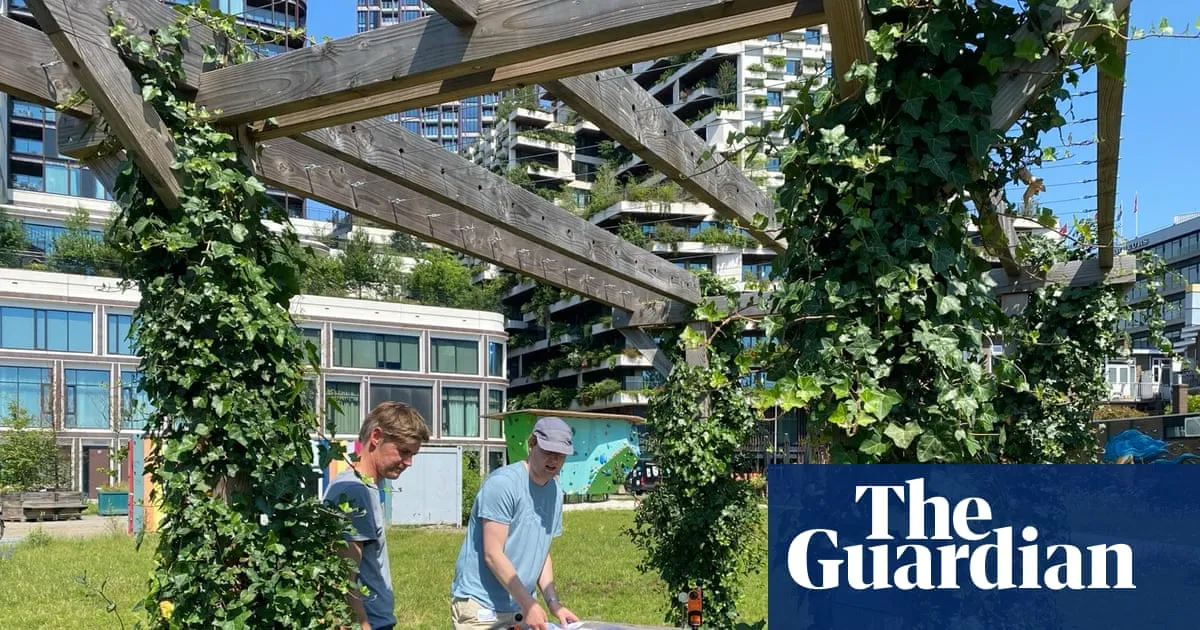
Households in Amsterdam are being urged to hang their curtains outside their windows as health experts recommend simple hacks to moderate the heatwave rolling across the Netherlands, where homes were built for old-fashioned damp and coldish northern European weather.In a viral social media post last week, Eline Coolen, the heat coordinator at the city’s public health institute, urged sweaty city-dwellers to rig up temporary curtain rails or drape curtains or sheets outside to stop the sun’s rays reaching their large windows.The government, meanwhile, has activated a national heatwave plan, with advice on caring for elderly and vulnerable people, and researchers are trialling everything from fake trees to shadow art to cool down pavements and pedestrians.“In Dutch houses, but also in many houses in northern Europe, you have very big windows,” said Coolen. “We have always built for the winter, when you want as much sun and warmth in your house as possible.“But every year in Amsterdam alone, 110 people die because of the heat – and that could rise to as many as 600 in the future without serious measures.”People seek out shade in the garden of the Rijksmuseum in Amsterdam. Photograph: ANP/ShutterstockInspired by the sheets that appear draped over windows in Amsterdam-Noord, where she lives, and a recent trip to Barcelona where people mounted blinds on their balconies, she urged people online to make DIY adjustments – because if you can stop the sun touching your windows, there will be less heat transfer into your house.It’s a matter of physics, according to Bert Blocken, a professor of mechanical engineering at Heriot-Watt University, who believes in alternatives to energy-guzzling air conditioning.“Most of the time we spend indoors, even on very beautiful, sunny days, because we’re working or we’re sleeping, when we also recover from heatwaves,” he said.“We need to keep our buildings cool, ideally without active cooling devices. The climate adaptation of individual buildings is important but still today, many are built with large, glazed facades that generate a lot of heat.”People cool off in the water in Amsterdam’s city centre. Photograph: ANP/ShutterstockA huge body of research showed the best way to keep a building cool was simply to keep out the sun, he said. If architects considered a textile striped canopy ugly, there were modern, retractable outdoor blinds.“The ancient Egyptians, Greeks and Romans did this tens of centuries ago, but sometimes we’re very good at forgetting lessons from the past,” Blocken said. “If I were mayor, my first executive order would be to apply exterior solar shading on all buildings.”There are three levels of action, according to RIVM, the Netherlands’ national public health institute: behaviour, housing and urban design. Werner Hagens, coordinator of the Dutch heatwave plan, said new research had shown that simple awareness campaigns appeared to reduce deaths during heatwaves.“You can make changes in the area, more green spaces, you can make changes in the building, like screens and maybe other cooling mechanisms, but you can also give perspectives on how people inside them can minimise heat,” he said. “These temperatures can form a risk for people in vulnerable health … and it reduces the risks.”A study by the homeowner association Vereniging Eigen Huis found that 23% of people surveyed felt their homes were too hot in a heatwave, although four in five had tried to do what they could to cool them down.Blocken said that while building owners could whitewash flat roofs and invest in outside blinds, greenery was key: not only green roofs and facades, but large parks, trees and green spaces.Fake trees, pergolas covered with greenery and mobile “jungle blocks” can all help pedestrians stay cool and even slightly moderate temperatures, according to Jeroen Kluck, a professor of climate resilient cities at the Amsterdam University of Applied Sciences.“There’s always a reason not to do it: there’s limited public space, there’s no more money,” he said. “But it makes the city more attractive, liveble on hot days and it increases biodiversity. If you make shadow, with a nice place to sit underneath and plants that can survive a bit of drought, it all helps.”Sandra Phlippen, an economist and head of climate strategy at ABN Amro, said it made economic sense for local governments and businesses to invest. “One night of sleep loss [costs] close to €200 [£173],” she said.“Imagine a street where there are 100 people living, everybody sleeps terribly for three nights because of a heatwave and the next day they’re unproductive. That’s your investment in trees for the whole year.”
SRCThe Guardian - World News
LANGEN
LEANCenter-Left
WORDS747
ENT10
MON · 2026-06-22 · 04:00 GMTBRIEF NSR-2026-0622-86299
NSR-2026-0622-86299News Report·EN·Public Health
From mobile jungles to shadow art: how Dutch people try to beat the heat
The Netherlands is implementing a national heatwave plan to combat rising summer temperatures, as homes built for cooler climates struggle to cope. Health experts in Amsterdam are advising residents to hang curtains outside windows to block sunlight and reduce indoor heat.
Senay Boztas in AmsterdamThe Guardian - World NewsFiled 2026-06-22 · 04:00 GMTLean · Center-LeftRead · 3 min
The Guardian - World NewsFIG 01
Reading time
3min
Word count
747words
Sources cited
3cited
Entities identified
10entities
Quality score
100%
§ 01
Briefing Summary
AI-generatedNEWSAR · AI
The Netherlands is implementing a national heatwave plan to combat rising summer temperatures, as homes built for cooler climates struggle to cope. Health experts in Amsterdam are advising residents to hang curtains outside windows to block sunlight and reduce indoor heat. Researchers are also exploring innovative solutions like fake trees and shadow art to cool public spaces. The Dutch government is focusing on behavioral changes, housing adaptations, and urban design to mitigate heat risks, particularly for vulnerable populations. Experts emphasize that preventing sun from entering buildings and increasing green spaces are effective, low-tech strategies to adapt to hotter weather.
Confidence 0.90Sources 3Claims 5Entities 10
§ 02
Article analysis
Model · rule-basedFraming
Public Health
Human Interest
Tone
Measured
AI-assessed
CalmNeutralAlarmist
Factuality
0.70 / 1.00
Factual
LowHigh
Sources cited
3
Well sourced
FewMany
§ 03
Key claims
5 extracted01
Keeping buildings cool without active cooling devices is ideal, according to a professor of mechanical engineering.
quoteBert Blocken
Confidence
1.00
02
In Amsterdam alone, 110 people die because of the heat annually, a number that could rise to 600.
statisticEline Coolen
Confidence
0.90
03
Households in Amsterdam are urged to hang curtains outside to moderate the heatwave.
factualEline Coolen
Confidence
0.90
04
Simple awareness campaigns have been shown to reduce deaths during heatwaves.
factualWerner Hagens
Confidence
0.80
05
Homes in the Netherlands were built for damp and coldish northern European weather.
factual
Confidence
0.80
§ 04
Full report
3 min read · 747 words§ 05
Entities
10 identifiedKey playerOppositionContextPositiveNeutralNegative
Organizations4
Events1
§ 06
Keywords & salience
10 termsheatwave
1.00
climate adaptation
0.90
cooling strategies
0.80
building design
0.70
passive cooling
0.70
urban heat
0.60
amsterdam
0.50
netherlands
0.50
diy solutions
0.40
public health
0.40
§ 07
Topic connections
Interactive graph Network visualization showing 12 related topics
View Full Graph Person Organization Location Event|Click node to navigate|Edge numbers = shared articles