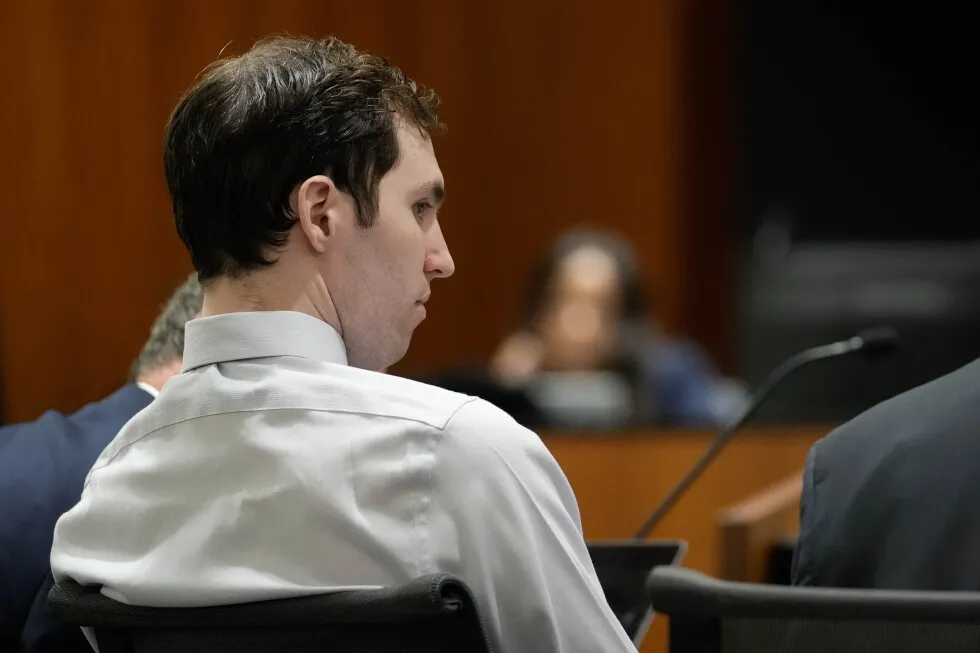
Judge in Charlie Kirk killing case to decide if prosecutors could be punished for comments in media 1 of 2 | Tyler Robinson, accused in the fatal shooting of Charlie Kirk, appears during a hearing in 4th District Court in Provo, Utah, on Friday, June 12, 2026. (Francisco Kjolseth /The Salt Lake Tribune via AP, Pool) 2 of 2 | Fourth District Court Judge Tony Graf in Provo listens during a hearing for Tyler Robinson, accused in the fatal shooting of Charlie Kirk, in 4th District Court in Provo, Utah, on Friday, June 12, 2026. (Francisco Kjolseth /The Salt Lake Tribune via AP, Pool) By MATTHEW BROWN and REBECCA BOONE Updated 6:21 AM MESZ, June 22, 2026 Add AP News on Google Add AP News as your preferred source to see more of our stories on Google. Share Share Facebook Copy Link copied Print Email X LinkedIn Bluesky Flipboard Pinterest Reddit The Utah judge in the murder case over Charlie Kirk’s killing says he will rule Monday whether prosecutors could face sanctions for comments to the media about a bullet fragment recovered from the conservative activist’s body. Lawyers for defendant Tyler Robinson have asked Judge Tony Graf to block the death penalty in the case, claiming the prosecutors’ comments could sway potential jurors regarding his guilt. But criminal law expert Paul Cassell said it would be extraordinary for Graf to grant the defense request. Their concerns could be addressed in other ways, such as more closely questioning jurors to ensure they aren’t biased, the Utah" class="entity-link entity-organization" data-entity-id="26667" data-entity-type="organization">University of Utah law professor said. “A standard defense attorney maneuver is to avoid talking about the guilt or innocence of your client. The theory is that as long as you’re talking about anything other than whether the defendant is guilty, you’re winning as a defense attorney,” Cassell said. “This seems to be an extreme example of that.” Representatives of the Utah-county-attorneys-office" class="entity-link entity-organization" data-entity-id="150424" data-entity-type="organization">Utah County Attorney’s Office said they were compelled to speak publicly about the case following speculation in some media outlets. More coverage Utah campus where Charlie Kirk was shot provided less security than other venues as he toured nation A timeline of Charlie Kirk’s assassination and the arrest of a suspect Charlie Kirk’s AI resurrection ushers in a new era of digital grief 19 The speculation began after the defense team publicly disclosed that initial tests were inconclusive to determine whether the bullet was fired from the suspected murder weapon. Conjecture over the evidence in Kirk’s killing has fueled unsubstantiated conspiracy theories that there might have been a second shooter, or that his death was staged. The case has attracted enormous media attention and concerns from both sides about misinformation tainting the potential jury pool. Robinson has not yet entered a plea. Prosecutors have said they intend to seek the death penalty if he is convicted. The 23-year-old from southwestern Utah is charged with aggravated murder in the Sept. 10 killing of Kirk, a close ally of President Donald Trump who was shot in the neck while addressing a crowd of thousands at Utah Valley University. Judge Graf held a hearing last week over whether prosecutors should be held in contempt for their comments about the bullet. Robinson’s attorneys accused prosecutors including Deputy Utah County Attorney Christopher Ballard of trying to influence potential jurors by going on a “media tour” to talk about ballistics evidence in the case. Ballard argued at the June 12 hearing that he didn’t speak to the media about case specifics, and he only remarked generally about how ballistics testing can be inconclusive. The defense team also pointed to another Utah criminal case in which prosecutors were accused of contempt and suggested that one potential remedy would be to bar the state from seeking the death penalty. While the judge in that earlier case disagreed that an order barring the death penalty was merited, Robinson’s attorneys noted that “the court did not conclude that such a remedy was beyond its authority where the facts support it.” A key hearing in Robinson’s case is scheduled for July 6-10, when prosecutors must show they have enough evidence to warrant a trial. Brown reported from Denver and Boone from Boise, Idaho. Associated Press reporter Hannah Schoenbaum contributed from Salt Lake City. MATTHEW BROWN Brown is based in Billings, Montana. He covers breaking news, the environment, politics, energy, crime and more. REBECCA BOONE Boone is a correspondent who covers breaking news, the courts, accountability issues and more for The Associated Press. She is based in Boise, Idaho. twitter mailto
SRCAssociated Press (AP)
LANGEN
LEANCenter
WORDS754
ENT12
MON · 2026-06-22 · 08:23 GMTBRIEF NSR-2026-0622-86340
NSR-2026-0622-86340News Report·EN·Legal & Judicial
Judge in Charlie Kirk killing case to decide if prosecutors could be punished for comments in media
A Utah judge will decide whether prosecutors in the Charlie Kirk killing case should face sanctions for comments made to the media regarding a bullet fragment. The defense for accused shooter Tyler Robinson is asking the judge to block the death penalty, arguing the prosecutors' statements could prejudice potential jurors.
Associated Press (AP)Filed 2026-06-22 · 08:23 GMTLean · CenterRead · 4 min
Associated Press (AP)FIG 01
Reading time
4min
Word count
754words
Sources cited
1cited
Entities identified
12entities
Quality score
100%
§ 01
Briefing Summary
AI-generatedNEWSAR · AI
A Utah judge will decide whether prosecutors in the Charlie Kirk killing case should face sanctions for comments made to the media regarding a bullet fragment. The defense for accused shooter Tyler Robinson is asking the judge to block the death penalty, arguing the prosecutors' statements could prejudice potential jurors. Prosecutors claim they were compelled to speak due to media speculation, particularly concerning inconclusive ballistics tests that fueled conspiracy theories. Legal experts suggest it would be unusual for the judge to grant the defense's request, proposing alternative methods like enhanced juror questioning to address bias concerns. A ruling on the sanctions is expected soon, with a key hearing scheduled for July to determine if there is sufficient evidence for a trial.
Confidence 0.90Sources 1Claims 5Entities 12
§ 02
Article analysis
Model · rule-basedFraming
Legal & Judicial
Political Strategy
Tone
Mixed Tone
AI-assessed
CalmNeutralAlarmist
Factuality
0.70 / 1.00
Factual
LowHigh
Sources cited
1
Limited
FewMany
§ 03
Key claims
5 extracted01
Prosecutors stated they were compelled to speak publicly due to media speculation.
factualUtah County Attorney's Office
Confidence
1.00
02
An expert called it an 'extraordinary' request for the judge to grant the defense's motion.
quotePaul Cassell
Confidence
1.00
03
Defense lawyers asked the judge to block the death penalty, citing prosecutors' comments to the media.
factual
Confidence
1.00
04
A judge will rule on whether prosecutors can be punished for media comments in the Charlie Kirk killing case.
factual
Confidence
1.00
05
Conjecture over evidence has fueled conspiracy theories about a second shooter or a staged death.
factual
Confidence
0.90
§ 04
Full report
4 min read · 754 words§ 05
Entities
12 identifiedKey playerOppositionContextPositiveNeutralNegative
People4
Organizations5
§ 06
Keywords & salience
9 termsprosecutorial misconduct
1.00
death penalty case
0.90
media comments
0.80
jury bias
0.70
legal sanctions
0.60
bullet fragment
0.50
murder case
0.50
tyler robinson
0.40
charlie kirk
0.40
§ 07
Topic connections
Interactive graph Network visualization showing 6 related topics
View Full Graph Person Organization Location Event|Click node to navigate|Edge numbers = shared articles