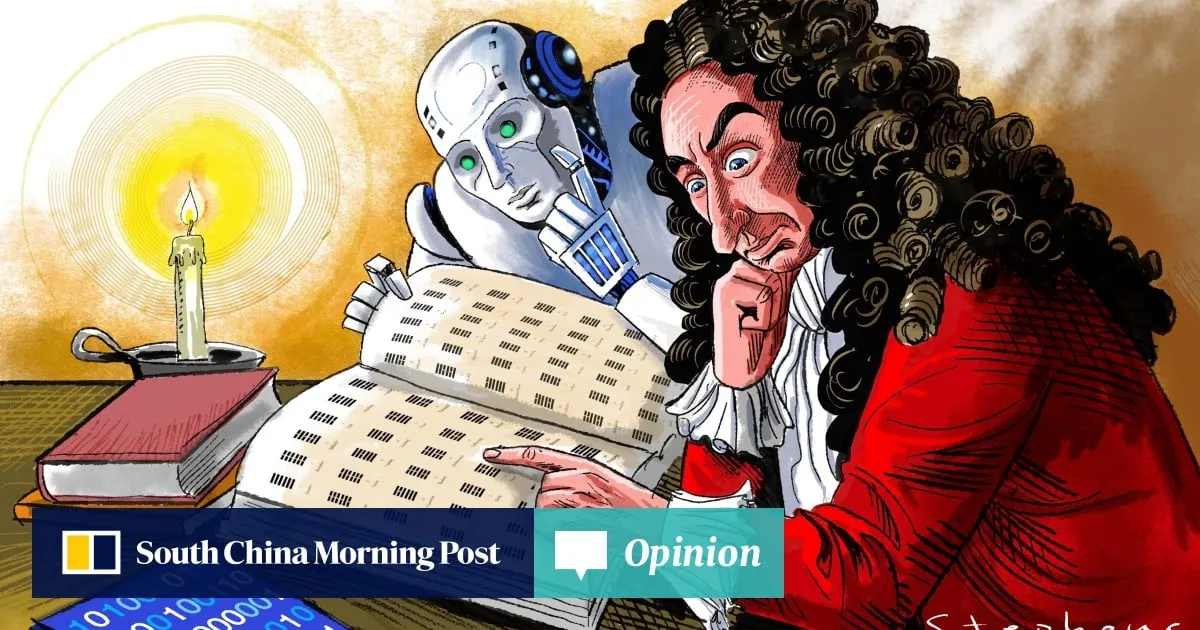
The advent of Artificial Intelligence (AI) appears sudden and revolutionary, yet its origins stretch deep into history, revealing a profound and forgotten intellectual exchange between China and the West.Long before Alan Turing, Claude Shannon, or even Charles Babbage and Ada Lovelace, there was Gottfried Wilhelm Leibniz – the German polymath born exactly 380 years ago next week. Among his monumental contributions to science is the binary numeral system, which serves as the bedrock of modern computing, AI and even DNA biology.Leibniz developed a “new” form of mathematics that uses only the digits 0 and 1 while designing a mechanical calculator. However, he struggled to convince his European peers that a two-digit system held any deep significance.
SRCSouth China Morning Post
LANGEN
LEANCenter-Right
WORDS116
ENT12
TUE · 2026-06-23 · 01:00 GMTBRIEF NSR-2026-0623-86545
NSR-2026-0623-86545Analysis·EN·Technology
The I Ching, Leibniz and AI: how old China-West links shaped modern science
Artificial intelligence (AI), while appearing revolutionary, has historical roots in an intellectual exchange between China and the West. Gottfried Wilhelm Leibniz, a German polymath, developed the binary numeral system, which uses only 0 and 1.
Chow Chung-yanSouth China Morning PostFiled 2026-06-23 · 01:00 GMTLean · Center-RightRead · 1 min
South China Morning PostFIG 01
Reading time
1min
Word count
116words
Sources cited
0cited
Entities identified
12entities
Quality score
100%
§ 01
Briefing Summary
AI-generatedNEWSAR · AI
Artificial intelligence (AI), while appearing revolutionary, has historical roots in an intellectual exchange between China and the West. Gottfried Wilhelm Leibniz, a German polymath, developed the binary numeral system, which uses only 0 and 1. This system is fundamental to modern computing, AI, and DNA biology. Leibniz created this system while designing a mechanical calculator, but he faced difficulty convincing his European contemporaries of its importance. This forgotten exchange highlights how ancient Chinese ideas influenced Western scientific advancements that underpin contemporary technologies.
Confidence 0.85Claims 4Entities 12
§ 02
Article analysis
Model · rule-basedFraming
Technology
Human Interest
Tone
Measured
AI-assessed
CalmNeutralAlarmist
Factuality
0.70 / 1.00
Factual
LowHigh
Sources cited
0
No named sources
FewMany
§ 03
Key claims
4 extracted01
Gottfried Wilhelm Leibniz developed the binary numeral system, which is the bedrock of modern computing and AI.
factual
Confidence
0.95
02
Leibniz designed a mechanical calculator using a two-digit system (0 and 1).
factual
Confidence
0.90
03
The advent of artificial intelligence (AI) has origins stretching deep into history, revealing an intellectual exchange between China and the West.
factual
Confidence
0.90
04
Leibniz struggled to convince his European peers of the significance of a two-digit system.
factual
Confidence
0.85
§ 04
Full report
1 min read · 116 words§ 05
Entities
12 identifiedKey playerOppositionContextPositiveNeutralNegative
People5
§ 06
Keywords & salience
8 termsartificial intelligence
1.00
binary numeral system
0.90
gottfried wilhelm leibniz
0.80
china-west intellectual exchange
0.70
modern computing
0.60
i ching
0.50
dna biology
0.40
mechanical calculator
0.40
§ 07
Topic connections
Interactive graph No topic relationship data available yet. This graph will appear once topic relationships have been computed.