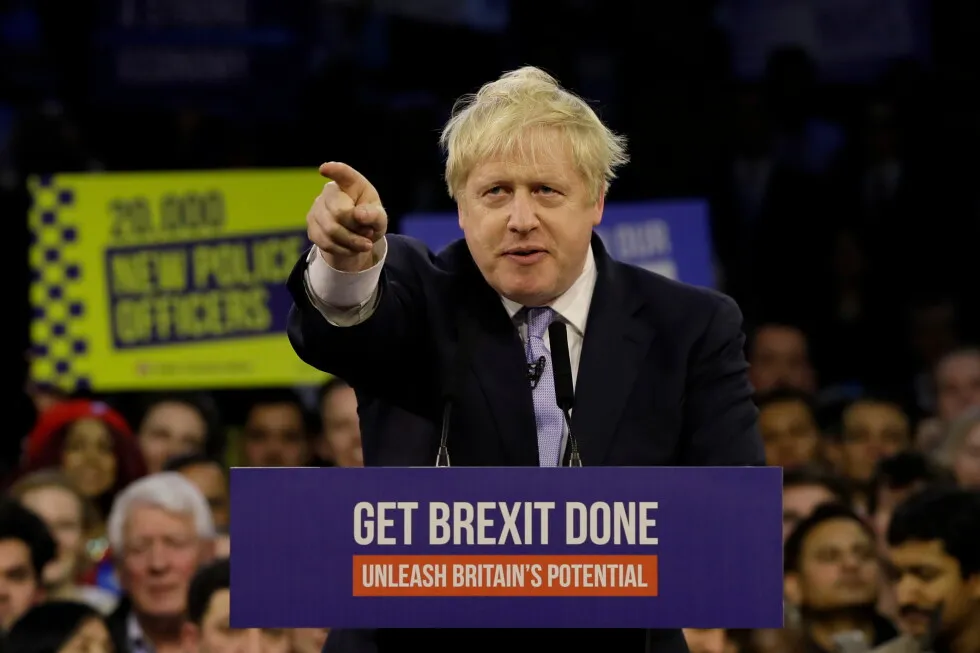
How Brexit broke British politics 0 seconds of 2 minutes, 31 secondsVolume 0% Press shift question mark to access a list of keyboard shortcuts Keyboard ShortcutsEnabledDisabled Shortcuts Open/Close/ or ? Play/PauseSPACE Increase Volume↑ Decrease Volume↓ Seek Forward→ Seek Backward← Captions On/Offc Fullscreen/Exit Fullscreenf Mute/Unmutem Decrease Caption Size- Increase Caption Size+ or = Seek %0-9 Next Up Keir Starmer announces resignation as Prime Minister and Labour Party Leader 01:55 Subtitle Settings OffEnglish(US)_v Font Color White Font Opacity 100% Font Size 100% Font Family Arial Character Edge None Edge Color Black Background Color Black Background Opacity 50% Window Color Black Window Opacity 0% Reset WhiteBlackRedGreenBlueYellowMagentaCyan 100%75%50%25% 200%175%150%125%100%75%50% ArialCourierGeorgiaImpactLucida ConsoleTahomaTimes New RomanTrebuchet MSVerdana NoneRaisedDepressedUniformDrop Shadow WhiteBlackRedGreenBlueYellowMagentaCyan WhiteBlackRedGreenBlueYellowMagentaCyan 100%75%50%25%0% WhiteBlackRedGreenBlueYellowMagentaCyan 100%75%50%25%0% 00:00 02:31 02:31 More Videos 01:55 Keir Starmer announces resignation as Prime Minister and Labour Party Leader 00:48 Keir Starmer announces his resignation as Prime Minister and Leader of the Labour Party 03:25 Profile UK Prime Minister Keir Starmer 01:49 Starmer says he'll resign as UK prime minister with Burnham confirming he will try to succeed him 00:49 Labour’s Andy Burnham wins a UK special election, setting up a likely push to oust Prime Minister Keir Starmer 00:49 Labour’s Andy Burnham wins a UK special election, setting up a likely push to oust Prime Minister Keir Starmer 02:23 Who is Andy Burnham, the lawmaker seeking to replace Keir Starmer? 02:23 Who is Andy Burnham, the lawmaker seeking to replace Keir Starmer? Close 1 of 6 | Britain is about to get its seventh prime minister in a single decade. On Monday, Keir Starmer announced his resignation, forced out by his own party after just two years and marking the sixth time a leader has given a farewell speech outside 10 Downing Street since 2016. (AP Production: Marissa Duhaney) 2 of 6 | Britain’s Prime Minister Boris Johnson speaks during his ruling Conservative Party’s final election campaign rally at the Copper Box Arena in London, Wednesday, Dec. 11, 2019. (AP Photo/Kirsty Wigglesworth, File) 3 of 6 | British conservative lawmaker Anna Soubry, centre, who campaigned to remain in the European Union during referendum debates, reacts with pro-Brexit protesters outside parliament in London, Thursday Jan. 10, 2019. (AP Photo/Alastair Grant, File) 4 of 6 | Britain’s Prime Minister Liz Truss announces her resignation as Prime Minister and leader of the Conservative Party, in Downing Street in London, Thursday, Oct. 20, 2022. (AP Photo/Alberto Pezzali, File) 5 of 6 | FILE- Anti Brexit campaigner Steve Bray walks on the beach to pose for a photograph during the Labour Party Conference at the Brighton Centre in Brighton, England, Monday, Sept. 23, 2019. (AP Photo/Kirsty Wigglesworth, File) 6 of 6 | Britain’s Prime Minister Keir Starmer speaks to the media outside 10 Downing Street to announce his resignation in London, Monday, June 22, 2026. (AP Photo/Thomas Krych) By JILL LAWLESS Updated 9:24 AM MESZ, June 23, 2026 Leer en español Add AP News on Google Add AP News as your preferred source to see more of our stories on Google. Share Share Facebook Copy Link copied Print Email X LinkedIn Bluesky Flipboard Pinterest Reddit London (AP) — Brexit fractured the European Union, and broke British politics. The U.K. is about to get its seventh prime minister since June 23, 2016, a decade ago Tuesday, when the country voted 52%-48% to leave the EU after more than four decades of membership. Conservative Prime Minister David Cameron, who called the referendum but campaigned for the U.K. to stay in the bloc, quit the next day. His successors have all grappled, largely unsuccessfully, with the consequences of that rupture. The latest is Labour Prime Minister Keir Starmer, who announced Monday that he was stepping down after two years of a sluggish economy, malfunctioning government and a divided and jaded electorate — all legacies, at least in part, of Brexit. Though the decision has faded from headlines, “the subterranean trace of Brexit” still runs through Britain’s increasingly unruly politics, said Chris Grey, an academic who has studied the fallout from Britain’s EU departure. Campaigners for Brexit promised that leaving the then-28 member political and economic bloc would let the U.K. “take back control” of its laws, economy and borders. While the “remain” campaign focused largely on the economic downsides of exiting, the “leave” side was emotive. “We can see the sunlit meadows beyond. I believe we would be mad not to take this once-in-a-lifetime chance to walk through that door,” Boris Johnson, a leading Brexit campaigner who later became prime minister, said a few weeks before the referendum. How Starmer went from Labour Party hero to calling it quits within 2 years 4 MIN READ A look at the quick succession of British prime ministers in the past 10 years 3 MIN READ How Keir Starmer will be replaced as UK prime minister and will anyone stand against Burnham? 3 MIN READ 67 Margaret MacMillan, emeritus professor of history at the University of Toronto, said Brexit was fueled by a bundle of motives including nostalgia “for an imagined past.” “It was against what people saw as unrestricted immigration. It was against what they saw as EU regulations. And then there was this mix of nostalgia — ‘We fought alone in the Second World War.’ Which was of course not true. “It was never clearly explained what Brexit might entail.” Hard reality soon collided with Brexiteers’ bold promises of immigration controls, trade deals, more money for public services and an end to complex regulations emanating from Brussels. Acrimonious divorce talks dragged on for years. The U.K. formally left the bloc on Jan. 31, 2020, followed by an 11-month transition period until the final split. Prime Minister Theresa May, Cameron’s successor, quit in 2019 after failing to find exit terms acceptable to a divided Parliament. Johnson succeeded May and promised to “get Brexit done,” and managed to secure a bare-bones trade deal after negotiations that left U.K.-EU relations in the deep freeze. He was ousted by the Conservative Party in mid-2022 after mounting financial and ethical scandals. His replacement, Liz Truss, lasted just 49 days in office. Her successor, Rishi Sunak, thawed the frosty EU relationship without making major changes. Starmer promised a “reset, ” but refused to consider rejoining the bloc’s frictionless single market, which was free of tariffs and other trade barriers. As he hands over power, Brexit remains unfinished business. Historian Anthony Seldon said Cameron called the referendum hoping it would end arguments about relations with Europe that had riven the Conservative Party. It didn’t. “The people who obsessed about it still obsess about it. Britain’s problems have continued,” Seldon told Times Radio. During the divorce negotiations, Conservatives who wanted a softer Brexit and closer ties with the EU were pushed out of the party by the triumphant Brexiteer faction. Labour, though much more pro-EU, also has an internal division between those who want to get closer to the bloc or even rejoin, and senior leaders like Starmer who want to avoid reopening old wounds. A decade on, millions of voters have deserted the two big parties for alternatives including the left-leaning Green Party and the hard-right Reform UK led by Nigel Farage. Farage has arguably been the biggest political winner from Brexit. He campaigned for the divorce then complained it had been betrayed. His anti-immigration message has shifted from focusing on Polish plumbers to asylum seekers in dinghies. His party consistently leads opinion polls. The economy has struggled in the past decade, with businesses facing new barriers to trade with Britain’s closest neighbors, though Brexit is not the only cause of low growth. The COVID-19 pandemic, the Russia-Ukraine war and the Iran war also played a part. Through it all, “we just haven’t had politicians who’ve been upfront with the public about the fact that when they get into power, they won’t be able to have no increases in taxes, no increases in debt, and better public services all in the same breath,” said Hannah White, director of the Institute for Government think tank. Brexit failed to ease debate about immigration, which has only become more heightened, regardless of the numbers. Net migration rose after Brexit to more than 900,000 in 2023 before falling to 171,000 last year. Cynicism has grown and trust in politicians has plunged. In recent years, agitators have fueled anti-immigration street violence following crimes committed by, or falsely reported to have been committed by, immigrants. In the past, Britain had a firm barrier “between the conventional dominant politics of talk and argument, and what was seen as beyond the pale: violence on the streets,” Grey said. “I think that boundary is being eroded. And I think that did to some large extent begin with Brexit.” Polls suggest a degree of “Bregret” about Britain’s choice a decade ago, with a recent Ipsos survey finding 52% of people in the U.K. would like to rejoin the EU while 33% oppose it. Hundreds of people, many waving blue and yellow EU flags, marched through London on Saturday on a “rejoin” march. It was a much smaller turnout than the mass protests on both sides at the height of the Brexit drama. Many people just want to move on. But Brexit remains a minefield that politicians fear to enter. Even if Britain wanted to rejoin, it would be a long road back to a wary EU. Grey said that until politicians are willing to face the legacy of Brexit, Britain faces an “undertow of low-grade crisis.” He likened the U.K. to a person with a nagging illness that saps their energy. “A chronic thing, in this case perhaps not incurable,” he said. “But it’s just that they don’t fancy going to the doctor because they know it’s not going to be very nice.” JILL LAWLESS Lawless is based in London, covering British politics, diplomacy and culture and top stories from the UK and beyond. She has reported for the AP from two dozen countries on four continents. twitter mailto
SRCAssociated Press (AP)
LANGEN
LEANCenter
WORDS1 659
ENT11
TUE · 2026-06-23 · 06:23 GMTBRIEF NSR-2026-0623-86597
NSR-2026-0623-86597Analysis·EN·Political Strategy
Britain left the EU 10 years ago. Its politics has been an unruly mess ever since
Ten years after the UK voted to leave the European Union, British politics remains in a state of disarray. The decision to exit the EU in 2016 has led to significant political instability, with the UK set to have its seventh prime minister since the referendum.
Associated Press (AP)Filed 2026-06-23 · 06:23 GMTLean · CenterRead · 7 min
Associated Press (AP)FIG 01
Reading time
7min
Word count
1 659words
Sources cited
0cited
Entities identified
11entities
Quality score
100%
§ 01
Briefing Summary
AI-generatedNEWSAR · AI
Ten years after the UK voted to leave the European Union, British politics remains in a state of disarray. The decision to exit the EU in 2016 has led to significant political instability, with the UK set to have its seventh prime minister since the referendum. Successive leaders have struggled to manage the consequences of Brexit, contributing to a sluggish economy, governmental dysfunction, and a divided electorate. The Brexit campaign, fueled by promises of regaining control and a sense of nostalgia, tapped into public discontent. However, the reality of leaving the EU has presented challenges, including new trade barriers and ongoing political divisions within both major parties. This has resulted in increased voter cynicism and a decline in trust in politicians, with some polls now indicating regret over the decision to leave the EU.
Confidence 0.90Claims 4Entities 11
§ 02
Article analysis
Model · rule-basedFraming
Political Strategy
Human Interest
Tone
Mixed Tone
AI-assessed
CalmNeutralAlarmist
Factuality
0.60 / 1.00
Mixed
LowHigh
Sources cited
0
No named sources
FewMany
§ 03
Key claims
4 extracted01
Six times a leader has given a farewell speech outside 10 Downing Street since 2016.
factual
Confidence
1.00
02
Keir Starmer announced his resignation, forced out by his own party after just two years.
factual
Confidence
1.00
03
Britain is about to get its seventh prime minister in a single decade.
factual
Confidence
1.00
04
Brexit broke British politics.
factual
Confidence
0.80
§ 04
Full report
7 min read · 1 659 words§ 05
Entities
11 identifiedKey playerOppositionContextPositiveNeutralNegative
People4
Organizations3
Events1
§ 06
Keywords & salience
10 termsbritish politics
1.00
brexit
1.00
prime minister
0.90
keir starmer
0.80
labour party
0.70
political instability
0.60
boris johnson
0.60
resignation
0.50
european union
0.40
political leadership
0.40
§ 07
Topic connections
Interactive graph Network visualization showing 51 related topics
View Full Graph Person Organization Location Event|Click node to navigate|Edge numbers = shared articles