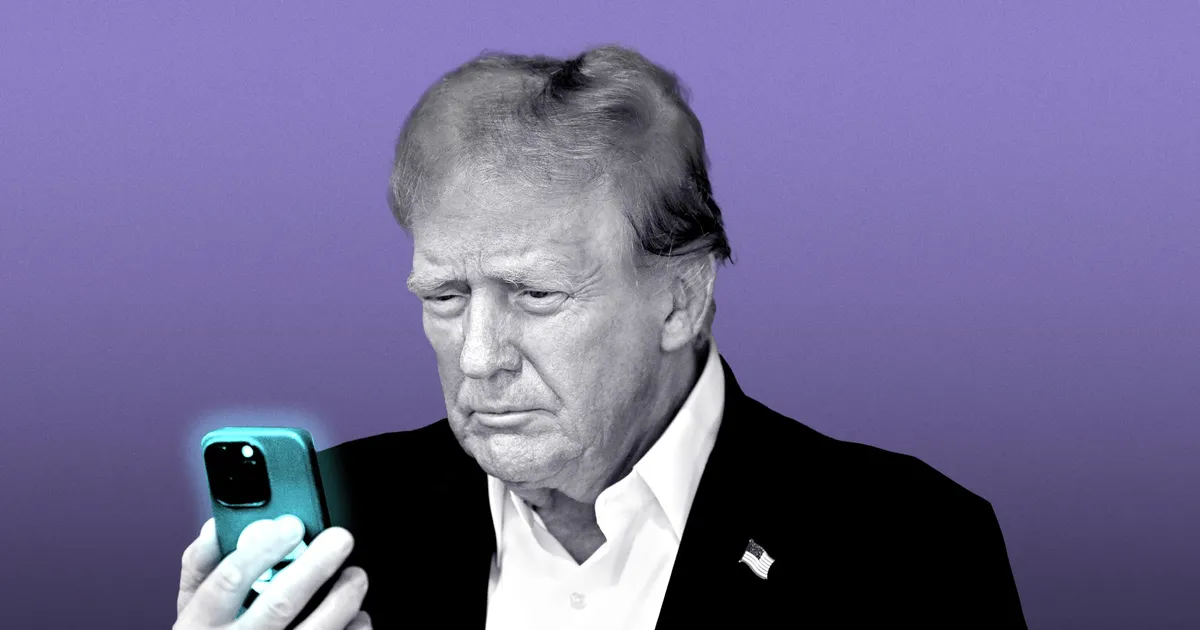
Photo illustration by Shoshana Gordon/ProPublica. Source image: Clive Mason/Getty Images. My family’s morning routine is usually pretty ordinary. We wake up early, drink some coffee and get our 1-year-old ready for daycare. But one Wednesday morning last month, I found myself uttering to my wife a sentence that sounded frankly surreal to both of us: “Just to let you know, I’m about to call Trump.” Then, hoping to avoid any urgent diaper events, I ducked into the next room and dialed up the president. I’d been trying to reach President Donald Trump for a few days. Each time, my heart would start pounding. After nearly two decades as a journalist, I’m reasonably used to talking to powerful people. But cold-calling the president of the United States — on his personal cellphone — made me feel like a cub reporter all over again. “Hello?” a voice said on the other end of the line. This time, the president had picked up. I introduced myself and told Trump I’m a reporter with ProPublica. “I’m writing a story about a big supporter of yours in the oil industry, Jeff Hildebrand,” I said. “Can I ask what you think about him?” By this point I had spent months reporting on Hildebrand, a little-known billionaire — and major Trump donor — who owns an empire of low-producing oil and gas wells across the country. “Stripper wells” like these contribute relatively little to the U.S. energy supply but emit vast amounts of Methane, a highly potent greenhouse gas. By calling the president, I was hoping for some color on his relationship with Hildebrand. He had, after all, named Hildebrand’s wife ambassador to Costa Rica. My reporting so far had also revealed that the administration was gathering advice from oil industry groups backed by Hildebrand, and that it planned to weaken environmental regulations on stripper wells — potentially making Hildebrand even richer. “I hear he does a good job,” Trump replied. “Don’t know him very well. OK?” Trump Plans to Protect Methane-Leaking Stripper Wells. This Billionaire Donor Will Benefit. At first I thought the exchange undermined my story, making Hildebrand seem less central to the president’s energy policies than I’d suspected. But I realized that Trump’s comments illustrated something important about how this administration works. Trump appeared to have little clue about Hildebrand’s business, but when I mentioned that it was threatened by the “Methane-rules" class="entity-link entity-topic" data-entity-id="151261" data-entity-type="topic">Biden Methane rules,” the president was quick to respond, “Certainly we do the opposite of what Biden did.” Trump, in other words, may be only vaguely aware of the people and groups helping to rewrite all manner of consequential policies. But what matters in Washington right now are not so much technical policy details but support for the president and an affinity with the broader ideological project: Deregulate everything. Even if the president is only loosely familiar with Hildebrand, the oil tycoon is someone you should know about. As a climate reporter, I’m always looking for ways to make the seemingly abstract problem of global warming feel more concrete, approachable and even personal. With Hildebrand, I felt I had found a compelling character who is also the poster boy for a hugely consequential issue: Stripper wells collectively contribute just 6% of the nation’s oil and gas, but scientists have found they’re responsible for roughly half the sector’s Methane pollution. That means they play an outsize role in climate change, which is amplifying heat waves, droughts and wildfires. My previous reporting has shown that a former lobbyist for Hildebrand’s company — who now has a top post at the Environmental Protection Agency — has been rewriting Methane regulations with advice from the oil industry. (An EPA spokesperson said the official “fulfilled all his ethical obligations to the letter.”) The EPA’s press office declined to comment on the details of its plans but confirmed it is working on a proposal to “provide relief” to the oil industry, saying in a statement, “We heard consistently from American oil and natural gas producers (shocker that we meet with stakeholders) that the Biden-Harris Administration’s oil and gas Methane regulations were unworkable and unnecessarily restricted American energy dominance.” In the story we ultimately published , I took a deep dive into how Hildebrand made his fortune, racking up dozens of environmental violations across the country, and now stands to benefit from the rollback that his former lobbyist is carrying out. I asked Hildebrand multiple times for an interview, even sending a letter to his home, but he didn’t respond. A spokesperson for his company, Hilcorp, said its operations complied with state and federal rules, adding that Hilcorp was “proud” of recent efforts to reduce its Methane emissions. As with many climate change stories, it can all sound pretty bleak. But in a world where global warming fixes can seem impossibly daunting, limiting Methane pollution from stripper wells is the rare low-hanging fruit, Andrew Logan of Ceres, a climate advocacy group, told me. “If you could lose 6% of production and cut emissions in half, who wouldn’t make that trade?” Logan said. Instead, the Trump administration is doubling down on the forms of energy that contribute most to global warming. In January, the president invited Hildebrand and two dozen other energy executives to the White House to discuss investing in Venezuela’s decrepit oil industry — which emits more Methane, relative to production, than almost any other major oil producing country, according to the International Energy Agency. Many of the executives couched their enthusiasm with caveats. ExxonMobil’s CEO called Venezuela “uninvestable” without changes to its legal system. The head of ConocoPhillips wanted U.S. government financing. But Hildebrand had already seen how loyalty could be rewarded. Even though he had no notable operations outside the U.S., he hunched toward a microphone and said in a halting voice, “Hilcorp is fully committed and ready to go to rebuilding the infrastructure in Venezuela.” “That’s good,” Trump said. “You’ll be very happy.” The post I Cold-Called President Trump. Here’s What He Told Me About an Oil Tycoon and Major Donor. appeared first on ProPublica .
SRCProPublica
LANGEN
LEANCenter-Left
WORDS1 010
ENT7
TUE · 2026-06-23 · 09:00 GMTBRIEF NSR-2026-0623-86688
NSR-2026-0623-86688News Report·EN·Environmental
I Cold-Called President Trump. Here’s What He Told Me About an Oil Tycoon and Major Donor.
A ProPublica reporter cold-called President Trump to ask about major donor and oil tycoon Jeff Hildebrand, who owns numerous low-producing "stripper wells" that emit significant methane. Trump stated he didn't know Hildebrand well but would do the opposite of Biden's methane rules, suggesting policy decisions are influenced by general support and deregulation ideology rather than specific knowledge of donors' businesses.
Alex CuadrosProPublicaFiled 2026-06-23 · 09:00 GMTLean · Center-LeftRead · 5 min
ProPublicaFIG 01
Reading time
5min
Word count
1 010words
Sources cited
1cited
Entities identified
7entities
Quality score
100%
§ 01
Briefing Summary
AI-generatedNEWSAR · AI
A ProPublica reporter cold-called President Trump to ask about major donor and oil tycoon Jeff Hildebrand, who owns numerous low-producing "stripper wells" that emit significant methane. Trump stated he didn't know Hildebrand well but would do the opposite of Biden's methane rules, suggesting policy decisions are influenced by general support and deregulation ideology rather than specific knowledge of donors' businesses. The article details how Hildebrand's former lobbyist, now at the EPA, is involved in weakening methane regulations on stripper wells, which could benefit Hildebrand financially. Despite Hildebrand's company's environmental violations and the significant methane pollution from stripper wells, the Trump administration is reportedly planning to "provide relief" to the oil industry.
Confidence 0.90Sources 1Claims 5Entities 7
§ 02
Article analysis
Model · rule-basedFraming
Environmental
Political Strategy
Tone
Mixed Tone
AI-assessed
CalmNeutralAlarmist
Factuality
0.60 / 1.00
Mixed
LowHigh
Sources cited
1
Limited
FewMany
§ 03
Key claims
5 extracted01
Trump stated he doesn't know Hildebrand very well but hears he does a good job.
quoteDonald Trump
Confidence
1.00
02
Stripper wells contribute little to U.S. energy supply but emit vast amounts of methane.
factual
Confidence
0.90
03
Jeff Hildebrand is a major Trump donor and owns an empire of low-producing oil and gas wells.
factual
Confidence
0.90
04
Trump indicated a willingness to reverse Biden's methane rules.
quoteDonald Trump
Confidence
0.90
05
The Trump administration was gathering advice from oil industry groups backed by Hildebrand and planned to weaken environmental regulations on stripper wells.
factual
Confidence
0.80
§ 04
Full report
5 min read · 1 010 words§ 05
Entities
7 identifiedKey playerOppositionContextPositiveNeutralNegative
Organizations1
§ 06
Keywords & salience
9 termsjeff hildebrand
1.00
donald trump
1.00
oil industry
0.90
stripper wells
0.90
methane emissions
0.80
environmental regulations
0.70
major donor
0.60
propublica
0.50
energy policy
0.40
§ 07
Topic connections
Interactive graph Network visualization showing 51 related topics
View Full Graph Person Organization Location Event|Click node to navigate|Edge numbers = shared articles