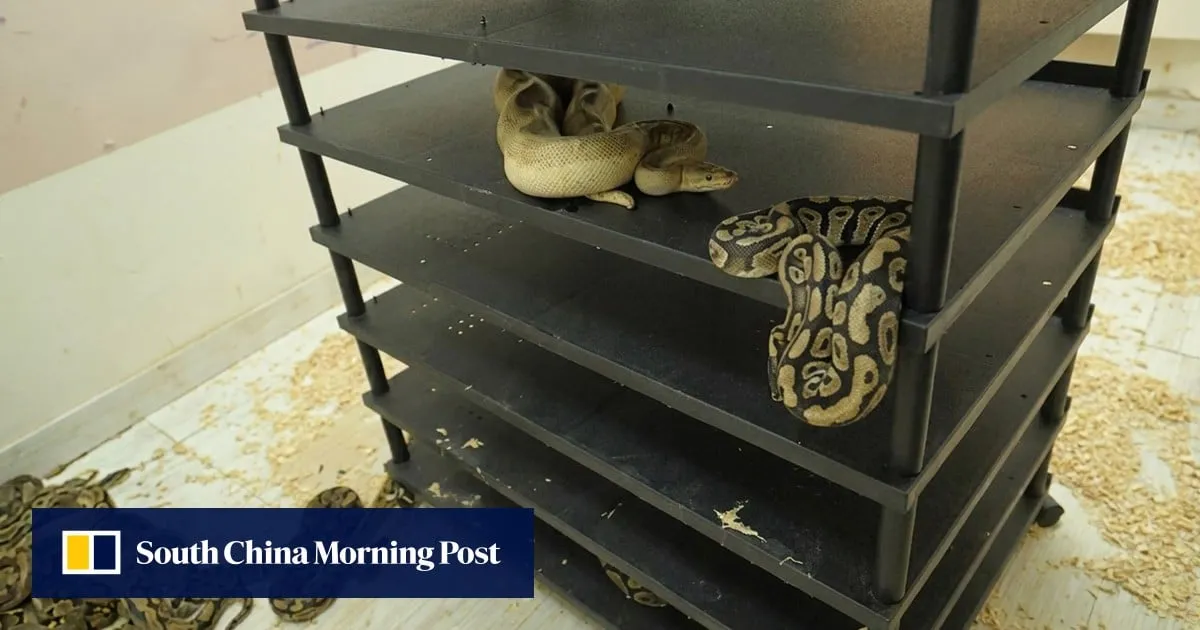
A man living alone in eastern China was sentenced to jail for breeding over 300 pythons at home.This shocking incident was revealed by state media CCTV in late June as a case of “serious” harm to rare and endangered wildlife.pythons are classified as Grade Two protected animals in China, and laws prohibit the buying, selling, breeding, and transporting of this species without official permission.The violator came to police attention after a senior citizen in Taizhou, Zhejiang province, discovered a large snake at the base of a local mountain in March 2024.The elderly man reported the snake to the authorities, believing the tawny reptile, as thick as an adult’s arm, was unusual for the region.Trimeresurus calamitas, above, positioned defensively on a branch, is a venomous, arboreal snake. Snakes are surging in popularity as pets across China, with an estimated 17.07 million Chinese citizens now keep exotic pets. Photo: ShutterstockOfficers speculated that the snake had escaped from its breeders, as it was not an indigenous species and snakes are generally inactive in the wild during March.A professional snake raiser consulted by the police provided a critical lead: pythons require a consistently warm and humid environment, indicating that their breeder must have used substantial electricity to maintain a temperature of 20–30 degrees Celsius.Police screened nearby residents based on their electricity consumption, ultimately identifying a man, surnamed Guo, as the prime suspect.Guo lived alone, was unmarried, and unemployed.Detectives noted that a man named Di frequently visited Guo.Di often collected parcels from courier stations; these packages contained small white mice bought online.Guo had arranged all his furniture in one bedroom while utilising the other two bedrooms and the living room for his reptiles. Photo: CCTVThe online sellers informed the police that the mice were typically bought to feed reptile pets.Further ReadingGuo had shared photos of snakes on social media, occasionally making indirect references to selling his pythons.A transaction record indicated that Di had sold two pythons to another individual for 1,000 yuan (US$150).Armed with these clues, the police decided to arrest Guo and Di for the pythons" class="entity-link entity-topic" data-entity-id="151177" data-entity-type="topic">illegal breeding and sale of pythons.Upon arriving at Guo’s flat, officers were taken aback and felt a chill as they witnessed numerous plastic boxes stacked high, each housing a python.Guo had arranged all his furniture in one bedroom while utilising the other two bedrooms and the living room for his reptiles.In total, 309 pythons were seized from Guo’s residence, which were later transferred to a local zoo.Upon arriving at Guo’s flat, officers were taken aback and felt a chill as they witnessed numerous plastic boxes stacked high, each housing a python. Photo: CCTVGuo admitted to having a long-standing interest in snakes and expressed no fear of the species.He bought four pythons in 2014 and had since been dedicated to researching snake breeding.“I am capable of cultivating snakes of various colours,” Guo was quoted as saying. “I feel like a creature creator.”Police discovered that Guo and Di had sold 80 pythons to date.The shop owner, Deng, who sold four snakes to Guo in 2014, was also arrested. Police found 47 pythons in Deng’s home.A local court in Taizhou sentenced Guo, Di, and Deng to prison, though the specifics of their sentences were not disclosed in the report.The case involved a total of 436 pythons, valued at over 30 million yuan (US$4.4 million).China’s Criminal Law stipulates that violators of regulations concerning Grade Two protected animals may face a maximum prison sentence of five years.
SRCSouth China Morning Post
LANGEN
LEANCenter-Right
WORDS573
ENT10
TUE · 2026-06-23 · 10:00 GMTBRIEF NSR-2026-0623-86723
NSR-2026-0623-86723News Report·EN·Legal & Judicial
Chinese man jailed after flat’s high electricity usage exposes breeding of 300 snakes
A man in eastern China was jailed for illegally breeding over 300 pythons in his home, an incident revealed by state media CCTV as a serious harm to rare and endangered wildlife. Pythons are protected animals in China, and their trade is prohibited without permission.
Alice YanSouth China Morning PostFiled 2026-06-23 · 10:00 GMTLean · Center-RightRead · 3 min
South China Morning PostFIG 01
Reading time
3min
Word count
573words
Sources cited
2cited
Entities identified
10entities
Quality score
100%
§ 01
Briefing Summary
AI-generatedNEWSAR · AI
A man in eastern China was jailed for illegally breeding over 300 pythons in his home, an incident revealed by state media CCTV as a serious harm to rare and endangered wildlife. Pythons are protected animals in China, and their trade is prohibited without permission. The man, surnamed Guo, came to police attention after a large snake was found near a mountain. Investigators identified Guo by his unusually high electricity consumption, necessary to maintain a warm environment for the reptiles. Guo, along with an associate named Di who helped supply mice and sell snakes, and a shop owner who sold initial snakes to Guo, were arrested. Authorities seized 309 pythons from Guo's residence, with a total of 436 pythons involved in the case, valued at over 30 million yuan.
Confidence 0.90Sources 2Claims 5Entities 10
§ 02
Article analysis
Model · rule-basedFraming
Legal & Judicial
Environmental
Tone
Mixed Tone
AI-assessed
CalmNeutralAlarmist
Factuality
0.90 / 1.00
Factual
LowHigh
Sources cited
2
Limited
FewMany
§ 03
Key claims
5 extracted01
309 pythons were seized from the man's residence.
factual
Confidence
1.00
02
Police identified the suspect by screening nearby residents based on high electricity consumption.
factual
Confidence
1.00
03
Pythons are classified as Grade Two protected animals in China.
factual
Confidence
1.00
04
A man in eastern China was jailed for breeding over 300 pythons at home.
factual
Confidence
1.00
05
An estimated 17.07 million Chinese citizens now keep exotic pets.
statisticstate media CCTV
Confidence
0.90
§ 04
Full report
3 min read · 573 words§ 05
Entities
10 identifiedKey playerOppositionContextPositiveNeutralNegative
Organizations1
§ 06
Keywords & salience
8 termsillegal snake breeding
1.00
python smuggling
0.90
wildlife protection laws
0.80
endangered species
0.70
electricity consumption
0.60
pet trade
0.50
taizhou, zhejiang
0.40
animal welfare
0.40
§ 07
Topic connections
Interactive graph Network visualization showing 51 related topics
View Full Graph Person Organization Location Event|Click node to navigate|Edge numbers = shared articles