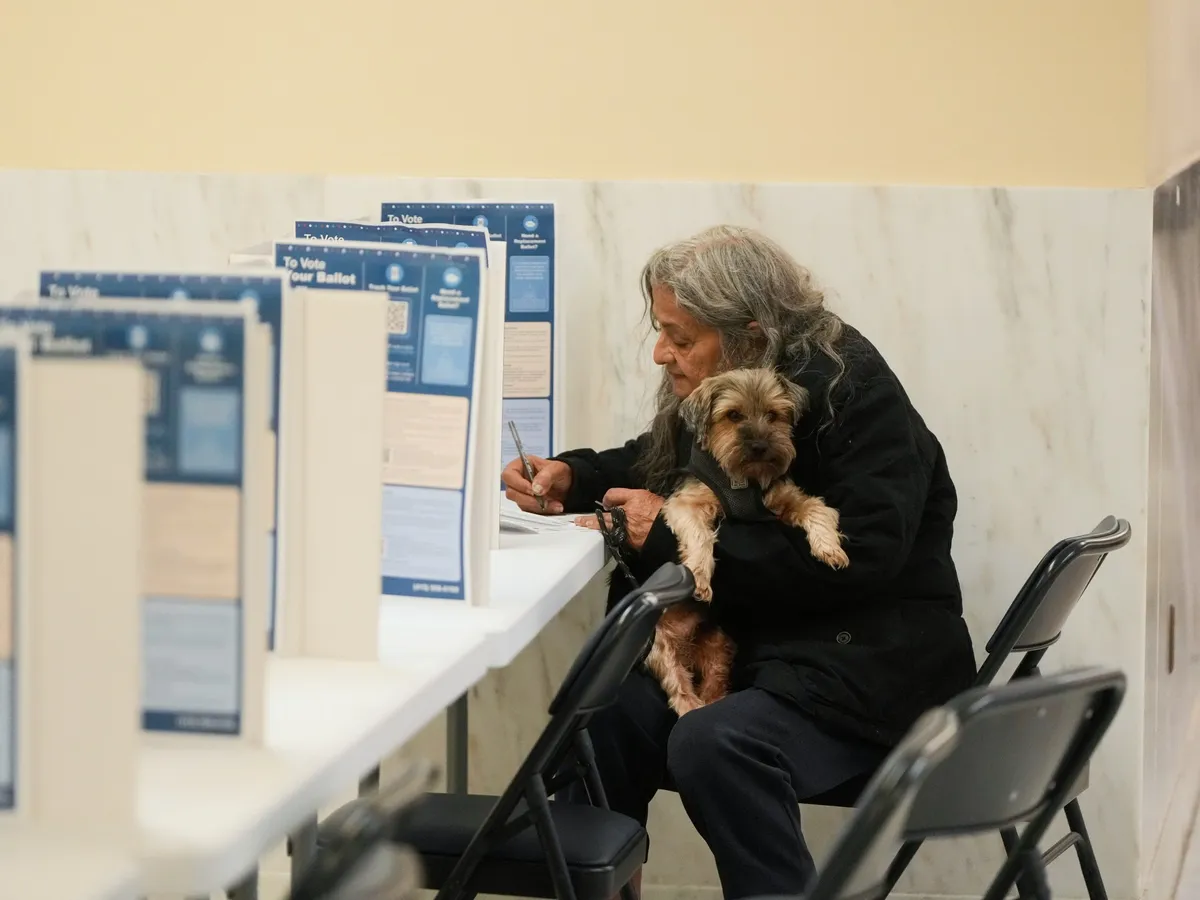
EXPLAINERRepublicans and Democrats have both employed tactics to boost weaker rivals ahead of midterms.Carmen Sandoval holds her dog Peluche as she votes in the California state primary election at City Hall on Tuesday, June 2, 2026, in San Francisco, California, the United States [Jeff Chiu/AP]Published On 23 Jun 2026Political campaign groups linked to the Republican Party in the United States have reportedly been funding Democratic candidates in ongoing primaries in an effort to boost “weak” candidates they believe are likely to be defeated by Republicans ahead of midterm elections in November.US media outlets have reported claims of this happening in New Jersey, Maine, Texas, Pennsylvania and Nebraska.Recommended Stories list of 4 itemslist 1 of 4Israeli strike kills Palestinian girl on her way to sit examlist 2 of 4Football offers escape for Gaza, but World Cup spirit dimmedlist 3 of 4What Israeli and Lebanese officials are saying before Washington talkslist 4 of 4Israeli fire kills two in Lebanon as Hezbollah slams truce ‘violation’end of listThe midterms often serve as a litmus test of a US administration’s popularity and can decide which party controls Congress – control that will be vital for the success of US President Donald Trump’s policies for his final two years in office.Democrats are currently a minority in both the House of Representatives and the Senate, but are pushing to flip the two chambers in November.Here’s what we know about the Republican-linked groups, known as political action committees (PACs), that are believed to be funding Democratic Party candidates:Rebecca Bennett, Democratic candidate for New Jersey’s 7th Congressional District, holds her daughter Rosie, alongside her husband Alex Hydrean and daughter Millie, at a primary election night watch party after winning the Democratic nomination Tuesday, June 2, 2026, in Bridgewater, New Jersey, the US [Ryan Murphy/AP]What are PACs?PACs (political action committees) are independent organisations that raise funds in order to lobby for or against a political party or candidate during elections. They can be highly influential in US election campaigns and, to a great extent, can determine who gets presented to voters.Originally, PACS, which have existed since 1944, were formed around labour unions or other interests. There are caps on the amount of money a traditional PAC is permitted to raise or donate to a single candidate.However, in 2010, the Supreme Court ruled that special-interest organisations and unions have the same First Amendment free speech rights as individuals and cancelled limits on independent political spending by such groups. This cleared the way for the creation of so-called “super PACs”, which are able to raise and spend unlimited funds to boost a candidate but are barred from directly funding individuals.These groups are required to file financial reports with the Federal Election Commission (FEC) disclosing funding sources. But the deadlines are post-election, meaning the electorate can only see information about how a PAC has been operating after voting takes place.Parties or lobby groups have also been known to create “pop-up” – of fake – super PACS to funnel money to a campaign while hiding their identities. Some call this type of funding “dark money”.The highly popular – and controversial – American Israel Public Affairs Committee (AIPAC), for example, is linked to the super PAC United Democracy Project and lobbies heavily for military and diplomatic support for Israel.On Monday, New York City Mayor Zohran Mamdani accused AIPAC of supporting what he called an “unjust” status quo in Gaza through “dark money”.“I think that it is important…how such death and destruction happens overseas, we also name those who allow it to take place,” he said.Are Republican super PACs supporting Democrats?New super PAC submissions to the FEC over the weekend indicated that two “pop-up” super PACS were spending heavily on Democratic primaries in several states.The groups, Real Change PAC and Lead Left, spent more than $4.3m to boost the profiles of often controversial Democrats whom Republicans believe will be relatively easy to defeat in the midterms, according to US media.Both are linked to the Conservative Americans PAC, a well-known Republican super PAC founded in 2023, and funded by a non-profit called the American Prosperity Alliance. Charities are legally allowed to conceal the identities of their donors, meaning the real funders of the Conservative Americans PAC are unknown.How does this sort of strategic funding affect candidates’ chances?The results have been mixed.The Lead Left PAC spent more than $750,000 on s in Texas for Maureen Galindo, a sex therapist who has been accused of making anti-Semitic statements while making criticisms of Israel. Galindo, who denies the accusations, lost the Democratic primary to rival Johnny Garcia.In Maine, however, the Real Change PAC boosted state auditor Matt Dunlap with contributions of about $500,000 to his campaign. He beat his main opponent, Joe Baldacci.The Lead Left PAC also spent $435,000 campaigning against John Cavanaugh, who eventually lost by a small margin to Denise Powell, an activist, in Nebraska.Democrats, too, have intentionally boosted a Republican candidate in order to have a better chance in elections.In 2022, the Democratic Congressional Campaign Committee (DCCC) successfully boosted Republican John Gibbs’s primary race against incumbent Representative Peter Meijer in Michigan. Democrat candidate Hillary Scholten eventually defeated Gibbs at the midterms.What have both sides said about this?Conservative Americans PAC spokesperson Samantha Bullock confirmed the group’s strategy, telling Politico it was payback for Democrats “meddling” in the past.“Republicans are levelling the playing field after over a decade of Democrats meddling in our primaries,” Bullock said, adding that Republicans “would be stupid not to take advantage”.Meanwhile, the DCCC condemned the move. In a statement, spokesperson Justin Chermol said the Republicans’ tactics had “backfired” and that the outlook for them was “bleak”.How much does money matter in US elections?A great deal.Since 2010, super PAC interventions have turned US elections into a money game, observers say.Securing funding from wealthy PACs is the muscle candidates often need to raise the millions of dollars required for crucial advertising campaigns, media blitzes and to pay teams of campaign staff. The amount of funding support a candidate has gathered can also scare away potential challengers.Millions of dollars are also spent on attacking rivals.Unlike pre-2010, when donations were capped, donors can now give massive amounts to a campaign without facing backlash or public criticism simply by using “pop-up” PACS or similar shadow groups that hide their identities.Election candidates unable to secure such support are unlikely to win primaries, and are unlikely to be presented to the ordinary voter at all.
SRCAl Jazeera
LANGEN
LEANCenter
WORDS1 064
ENT12
TUE · 2026-06-23 · 14:34 GMTBRIEF NSR-2026-0623-86763
NSR-2026-0623-86763Analysis·EN·Political Strategy
Republican-linked PACs funding Democratic US primaries: Why it matters
Republican-linked PACs are reportedly funding Democratic candidates in US primaries to boost "weak" contenders they believe will be easier for Republicans to defeat in the upcoming midterm elections. This tactic has been observed in states like New Jersey, Maine, Texas, Pennsylvania, and Nebraska.
Shola LawalAl JazeeraFiled 2026-06-23 · 14:34 GMTLean · CenterRead · 5 min
Al JazeeraFIG 01
Reading time
5min
Word count
1 064words
Sources cited
0cited
Entities identified
12entities
Quality score
100%
§ 01
Briefing Summary
AI-generatedNEWSAR · AI
Republican-linked PACs are reportedly funding Democratic candidates in US primaries to boost "weak" contenders they believe will be easier for Republicans to defeat in the upcoming midterm elections. This tactic has been observed in states like New Jersey, Maine, Texas, Pennsylvania, and Nebraska. Two "pop-up" super PACs, Real Change PAC and Lead Left, linked to the Republican group Conservative Americans PAC, have spent millions to support controversial Democrats. The goal is to influence the composition of Congress, which is crucial for President Trump's policies. While the effectiveness of this strategy has been mixed, it highlights the complex and sometimes opaque nature of campaign finance in US elections, with "dark money" potentially influencing outcomes.
Confidence 0.90Claims 5Entities 12
§ 02
Article analysis
Model · rule-basedFraming
Political Strategy
Tone
Measured
AI-assessed
CalmNeutralAlarmist
Factuality
0.70 / 1.00
Factual
LowHigh
Sources cited
0
No named sources
FewMany
§ 03
Key claims
5 extracted01
Democrats are pushing to flip control of the House of Representatives and the Senate in November.
factual
Confidence
1.00
02
Midterm elections often serve as a litmus test of a US administration’s popularity.
factual
Confidence
1.00
03
Super PACs can raise and spend unlimited funds but are barred from directly funding individuals.
factual
Confidence
1.00
04
Republican-linked PACs are reportedly funding Democratic candidates in US primaries.
factualUS media outlets
Confidence
0.80
05
The tactic aims to boost 'weak' Democratic candidates likely to be defeated by Republicans in November midterms.
factualArticle's interpretation of reported claims
Confidence
0.70
§ 04
Full report
5 min read · 1 064 words§ 05
Entities
12 identifiedKey playerOppositionContextPositiveNeutralNegative
Organizations4
Locations6
§ 06
Keywords & salience
8 termsrepublican-linked pacs
1.00
us primaries
1.00
funding democratic candidates
0.90
midterm elections
0.80
political action committees
0.70
election strategy
0.60
us politics
0.50
congress control
0.40
§ 07
Topic connections
Interactive graph Network visualization showing 51 related topics
View Full Graph Person Organization Location Event|Click node to navigate|Edge numbers = shared articles