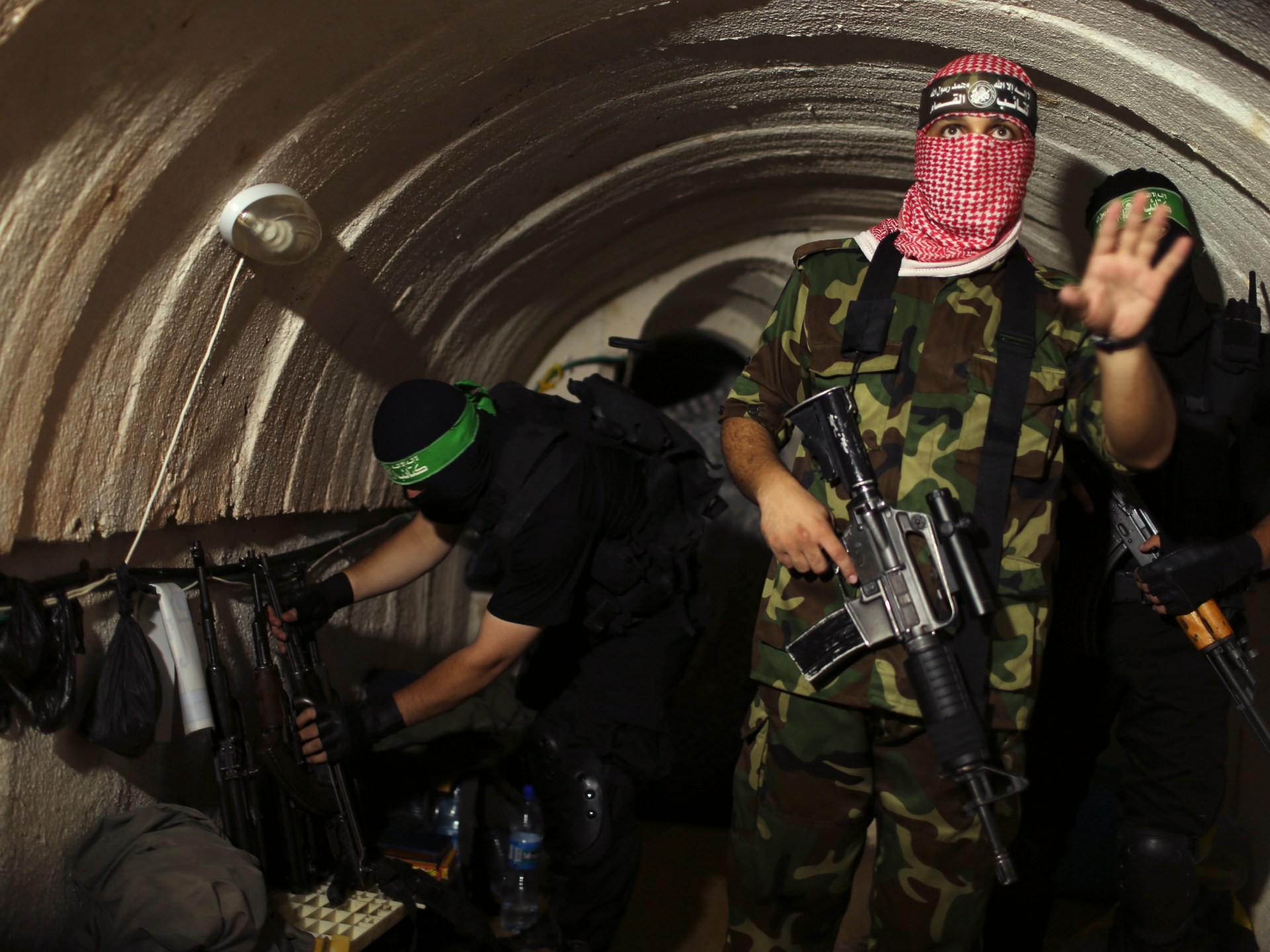
EXCLUSIVEWhile Palestinian factions offered to store heavy weapons, Gaza’s high representative is pushing for the handover of underground networks and family firearms.A Palestinian fighter from the armed wing of Hamas inside an underground tunnel in Gaza on August 18, 2014 [File: Mohammed Salem/Reuters]Published On 23 Jun 2026Ceasefire talks in Egypt between Palestinian factions and mediators face a serious test after Nickolay Mladenov, the high representative of the “Board of Peace“, demanded that not a “single bullet” should be left in Gaza.Among the maximalist demands of US President Donald Trump’s oversight body for Gaza is the complete disarmament of Hamas, the surrender of maps of tunnels operated by the group, and even weapons privately held by Palestinians in the enclave.Recommended Stories list of 3 itemslist 1 of 3Photos: UN says Palestinian children targeted in Gaza genocide, war crimeslist 2 of 3NYC Mayor Zohran Mamdani doubles down on criticism of AIPAClist 3 of 3Why is Israel being accused of meddling in Colombia presidential election?end of listDetails from sources involved in the Cairo talks say that the handover of Palestinian weapons is the primary hurdle to completely ending Israel’s genocidal war on Gaza.Palestinian officials argue that the complete disarmament stipulation means that Mladenov is essentially a facilitator for Israel’s maximalist demands.The battle over Clause 8At the heart of the current deadlock is “Clause 8”, a pivotal section of the United States-brokered October 2025 ceasefire plan, which dictates the exact terms of disarmament, the management of military infrastructure in post-war Gaza, as well as the transfer of security responsibilities for the enclave to a unified Palestinian body.An informed source familiar with the internal dynamics of the talks told Al Jazeera that Hamas initially demonstrated “high positivity” regarding this clause.For the first time, Hamas had agreed to the handover of its “inventory and storage of heavy weapons”, referring to the arsenal of rockets, missiles, and Kornet antitank missiles that the movement is believed to possess.“The mediators were, of course, happy because for the first time Hamas engaged with this matter,” the informed source said. “Previously, they would not engage in this topic at all.”A tale of two textsA Hamas source involved in the talks provided Al Jazeera with the competing drafts of Clause 8 of the ceasefire plan, which covers the handover of weapons by Palestinian factions in Gaza.Mladenov, who, as high representative, has responsibility for post-war transition in Gaza, wants the unconditional surrender of all arms by Palestinian armed groups in Gaza.Hamas and Palestinian factions, meanwhile, have tied the handover of weapons to the withdrawal of Israeli forces from Gaza.The high representative’s proposed text: A gradual, phased process to “inventory/collect” all weapons based on an agreed timeline, monitored by the high representative, the Implementation Verification Committee, and the International Stabilization Force (ISF). The process would be Palestinian-led via the National Committee for the Administration of Gaza (NCAG), with all armed groups participating in the inventory of infrastructure and collection of weapons. No armed group would be required to transfer its weapons directly to Israel. Hamas and the Palestinian factions’ final text: The gradual “inventory and storage of heavy weapons” must be carried out in tandem with a phased Israeli military withdrawal from Gaza. Implementation is entirely contingent on completing Phase 1 of the ceasefire, the NCAG assuming its duties, ISF deployment, and the dismantling of armed militias. The execution of the agreement, including the weapons clause, must lead to a political path guaranteeing the rights of the Palestinian people to establish a state and achieve self-determination. ‘Neutralising infrastructure’ and the ‘single bullet’When Mladenov presented the amended Palestinian text to the Israelis, they outright rejected it. They then countered with a new demand of their own: The dismantling of the entire tunnel network operated by the Qassam Brigades, Hamas’s armed wing, and that all facilities belonging to the armed group should be dismantled.When Hamas refused, Mladenov aligned with the Israeli position. “He said: ‘No, we will not accept, and you must bring everything. You must hand over tunnel maps, manufacturing workshops, heavy weapons, and light weapons,'” the informed source quoted Mladenov as saying.Another senior Hamas official confirmed to Al Jazeera that the talks had not collapsed, but the demand for Hamas’s complete disarmament was severely testing the negotiations.“Mladenov stressed that Gaza will be completely free of any weapons, down to the single bullet,” the Hamas official said. “No factions, no families, no militias, not even individuals.”The June 12 draft and family weaponsAnother source from a Palestinian faction participating in the Cairo talks provided details about how the talks had moved towards the current standoff.After meeting for four consecutive days starting June 9, Palestinian factions agreed on June 12 to a unified modification of Clause 8, offering to inventory and storage for heavy weapons. Mladenov met Hamas representatives four days later to discuss the framework.Mladenov initially expressed “discomfort” with the Palestinian amendments, and subsequently introduced sweeping new modifications based on his 15-point roadmap for peace between Hamas and Israel. This included a demand for dismantling Hamas and other Palestinian factions’ military capabilities in Gaza, including “weapons storage facilities, tunnels, and workshops”.Mladenov’s framework reiterated his demand that all personal weapons belonging to Palestinians in Gaza be handed over.The plan would see all rifles and other firearms be surrendered to the NCAG, which would manage them through a strict “purchase or licensing” scheme.Mladenov formally submitted this document on June 17, and it is currently being reviewed by all factions. “There will certainly be a comprehensive meeting for all forces to reach a joint formulation and present it once again to Mladenov,” a Palestinian source involved in the talks told Al Jazeera. “The door is not closed.”Factions push backThe push for total disarmament has been squarely rejected by all Palestinian leaders, who view the disarmament demand as a way of subverting the peace process in Gaza.Mohammad al-Braim, the media official for the Popular Resistance Committees – one of the key factions officially attending the Cairo talks – told Al Jazeera that the groups have shown “unparalleled flexibility” regarding weapons arrangements.“We will not raise the white flag, and we will not submit under any threat, pressure, or procrastination,” al-Braim, also known as Abu Mujahid, said.He accused Israeli Prime Minister Benjamin Netanyahu and Mladenov of trying to turn the weapons file into a “gateway to control all tracks”, stressing that any disarmament steps must be linked to a comprehensive political solution and a full Israeli withdrawal from Gaza. “This matter will not be for free,” he added.An ’employee of Netanyahu’Mladenov’s pivot has drawn scathing criticism from Palestinian observers of the process.Saeed Ziad, a Palestinian political analyst, told Al Jazeera that the factions’ initial offer was strictly about “rearranging the resistance’s weapons”. This aligns with earlier statements from Hamas officials that weapons would no longer be visible on Gaza’s streets, but that some would be kept in reserve by armed groups.“There is no discussion of disarmament or dissolving military formations except when a fully integrated Palestinian state is established,” Ziad said.
SRCAl Jazeera
LANGEN
LEANCenter
WORDS1 159
ENT10
TUE · 2026-06-23 · 13:59 GMTBRIEF NSR-2026-0623-86764
NSR-2026-0623-86764News Report·EN·Diplomatic
Demand for tunnel maps and personal weapons tests Gaza talks
Gaza ceasefire talks in Egypt are stalled due to demands from UN envoy Nickolay Mladenov for the complete disarmament of Palestinian factions. Mladenov, representing the "Board of Peace," insists on the surrender of all weapons, including private firearms and maps of Hamas's tunnel network.
Mohammad MansourAl JazeeraFiled 2026-06-23 · 13:59 GMTLean · CenterRead · 5 min
Al JazeeraFIG 01
Reading time
5min
Word count
1 159words
Sources cited
3cited
Entities identified
10entities
Quality score
100%
§ 01
Briefing Summary
AI-generatedNEWSAR · AI
Gaza ceasefire talks in Egypt are stalled due to demands from UN envoy Nickolay Mladenov for the complete disarmament of Palestinian factions. Mladenov, representing the "Board of Peace," insists on the surrender of all weapons, including private firearms and maps of Hamas's tunnel network. While Palestinian factions initially agreed to store heavy weapons, they have tied the handover to a phased Israeli military withdrawal and a political path for Palestinian self-determination. The core of the deadlock is "Clause 8" of a US-brokered plan, with competing texts outlining disarmament terms. Israel rejected Hamas's proposed text and subsequently demanded the dismantling of Hamas's tunnel infrastructure, a demand Mladenov has aligned with.
Confidence 0.90Sources 3Claims 5Entities 10
§ 02
Article analysis
Model · rule-basedFraming
Diplomatic
Conflict
Tone
Mixed Tone
AI-assessed
CalmNeutralAlarmist
Factuality
0.60 / 1.00
Mixed
LowHigh
Sources cited
3
Well sourced
FewMany
§ 03
Key claims
5 extracted01
Hamas had agreed to the handover of its 'inventory and storage of heavy weapons' for the first time.
factualinformed source familiar with the internal dynamics of the talks
Confidence
0.90
02
Hamas initially demonstrated 'high positivity' regarding Clause 8 of the ceasefire plan.
factualinformed source familiar with the internal dynamics of the talks
Confidence
0.90
03
Nickolay Mladenov demanded that not a 'single bullet' should be left in Gaza.
factualarticle
Confidence
0.80
04
Gaza's high representative is pushing for the handover of underground networks and family firearms.
factualarticle
Confidence
0.80
05
The handover of Palestinian weapons is the primary hurdle to completely ending Israel’s genocidal war on Gaza.
factualsources involved in the Cairo talks
Confidence
0.70
§ 04
Full report
5 min read · 1 159 words§ 05
Entities
10 identifiedKey playerOppositionContextPositiveNeutralNegative
Organizations3
§ 06
Keywords & salience
9 termspalestinian disarmament
1.00
gaza ceasefire talks
1.00
tunnel maps
0.90
personal firearms
0.80
hamas weapons
0.80
clause 8
0.70
nickolay mladenov
0.60
israel's war on gaza
0.50
unified palestinian body
0.40
§ 07
Topic connections
Interactive graph Network visualization showing 51 related topics
View Full Graph Person Organization Location Event|Click node to navigate|Edge numbers = shared articles