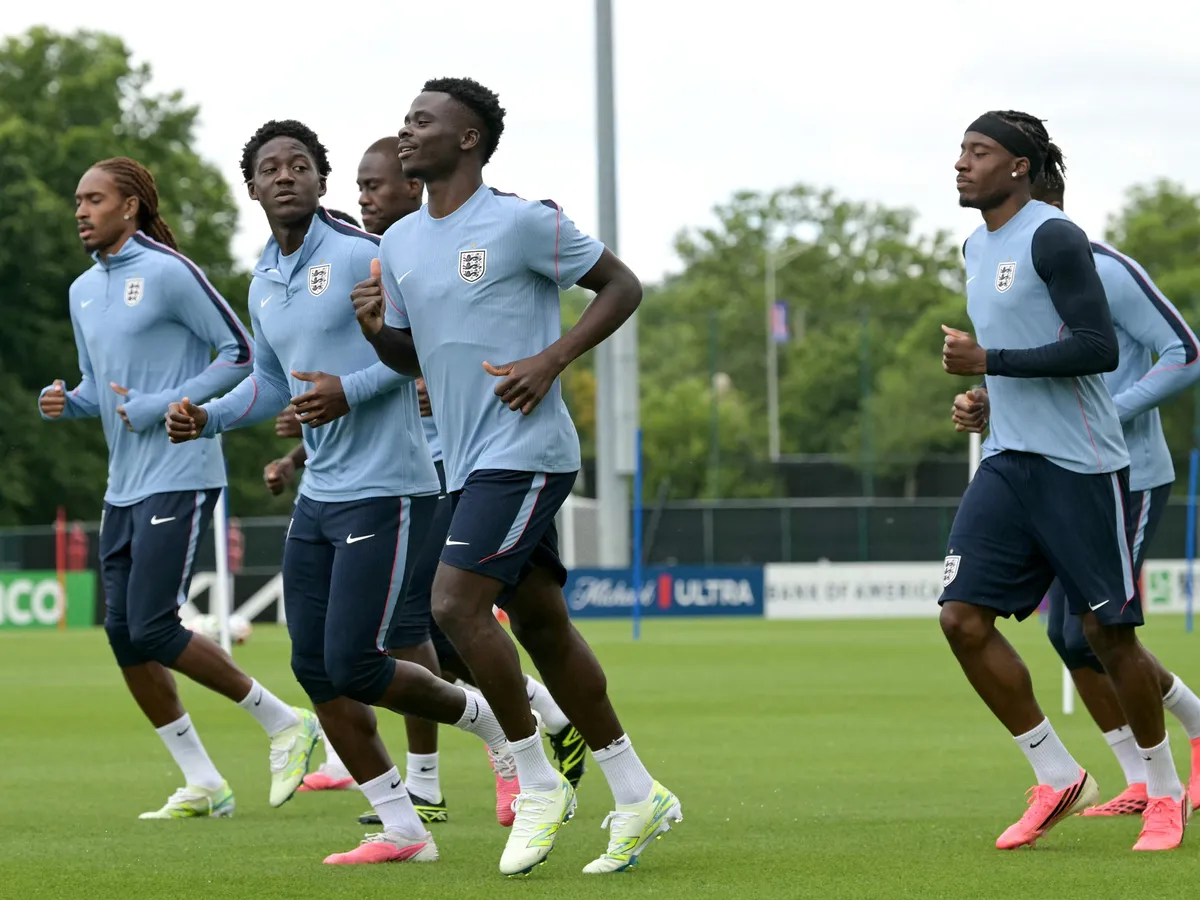
As England face Ghana at the World Cup, divided loyalties reveal how empire, migration and race still shape football’s sense of belonging.Published On 23 Jun 2026England's forward Bukayo Saka (C) and teammates take part in a MD-1 training session ahead of the 2026 World Cup football tournament match between England and Ghana at Swope Soccer Village in Kansas City on June 22, 2026 [AFP]When England takes on Ghana, a former British colony, there is something you should pay attention to. Watch Kobbie Boateng Mainoo, one of the most talented young players in all of football, then watch Brandon Thomas-Asante, Jerome Opoku and Antoine Semenyo. All four of these young men share very similar backgrounds and stories. All four born in England, socially and culturally shaped by English football, all with Ghanaian heritage. Yet only Kobbie Mainoo plays for England, while the others play for Ghana.Things like this make me question my allegiances. They make me wonder who I should truly root for. But we will get to that.This is for the keep-sports-out-of-politics crowd: Many of England’s 26 players are sons or grandsons of people from Caribbean and African countries. Most of those countries are former colonies of the British Empire. Football has never been just a game. It has always been a mirror.Research from the Migration Observatory at the University of Oxford has revealed that nearly a quarter of the 1,248 players selected for national teams at the 2026 World Cup were born in a different country than the one they represent, and 23.6 percent of players will represent a country other than the one they were born in. Twenty years ago, at the 2006 World Cup, that number was less than 9 percent. FIFA’s eligibility rules have changed and that has expanded the talent pools.You are seeing talented players raised in some of Europe’s finest academies come home. This has made the gap between the traditional powers and the rest of the world narrow. You are seeing the Ivory Coast go head-to-head with Germany, Cape Verde holding their own against Spain. It is not perfect, but things are changing for the better. From South America to the Caribbean to North America to Africa, you go down that rabbit hole and you realise the same truth keeps surfacing: Many of us have suffered under the strong arm of European colonialism and empire. The diaspora is not a footnote. The diaspora is the story.I have a confession to make: I have a soft spot for the Three Lions.When my younger brother and I nursed our professional ambitions in football (he would go on to achieve his), we would often debate who we would play for internationally. On the one hand, we were born and raised in England in the 90s and 2000s, our consciousness shaped by the infamous England Golden Generation. On the other hand, there was Nigeria, our mother and fatherland, our pride and joy, our cornerstone, with its own beautiful chaos on and off the pitch. And then there was the good old United States, where we also grew up, where we also played in the youth system.My love for both England and Nigeria started at one of football’s cathedrals, the original Wembley Stadium. I was four years old, but I’ll never forget it. Seeing the famous twin towers. It was November 16, 1994, the day after my brother’s second birthday. My dad, my uncle and I went to watch England play Nigeria, a Nigeria fresh off winning AFCON ’94 and having shocked the world at the 1994 World Cup. A seriously talented team. David Platt, England captain that day, scored the only goal with a first-half header, and I knew I would never be the same. That day made me love football, andmade me comfortable with pain, watching Nigeria lose but feeling something ignite. So much so that two years later, when Gareth Southgate missed that penalty against Germany, I cried. The tears were so hot, streaming down my face, they could probably fry eggs.Then 1998 came, and I learned football is masochism. England losing to Argentina. Nigeria losing to Denmark. Both of my allegiances, for all their talent, breaking my heart. In the 28 years since, I could write a dissertation on how they have both let me down. But this is not a therapy session.What I want to address is the ever-nagging reality of what it is like to be Black and support these Western nations, these places you were born and raised in.My first real superheroes outside my family, the people who made me think and dream bigger, were Black British footballers. Viv Anderson, the first Black England player in 1978. Luther Blissett opened his England account with a hat-trick against Luxembourg in 1982 to become the first Black player to score for the senior team. Paul Ince became England’s first Black captain when he led out the team against the USA in Boston in June 1993. In March 2021, Ollie Watkins became the 100th Black player to debut for England, and as of June 2026, the number stands at 127 following Rio Ngumoha’s debut against New Zealand in Tampa.These are not statistics. These are milestones carved out of resistance and sheer determination.I think of my heroes: Ian Wright, Paul Ince, Les Ferdinand, Andrew Cole, and Rio Ferdinand. Then my sort of big brothers: Ledley King, Jermain Defoe, Shaun Wright-Phillips, Micah Richards. Then my age-mates: Danny Welbeck, Chris Smalling, Kyle Walker, Daniel Sturridge, Raheem Sterling. Then the younger generation: Marcus Rashford, Jesse Lingard, Jadon Sancho, Trent Alexander-Arnold, Bukayo Saka. Then the new wave: Jude Bellingham, Reece James, Kobbie Mainoo, Rio Ngumoha. These are pioneers. These are giants. The way Ian Wright and Andrew Cole inspired me is the same way another young kid like me is inspired watching Jude celebrate, watching Kobbie pass and move, watching Reece James maraud down the right wing or seeing Bukayo Saka be as precise as a studio session with Quincy Jones and Michael Jackson.And yet that pride comes with a contradiction I have never been able to escape: the same country that turns Black footballers into symbols of national glory can still make their belonging feel conditional.You see it in how the English media treats these kids.How the English media treats these kids. We saw it with Marcus Rashford, Jadon Sancho and Bukayo Saka. We have seen it with Raheem Sterling, handled with a heavier hand compared with his contemporaries. Stan Collymore has addressed it often. The instances are too many to count, the ways words and actions can derail and hurt players. I look at Andrew Cole, the reason I became a Manchester United fan, and Glenn Hoddle’s verdict that he needed five chances to score a goal. That perception became reality, and it stuck. And it is things like this that make it hard to celebrate England sometimes. The microaggressions, the digs, the subtle way of putting you down even as they champion you when you perform. That contradiction is exhausting to live with.So when I look at the brothers at this tournament who chose differently, Guela Doue representing Ivory Coast while Desire Doue represents France, Nico Williams choosing Spain while Inaki Williams chose Ghana, Derrick Luckassen representing Ghana while Brian Brobbey represents the Netherlands, I understand every side of that decision.I understand why someone picks England over Ghana. There is prestige and comfort. There are also practical considerations, including stability, resources and federation politics, but that is a conversation for later. These are not small things, and they are real. I do not judge anyone for them.But something is shifting.Ibrahim Mbaye chose Senegal over France. Ayyoub Bouaddi picked Morocco over France. Cape Verde are putting on a show at this World Cup. African teams are closing the gap. Over the last decade, AFCON has become the best continental tournament on the planet, better than the Euros, better than Copa America, and it is showing up at World Cups. Morocco, armed with its bevy of diaspora talent and the King Mohammed VI academy, reached the 2022 semifinals, the first African nation to do so. More and more diaspora talents are coming home. Not because they have to. Because they want to.
SRCAl Jazeera
LANGEN
LEANCenter
WORDS1 364
ENT12
TUE · 2026-06-23 · 16:50 GMTBRIEF NSR-2026-0623-86797
NSR-2026-0623-86797Analysis·EN·Human Interest
The weight of the Three Lions: Football, colonialism, diaspora
The England vs. Ghana World Cup match highlights how football reflects complex histories of empire, migration, and belonging.
Tosin MakindeAl JazeeraFiled 2026-06-23 · 16:50 GMTLean · CenterRead · 6 min
Al JazeeraFIG 01
Reading time
6min
Word count
1 364words
Sources cited
1cited
Entities identified
12entities
Quality score
100%
§ 01
Briefing Summary
AI-generatedNEWSAR · AI
The England vs. Ghana World Cup match highlights how football reflects complex histories of empire, migration, and belonging. Players like Kobbie Mainoo, born in England with Ghanaian heritage, represent England, while others with similar backgrounds, such as Brandon Thomas-Asante and Antoine Semenyo, play for Ghana. This phenomenon is increasingly common, with nearly a quarter of players at the 2026 World Cup born in a different country than the one they represent, a significant increase from 2006. Changes in FIFA's eligibility rules have broadened talent pools, allowing players raised in European academies to represent their ancestral nations, thus narrowing the gap between traditional football powers and other countries. The article explores the personal experience of supporting multiple nations, particularly for Black individuals with ties to former British colonies, and acknowledges the historical significance of Black players in the English national team.
Confidence 0.90Sources 1Claims 4Entities 12
§ 02
Article analysis
Model · rule-basedFraming
Human Interest
Social Justice
Tone
Measured
AI-assessed
CalmNeutralAlarmist
Factuality
0.40 / 1.00
Mixed
LowHigh
Sources cited
1
Limited
FewMany
§ 03
Key claims
4 extracted01
Nearly a quarter of players at the 2026 World Cup were born in a different country than they represent, up from less than 9% in 2006.
statisticMigration Observatory at the University of Oxford
Confidence
1.00
02
Many nations have suffered under European colonialism and empire, and the diaspora is a significant part of the story.
factual
Confidence
0.90
03
Four England-born players with Ghanaian heritage (Kobbie Mainoo, Brandon Thomas-Asante, Jerome Opoku, Antoine Semenyo) have divided international allegiances.
factual
Confidence
0.90
04
FIFA's eligibility rule changes have expanded talent pools, narrowing the gap between traditional powers and other nations.
factual
Confidence
0.80
§ 04
Full report
6 min read · 1 364 words§ 05
Entities
12 identifiedKey playerOppositionContextPositiveNeutralNegative
People5
Organizations3
§ 06
Keywords & salience
10 termsfootball
1.00
colonialism
0.90
diaspora
0.90
migration
0.80
race
0.70
sense of belonging
0.60
british empire
0.50
world cup
0.50
national teams
0.40
fifa eligibility rules
0.40
§ 07
Topic connections
Interactive graph Network visualization showing 51 related topics
View Full Graph Person Organization Location Event|Click node to navigate|Edge numbers = shared articles