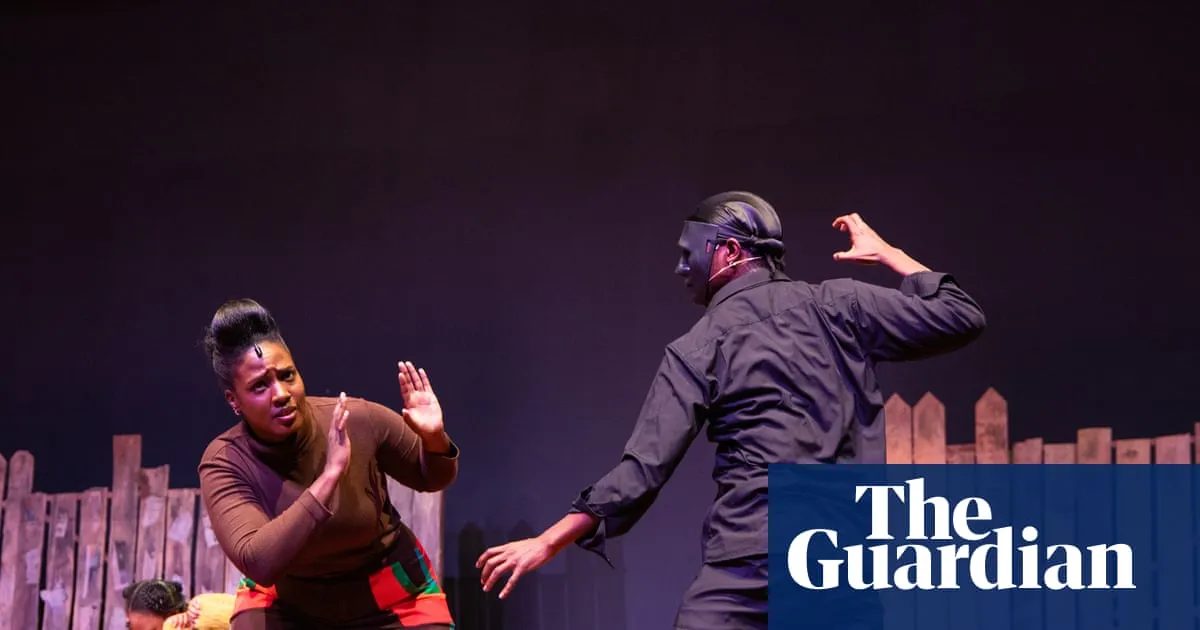
There are audible gasps in the auditorium in Nairobi as a husband launches a volley of blows and slaps on his wife and pushes her to the floor. “I wish I could spare you this,” the wife tells the audience. “My husband beat me up as if we were in a bar fight. Except, in a bar someone fights back.”The scene comes from Free Me, an autobiographical play by Gathoni Kimuyu, a Kenyan theatre and TV producer who lived through an abusive marriage.The success of the production, which was first performed in November and returned this month for a rerun, reflects a public outcry over gender-based violence (GBV) in Kenya, where already high rates of femicide and abuse have risen further in recent years.A scene from Free Me.This month, hundreds of women marched in Nairobi to protest against violence against women and to call on the government to declare GBV a national crisis.In January 2025, after a series of marches across the country in 2024 and the supporting online campaigns #StopKillingUs, #EndFemicideKe and #TotalShutDownKe, the government formed a technical working group to identify trends, hotspots and causes of GBV and femicide.It released a report citing a mix of factors behind GBV, including social and cultural factors such as patriarchal structures and gender inequality. The document made recommendations such as amending the law to define and codify femicide as a distinct offence from murder and for the president to declare GBV a national crisis.The government has yet to implement the recommendations, and GBV cases continue to make headlines.Gathoni Kimuyu is the producer of the autobiographical play.“When we look at the numbers in Kenya right now, cases of femicide, sexual abuse, physical abuse – any type of abuse against women – are very high,” said Kimuyu, who is also the producer and head of marketing for the play. “And the numbers just keep rising and rising.”She added: “One of the reasons why we’re restaging this show is because of how important it is to the conversations that we’re having now and for the change that we’re looking for as women and as a country.”Popularly known as Queen Gathoni, the 41-year-old writer-producer has worked on some of Kenya’s defining TV and theatre productions, including the children’s TV drama Machachari and the historical play series Too Early for Birds.Mugambi Nthiga: ‘This is not just a story. This is someone’s true story.’Free Me covers her life from her teenage years living with her family in Nairobi’s eastern outskirts in the early 2000s to the present day. It tells her story in different stages of her life, played by different actors: the mischievous 16-year-old who is full of life; the 21-year-old who gets married and starts being abused; the 25-year-old who gives birth and leaves the marriage; and the 30-year-old who picks herself up and starts rebuilding.Mugambi Nthiga, the show’s director and co-writer, said: “This is a play about gender-based violence about someone who lived [through it], but it’s being staged in a reality where there’s more than one woman every day who is not so lucky [and] who doesn’t get to have the same kind of ending that this play does.”He added: “This is not just a story. This is someone’s true story. And it’s a story of someone who’s able to get out of it.”Renee Gichuki: ‘We are educating and we are shedding light to both parties.’Renee Gichuki, who plays the Kimuyu character at the age of 16, said the play was timely because Kimuyu’s experience was not an isolated story and because GBV “has become a crisis”.“The person standing next to you has experienced it or knows someone who has experienced it,” she said. “We are educating and we are shedding light to both parties to know what can be done differently.”Tobit Tom, who plays the husband, said acting out the role “comes with a lot of heaviness” for him as a man, but he understood that men were the main perpetrators of GBV and he had to show that GBV “is happening and we have to talk about it and address it with seriousness”.Tom Tobit plays the husband in the show.Wambui Njeri, a 24-year-old businesswoman, said after watching the show that it humanised the victims and showed that the perpetrator could be anybody. “This makes it very clear that it’s your everyday woman, it’s your everyday man,” she said.Sitting next to her, her friend Patrick Muchiri, 40, a communications practitioner, said: “As men we really need to do better … Yes, we are the head of families and the head of societies. But that doesn’t translate to belittling or looking down or causing violence or harm.”Kimuyu hopes the play encourages victims to speak out and not be ashamed.In the show, Kimuyu’s character stays with her husband for two years despite the abuse. After she finally tells him she’s leaving him, his character draws derisive laughs from the audience when he says: “You are never going to find anyone who loves you like I love you.” The laughs turn to cheers when she replies: “Your love is exactly the kind of love I’m walking away from. For ever.”Kimuyu hopes the play encourages victims to speak out and not be ashamed, and reframes the conversation about women’s safety to stop blaming women and to hold abusers responsible.Five actors play Kimuyu at different ages. From left: Renee Gichuki, Nungari Kiore, Gathoni Mutua, Ellah Maina and Joan Cherono.She said she chose to tell her own experience rather than create fiction to make people connect with the story more. “There’s nothing that resonates harder for people than a story about someone they know,” she said. “To see someone survive and actually be on this side makes people believe that it’s possible.”
SRCThe Guardian - World News
LANGEN
LEANCenter-Left
WORDS954
ENT10
WED · 2026-06-24 · 04:00 GMTBRIEF NSR-2026-0624-86920
NSR-2026-0624-86920News Report·EN·Human Interest
Play puts spotlight on Kenya’s crisis of gender-based violence
The autobiographical play "Free Me," by Kenyan producer Gathoni Kimuyu, is highlighting the rising crisis of gender-based violence (GBV) in Kenya. The play, which recounts Kimuyu's experience of an abusive marriage, aims to encourage victims to speak out.
Carlos Mureithi in Nairobi. Photographs by Esther SweeneyThe Guardian - World NewsFiled 2026-06-24 · 04:00 GMTLean · Center-LeftRead · 4 min
The Guardian - World NewsFIG 01
Reading time
4min
Word count
954words
Sources cited
3cited
Entities identified
10entities
Quality score
100%
§ 01
Briefing Summary
AI-generatedNEWSAR · AI
The autobiographical play "Free Me," by Kenyan producer Gathoni Kimuyu, is highlighting the rising crisis of gender-based violence (GBV) in Kenya. The play, which recounts Kimuyu's experience of an abusive marriage, aims to encourage victims to speak out. Its success reflects a public outcry, with recent protests and online campaigns calling for government action. In response, a technical working group was formed to study GBV and femicide, identifying social and cultural factors like patriarchal structures and gender inequality as causes. The group recommended legal amendments and a presidential declaration of GBV as a national crisis, but these have not yet been implemented. The play's staging underscores the urgency of the issue, as GBV cases continue to be prevalent in Kenya.
Confidence 0.90Sources 3Claims 5Entities 10
§ 02
Article analysis
Model · rule-basedFraming
Human Interest
Social Justice
Tone
Mixed Tone
AI-assessed
CalmNeutralAlarmist
Factuality
0.70 / 1.00
Factual
LowHigh
Sources cited
3
Well sourced
FewMany
§ 03
Key claims
5 extracted01
A government technical working group was formed in January 2025 to address GBV and femicide, citing social and cultural factors like patriarchal structures and gender inequality.
factualarticle
Confidence
1.00
02
Hundreds of women marched in Nairobi to protest violence against women and call on the government to declare GBV a national crisis.
factualarticle
Confidence
1.00
03
The play 'Free Me' by Gathoni Kimuyu, an autobiographical work, highlights the crisis of gender-based violence (GBV) in Kenya.
factualarticle
Confidence
1.00
04
The government has yet to implement recommendations from the working group, and GBV cases continue to be reported.
factualarticle
Confidence
0.90
05
Rates of femicide and abuse in Kenya have risen further in recent years.
factualarticle
Confidence
0.90
§ 04
Full report
4 min read · 954 words§ 05
Entities
10 identifiedKey playerOppositionContextPositiveNeutralNegative
People3
Events3
§ 06
Keywords & salience
10 termsgender-based violence
1.00
femicide
0.90
domestic abuse
0.80
women's rights
0.70
kenya
0.60
gender inequality
0.50
patriarchal structures
0.50
theatre production
0.40
social factors
0.40
public outcry
0.40
§ 07
Topic connections
Interactive graph Network visualization showing 3 related topics
View Full Graph Person Organization Location Event|Click node to navigate|Edge numbers = shared articles