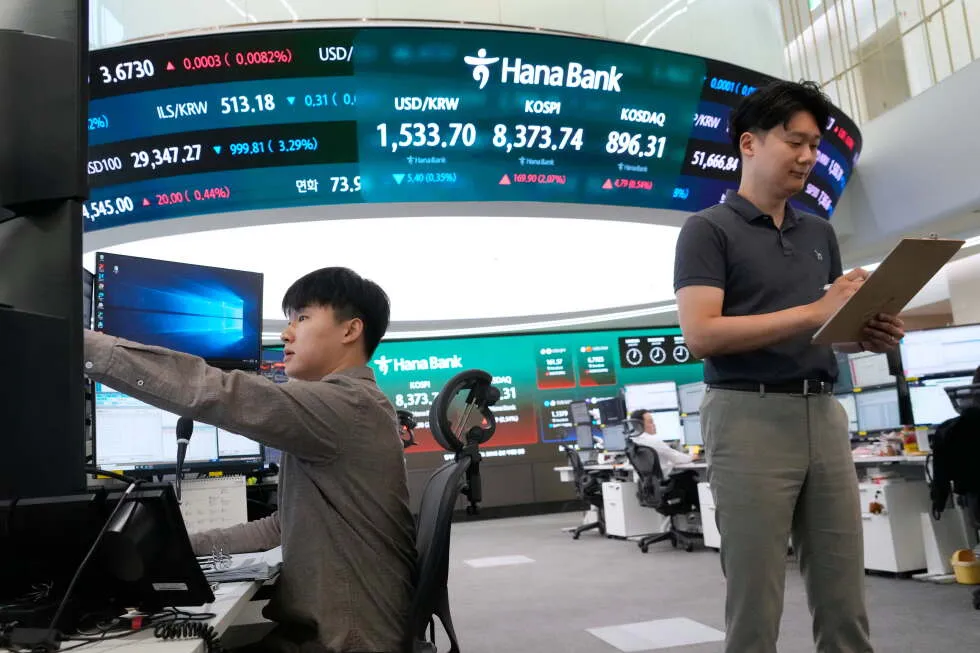
Asian stocks are mixed after Big Tech sell-off 1 of 4 | Currency traders work near a screen showing the Korea Composite Stock Price Index (KOSPI) and the foreign exchange rate between U.S. dollar and South Korean won at the foreign exchange dealing room of the Hana Bank headquarters in Seoul, South Korea, Wednesday, June 24, 2026. (AP Photo/Ahn Young-joon) 2 of 4 | A currency trader watches monitors near a screen showing the Korea Composite Stock Price Index (KOSPI) and the foreign exchange rate between U.S. dollar and South Korean won at the foreign exchange dealing room of the Hana Bank headquarters in Seoul, South Korea, Wednesday, June 24, 2026. (AP Photo/Ahn Young-joon) 3 of 4 | Currency traders work near a screen showing the Korea Composite Stock Price Index (KOSPI) at the foreign exchange dealing room of the Hana Bank headquarters in Seoul, South Korea, Wednesday, June 24, 2026. (AP Photo/Ahn Young-joon) 4 of 4 | A currency trader watches monitors near a screen showing the Korea Composite Stock Price Index (KOSPI) and the foreign exchange rate between U.S. dollar and South Korean won at the foreign exchange dealing room of the Hana Bank headquarters in Seoul, South Korea, Wednesday, June 24, 2026. (AP Photo/Ahn Young-joon) 1 of 4 | Currency traders work near a screen showing the Korea Composite Stock Price Index (KOSPI) and the foreign exchange rate between U.S. dollar and South Korean won at the foreign exchange dealing room of the Hana Bank headquarters in Seoul, South Korea, Wednesday, June 24, 2026. (AP Photo/Ahn Young-joon) 1 of 4 Currency traders work near a screen showing the Korea Composite Stock Price Index (KOSPI) and the foreign exchange rate between U.S. dollar and South Korean won at the foreign exchange dealing room of the Hana Bank headquarters in Seoul, South Korea, Wednesday, June 24, 2026. (AP Photo/Ahn Young-joon) Add AP News on Google Add AP News as your preferred source to see more of our stories on Google. Share 2 of 4 | A currency trader watches monitors near a screen showing the Korea Composite Stock Price Index (KOSPI) and the foreign exchange rate between U.S. dollar and South Korean won at the foreign exchange dealing room of the Hana Bank headquarters in Seoul, South Korea, Wednesday, June 24, 2026. (AP Photo/Ahn Young-joon) 2 of 4 A currency trader watches monitors near a screen showing the Korea Composite Stock Price Index (KOSPI) and the foreign exchange rate between U.S. dollar and South Korean won at the foreign exchange dealing room of the Hana Bank headquarters in Seoul, South Korea, Wednesday, June 24, 2026. (AP Photo/Ahn Young-joon) Add AP News on Google Add AP News as your preferred source to see more of our stories on Google. Share 3 of 4 | Currency traders work near a screen showing the Korea Composite Stock Price Index (KOSPI) at the foreign exchange dealing room of the Hana Bank headquarters in Seoul, South Korea, Wednesday, June 24, 2026. (AP Photo/Ahn Young-joon) 3 of 4 Currency traders work near a screen showing the Korea Composite Stock Price Index (KOSPI) at the foreign exchange dealing room of the Hana Bank headquarters in Seoul, South Korea, Wednesday, June 24, 2026. (AP Photo/Ahn Young-joon) Add AP News on Google Add AP News as your preferred source to see more of our stories on Google. Share 4 of 4 | A currency trader watches monitors near a screen showing the Korea Composite Stock Price Index (KOSPI) and the foreign exchange rate between U.S. dollar and South Korean won at the foreign exchange dealing room of the Hana Bank headquarters in Seoul, South Korea, Wednesday, June 24, 2026. (AP Photo/Ahn Young-joon) 4 of 4 A currency trader watches monitors near a screen showing the Korea Composite Stock Price Index (KOSPI) and the foreign exchange rate between U.S. dollar and South Korean won at the foreign exchange dealing room of the Hana Bank headquarters in Seoul, South Korea, Wednesday, June 24, 2026. (AP Photo/Ahn Young-joon) Add AP News on Google Add AP News as your preferred source to see more of our stories on Google. Share Updated [hour]:[minute] [AMPM] [timezone], [monthFull] [day], [year] HONG KONG (AP) — Asian stocks were mixed on Wednesday following a sell-off in big technology stocks from Asia to Wall Street.U.S. stock futures were also trading mixed, as global investors monitor market movements in Japan and South Korea, which have seen big gains in recent months on the global AI boom but both fell sharply on Tuesday.South Korea’s benchmark KOSPI index was up 3.3% to 8,471.02, recovering from its 10% decline on Tuesday. Shares of memory chipmaker SK Hynix, one of the country’s most valuable stocks, climbed 1%. Samsung Electronics jumped 9.8%, after Tuesday’s 12.3% plummet.Tokyo’s Nikkei 225 lost 0.9% to 69,174.97 after falling 3.6% on Tuesday.Taiwan’s Taiex, which is also heavily influenced by tech shares, fell 2.2%.Hong Kong’s Hang Seng was 0.5% higher at 23,441.48. The Shanghai Composite index was up 0.1% to 4,110.81. Australia’s S&P/ASX 200 edged up 0.2% to 8,808.40. The declines in Asian markets, including Japan’s, followed Tuesday’s 1.4% drop for Wall Street’s benchmark S&P 500 index. The technology-heavy Nasdaq composite fell 2.2%, while the Dow Jones Industrial Average ended 0.1% lower. 4 MIN READ 3 MIN READ 5 MIN READ Big Tech and semiconductor stocks fell in the U.S. On Tuesday, Micron Technology sank 13.2%, while Nvidia lost more than 4.1%.The big falls in tech shares were an “illustration of rising volatility” in these stocks, said James Reilly, senior markets economist at Capital Economics. “This is particularly true in Korea where domestic retail buyers are taking on an increasing role,” he said. Oil prices fell early Wednesday, as more ships crossed the Strait of Hormuz while U.S.-Iran talks on a permanent end to the Iran war made progress.“Price movements suggest the market expects a fairly rapid recovery in Persian Gulf oil supplies,” ING commodities strategists Warren Patterson and Ewa Manthey said in a commentary.Still, while vessel crossings in the strait increased in recent days, they remained well below prewar levels, they noted. Brent crude, the international standard, fell 1.2% to $75.91 a barrel. It has been trading below $80 in recent days but is still elevated compared with the approximately $70 per barrel in late February before the war began.Benchmark U.S. crude was down 1.3% to $72.26 a barrel.In the U.S., investors are awaiting a report due Thursday of May’s personal consumption expenditures price index, or PCE, which is the preferred inflation gauge by the Federal Reserve.Some economists predict the Fed may hold key interest rate this year but is unlikely to raise rates. Bond yields have remained higher, as inflation concerns grew amid global energy shocks.In other dealings, the U.S. dollar was trading at 161.69 Japanese yen, up from 161.55 yen. The euro was trading at $1.1354, down from $1.1382.
SRCAssociated Press (AP)
LANGEN
LEANCenter
WORDS1 142
ENT10
WED · 2026-06-24 · 06:23 GMTBRIEF NSR-2026-0624-86967
NSR-2026-0624-86967News Report·EN·Economic Impact
Asian stocks are mixed after big tech sell-off
Asian stocks experienced mixed trading on Wednesday following a significant sell-off in major technology companies across Asia and Wall Street. Investors are closely watching market movements in Japan and South Korea, which had previously seen substantial gains due to the AI boom but experienced sharp declines on Tuesday.
By
CHAN HO-HIMAssociated Press (AP)Filed 2026-06-24 · 06:23 GMTLean · CenterRead · 5 min
Associated Press (AP)FIG 01
Reading time
5min
Word count
1 142words
Sources cited
0cited
Entities identified
10entities
Quality score
100%
§ 01
Briefing Summary
AI-generatedNEWSAR · AI
Asian stocks experienced mixed trading on Wednesday following a significant sell-off in major technology companies across Asia and Wall Street. Investors are closely watching market movements in Japan and South Korea, which had previously seen substantial gains due to the AI boom but experienced sharp declines on Tuesday. South Korea's Kospi index saw a slight recovery, while Tokyo's Nikkei 225 continued to fall. Taiwan's tech-heavy Taiex also declined, while Hong Kong and Shanghai saw modest gains. This volatility in tech and semiconductor stocks, including companies like Nvidia and Micron Technology in the U.S., is attributed to rising market fluctuations.
Confidence 0.90Claims 4Entities 10
§ 02
Article analysis
Model · rule-basedFraming
Economic Impact
Technology
Tone
Measured
AI-assessed
CalmNeutralAlarmist
Factuality
0.80 / 1.00
Factual
LowHigh
Sources cited
0
No named sources
FewMany
§ 03
Key claims
4 extracted01
The KOSPI index and the USD/KRW exchange rate are shown on screens in the images.
factual
Confidence
1.00
02
The images depict currency traders at Hana Bank headquarters in Seoul, South Korea.
factual
Confidence
1.00
03
The article includes multiple image captions detailing currency traders and stock market data.
factual
Confidence
1.00
04
Asian stocks are mixed following a significant sell-off in big tech companies.
factual
Confidence
0.90
§ 04
Full report
5 min read · 1 142 words§ 05
Entities
10 identifiedKey playerOppositionContextPositiveNeutralNegative
Organizations6
Topics1
§ 06
Keywords & salience
8 termsasian stocks
1.00
big tech sell-off
0.90
stock market
0.80
currency traders
0.70
kospi
0.60
foreign exchange rate
0.50
u.s. dollar
0.40
south korean won
0.40
§ 07
Topic connections
Interactive graph Network visualization showing 51 related topics
View Full Graph Person Organization Location Event|Click node to navigate|Edge numbers = shared articles