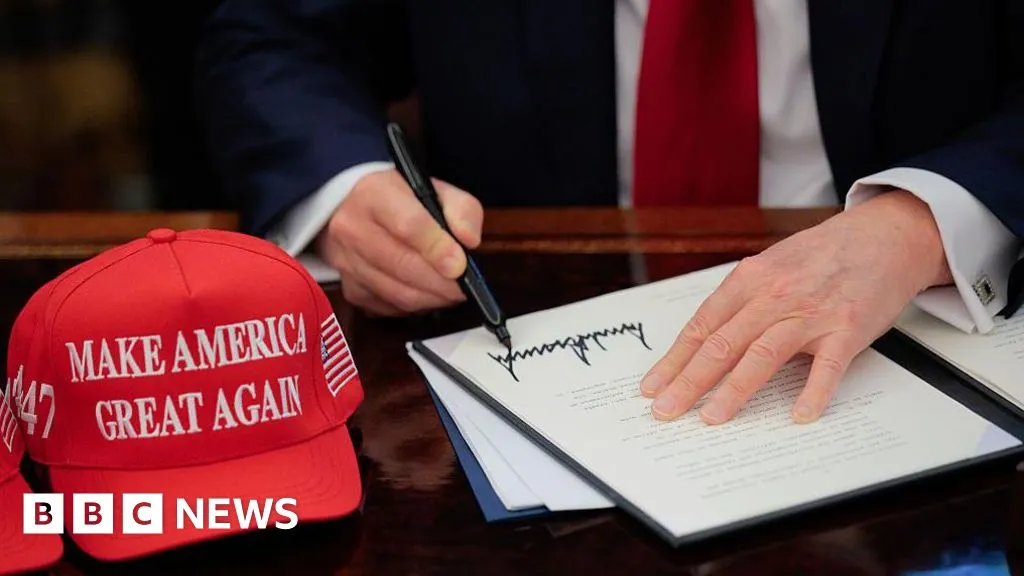
What tariffs has Trump announced and why?3 hours agoJennifer ClarkeBBC NewsGetty ImagesUS President Donald Trump has threatened to impose fresh tariffs on eight allies that oppose his demands for control of Greenland.Last year, he placed taxes on goods reaching the US from countries around the world, arguing the move would boost American manufacturing and create jobs.Critics warned of higher prices and damage to the global economy.Tariffs are taxes on imported goods.Typically, the charge is a percentage of a good's value.For example, a 10% tariff on a $10 product would mean a $1 tax on top - taking the total cost to $11 (£8.17).The tax is paid to the government by companies bringing in the foreign products.These firms may pass some or all of the extra cost on to their customers, which in this case means ordinary Americans and other US businesses. They may also decide to import fewer goods.Why is Trump using tariffs? Trump says tariffs increase the amount of tax raised by the government, encourage consumers to buy more American-made goods and boost investment in the US.He wants to reduce the US trade deficit - the gap between the value of goods it buys from other countries and those it sells to them.The president argues that the US has been exploited by "cheaters" and "pillaged" by foreigners.Trump has also used tariffs to make other demands.He has threatened fresh tariffs of 10% on the UK, Denmark, Norway, Sweden, France, Germany, the Netherlands, and Finland, because they oppose a US takeover of Greenland. Trump said the tariffs would be in place by 1 February and would rise to 25% by 1 June. When announcing tariffs against China, Mexico and Canada, he said the countries must do more to stop migrants and the illegal drug fentanyl reaching the US.Many tariffs have been amended or delayed after being announced.Why has the Supreme Court been considering the legality of Trump's tariffs?Trump's tariffs have faced numerous legal challenges.Instead of getting Congressional approval, the Trump administration used the 1977 International Emergency Economic Powers Act. Declaring an emergency under the law meant Trump could issue immediate orders and bypass Congress.In August 2025, a US appeals court ruled that most of Trump's tariffs were illegal, but left them in place. The White House asked the US Supreme Court to overturn that decision. A ruling is expected in the coming weeks. Trump has posted on social media that it would be a "complete mess" if the Supreme Court struck down his tariffs, and warned of difficulties if businesses were told they could claim refunds. "It would take many years to figure out what number we are talking about and even, who, when, and where, to pay," Trump said.What are Trump's tariffs on countries?Negotiations are continuing with a number of countries, including America's top three trading partners. China, Canada and Mexico were all warned that they faced particularly high tariffs:China and the US threatened tariffs on each other's goods of more than 100% in the months after Trump took office at the start of 2025, but subsequently extended a truce until November. On 30 October, after meeting President Xi Jinping, Trump said the two countries would sign a trade deal "pretty soon". He announced an immediate end to the part of tariffs levied on Chinese goods over concerns about Beijing's failure to stop the flow of ingredients used to make fentanyl. Tariff exclusions on 178 Chinese products have been extended until 10 November 2026. Other much lower tariffs remain in place for non-exempt goodsCanada is facing 35% tariffs on its goods - although most are exempt under the existing United States-Canada-Mexico (USMCA) free trade agreement. Canada is affected by the blanket 50% levy on imported metals and 25% on non-US automobiles. On 25 October, Trump said he was suspending trade talks and would increase Canada's levies "by 10% over and above what they are paying now", after the country broadcast an anti-tariff advert. Prime Minister Mark Carney later apologised to TrumpMexico is facing 30% tariffs on its goods, plus the sector-specific levies and a 25% fentanyl tariff. However, like Canada, most of its goods are exempt under the USMCA. The tariffs were put on hold until the end of October to allow time to strike a deal. On 27 October, Mexican President Claudia Sheinbaum said she and Trump had agreed to extend this deadline by "a few more weeks". Talks are ongoingA patchwork of different rates is in place for other countries. Many of these stem from Trump's announcement in April 2025 that a "baseline" of 10% would apply to imports from all countries. Nations considered the "worst offenders" would face higher rates, as payback for unfair trade policies.New tariff rates for dozens of countries were subsequently introduced in August, after delays to allow for trade talks. These include:50% tariffs on Indian goods - including a 25% penalty for trade with Russia50% tariffs on Brazilian goods30% tariffs on South African goods20% tariffs on Vietnamese goods15% tariffs on Japanese goods15% tariffs on South Korean goods15% tariffs on most EU goodsOn 13 January, Trump announced the US would apply a 25% tariff to countries which continue to trade with Iran, after Tehran cracked down on anti-government protests, with thousands of people feared dead.On 17 January, the US president said he would impose a 10% tariff on eight countries who are opposed to his proposed takeover of Greenland.The extra tariff on goods from Denmark, Norway, Sweden, France, Germany, the UK, the Netherlands and Finland would come into force on 1 February, but could later rise to 25% - and would last until a deal was reached.What is the UK tariff deal? ReutersIn June 2025, the UK negotiated a 10% US tariff rate, the lowest so far of any country that has struck a deal with Trump.It exported about £58bn of goods to the US in 2024 - mainly cars, machinery and pharmaceuticals.The 10% rate applies to the first 100,000 UK vehicles exported every year - roughly the number of cars sold in 2024. Additional vehicles face the standard 25% tariff.The agreement also lets the two countries sell beef to each other. Some US ethanol will face 0% tariffs, instead of 19%.Trump announced "the deal was done" in June, but did not confirm the expected removal of all charges on steel imports from the UK. The UK is the only country which does not face 50% tariffs on steel and aluminium. It pays 25% instead.The BBC understands the plan to eliminate tariffs on UK steel exports entirely has now been put on hold. However, speaking to reporters ahead of his second state visit to the UK in September, Trump said he was "into helping" Britain fine-tune the deal.Which goods are affected by Trump's tariffs?ReutersThe US is the biggest importer of steel in the world after the EU, with most coming from Canada, Brazil, Mexico and South KoreaIn addition, Trump ended an exemption for imports valued at $800 (£592) or less.It means low-cost goods are no longer duty-free - a move affecting millions of packages sent every day, including those from online retailers like Shein and Temu. The companies shipping the parcels now have to pay duties based on the tariff rate which applies to the country the goods were sent from. Otherwise, for six months, they can choose to pay a fixed fee of between $80 and $200 per package. On 2 January, the White House confirmed it had slashed proposed tariffs of almost 92% on some imported pasta. The government had alleged that certain Italian-made goods were being sold at "less than normal value" in the US, undercutting local producers, but reduced the level of the tariffs after what it called constructive engagement with the firms in question.In November, Trump signed an executive order exempting a range of other food products from tariffs, including avocados, bananas, beef and coffee. The administration said it acted because the specified goods could not be produced in sufficient quantities domestically.Are prices going up for US consumers?Shoppers have seen price rises for some products, including toys, appliances and furniture as well as certain foodstuffs. US inflation was 3% in the 12 months to September, having gone up since April, when it stood at 2.4%. It fell back to 2.7% in November, and remained at that level in December, which was lower than many analysts had expected. Many firms have said they will pass on the cost of tariffs to US customers, including Target, Walmart and Adidas. The cost of goods manufactured in the US using imported components is also expected to rise.For example, car parts typically cross the US, Mexican and Canadian borders multiple times before a vehicle is completely assembled.How are tariffs affecting the US and global economies?Trump was accused of throwing the global economy into turmoil when he announced the first tariffs of his second presidential term.Although financial markets have since largely recovered, in October 2025 the International Monetary Fund (IMF) said the overall picture remained volatile, and that US tariffs were having a negative effect. It forecast global growth of 3.2% for 2025, and 3.1% in 2026. That was a slight increase from its July predictions, but still below the 3.3% it had projected for both years before Trump's measures were announced.It thinks the US economy will grow by 2% in 2025, and 2.1% in 2026. That's down from the 2.8% growth recorded in 2024, but still the fastest among the world's most advanced economies.The most recent US figures show the economy picked up speed over the three months to September 2025, as consumer spending jumped and exports increased.The economy grew at an annual rate of 4.3%, up from 3.8% in the previous quarter. That was better than expected, and marked the strongest growth in two years.Imports - which count against growth - continued to decline during the period.
SRCBBC News - World
LANGEN
LEANCenter
WORDS1 634
ENT12
MON · 2026-01-19 · 12:05 GMTBRIEF NSR-2026-0119-8704
NSR-2026-0119-8704News Report·EN·Economic Impact
What tariffs has Trump announced and why?
Donald Trump, while president, imposed tariffs on imported goods, arguing it would boost American manufacturing and reduce the US trade deficit. These tariffs, taxes paid by companies importing goods, could increase costs for consumers.
BBC News - WorldFiled 2026-01-19 · 12:05 GMTLean · CenterRead · 7 min
BBC News - WorldFIG 01
Reading time
7min
Word count
1 634words
Sources cited
1cited
Entities identified
12entities
Quality score
100%
§ 01
Briefing Summary
AI-generatedNEWSAR · AI
Donald Trump, while president, imposed tariffs on imported goods, arguing it would boost American manufacturing and reduce the US trade deficit. These tariffs, taxes paid by companies importing goods, could increase costs for consumers. Trump also threatened tariffs against allies like the UK and several European countries for opposing a US takeover of Greenland, and against China, Mexico, and Canada to pressure them on migration and drug control. The legality of Trump's tariffs, enacted under the International Emergency Economic Powers Act, was challenged in court, with a US appeals court ruling them mostly illegal in August 2025. The Supreme Court is expected to rule on the case in the coming weeks.
Confidence 0.90Sources 1Claims 5Entities 12
§ 02
Article analysis
Model · rule-basedFraming
Economic Impact
Political Strategy
Tone
Measured
AI-assessed
CalmNeutralAlarmist
Factuality
0.80 / 1.00
Factual
LowHigh
Sources cited
1
Limited
FewMany
§ 03
Key claims
5 extracted01
Trump said it would be a 'complete mess' if the Supreme Court struck down his tariffs.
quoteTrump
Confidence
1.00
02
A US appeals court ruled that most of Trump's tariffs were illegal, but left them in place.
factualBBC News
Confidence
1.00
03
The Trump administration used the 1977 International Emergency Economic Powers Act to issue tariffs.
factualBBC News
Confidence
1.00
04
Trump says tariffs increase tax revenue, encourage buying American, and boost US investment.
quoteTrump
Confidence
1.00
05
Trump has threatened fresh tariffs of 10% on eight allies that oppose a US takeover of Greenland.
factualBBC News
Confidence
1.00
§ 04
Full report
7 min read · 1 634 words§ 05
Entities
12 identifiedKey playerOppositionContextPositiveNeutralNegative
§ 06
Keywords & salience
8 termstariffs
1.00
donald trump
0.90
trade deficit
0.70
imported goods
0.60
us economy
0.60
supreme court
0.50
international emergency economic powers act
0.50
trade war
0.40
§ 07
Topic connections
Interactive graph No topic relationship data available yet. This graph will appear once topic relationships have been computed.