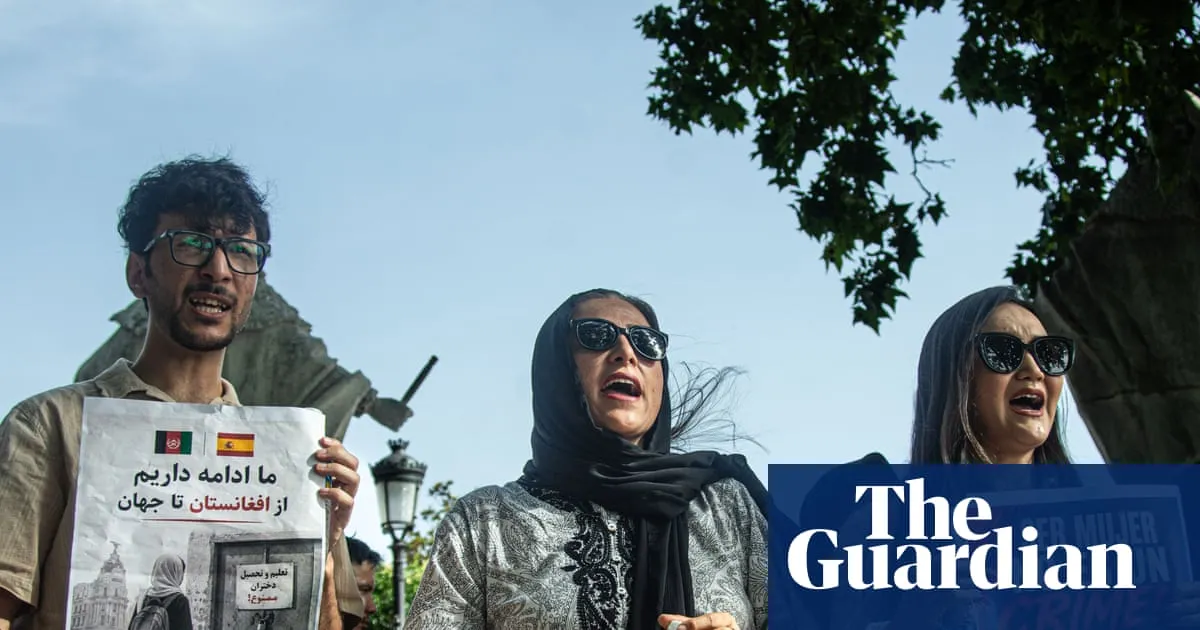
There is increasing concern over restrictions imposed on women across Afghanistan. Photograph: Francesco Militello Mirto/NurPhoto/Shutterstock View image in fullscreen There is increasing concern over restrictions imposed on women across Afghanistan. Photograph: Francesco Militello Mirto/NurPhoto/Shutterstock Thursday briefing: Why EU-Taliban talks have sparked outrage among Afghan women In today’s newsletter: Amid rising anti‑immigration rhetoric across Europe, the decision to engage with the Taliban signals a profound shift in how the EU balances security and human rights Good morning. It’s a slap in the face. That’s the phrase I kept hearing – in furious overnight messages, in blazing opinion columns – as Afghan women responded to the meeting between EU officials and the Taliban that took place in Brussels on Tuesday. The talks, to discuss how to scale up the deportation of Afghan migrants, were met with widespread outrage, and disbelief that Europe would countenance offering legitimacy to a regime that affords a bird better protections than a woman. For today’s First Edition, I spoke to our European community affairs correspondent Ashifa Kassam about the reaction to this meeting, what it tells us about European migration policy and the insidious consequences of normalisation. But first the headlines. World news | Venezuela’s interim leader has declared a state of emergency after the country was struck by two powerful earthquakes that collapsed dozens of buildings and killed at least 32 people, with experts warning the death toll could rise significantly. Heatwave | The UK has broken its all-time temperature record for June and France has recorded its hottest day ever for the second day running, as a heatwave affecting more than 90 million people sweeps across swathes of Europe. UK politics | Donald Trump has labelled Andy Burnham “extremely liberal”, in his first public comments about the former Greater Manchester mayor since he emerged as the frontrunner to replace Keir Starmer. Europe news | The first case of Ebola has been confirmed in France, the country’s health ministry has said, in a doctor who had returned from a humanitarian mission to an area affected by the outbreak in the DRC. UK news | A little-known system in which US military personnel are tried through a court martial for alleged crimes committed in the UK is under growing scrutiny. In depth: ‘Our suffering doesn’t amount to anything’ View image in fullscreen Women and girls in Afghanistan have faced growing oppression in the last five years since the Taliban returned to power. Photograph: Qudratullah Razwan/EPA In the five years since the Taliban regime swept back to power in Kabul after the chaotic 2021 withdrawal of US and Nato troops, the rights of women and girls have been mercilessly constricted: no schooling beyond the age of 11, exclusion from the job market and public spaces, and a brutal new marriage law that perpetuates domestic violence and child abuse. “This is something that the EU has been very vocal in condemning,” Ashifa says, pointing me to consecutive resolutions passed by the European parliament, earlier this year stating “Afghan women and girls have been subjected to systematic persecution.” “Women’s lives have shrunk incredibly and it’s been horrific to watch from the outside,” Ashifa continues. And yet after 20 member states called for concrete pathways to deport Afghans without legal residence permits, the European Commission confirmed a meeting with the Taliban was being arranged. The talks, which took place on Tuesday, would focus on those who “pose a security threat” to the EU, a spokesperson said. And that’s an apparent piece of legerdemain right there, says Ashifa, speaking to me from Spain. “When European officials did admit they were having talks, they emphasised that deportations would focus on people who had committed crimes or were seen as security threats. But when the invitation letter went to Taliban officials, it referenced Afghans with no legal right to be in the EU. That’s two very different things.” Following angry protests outside the Brussels parliament and condemnation from human rights campaigners, the EU stands accused of allowing the far right’s anti-immigration rhetoric to set its policy agenda, putting lives in danger and legitimising a repressive regime. The European parliament has shifted its centre of political gravity over recent years, with a record number of right wing MEPs elected in 2024. According to EU data, member states received about 1 million asylum applications from Afghans between 2013 and 2024, with roughly half approved. While numbers have fallen since 2022, people from Afghanistan still made up the highest number of applicants last year, with many in Germany, which has the largest Afghan community in the bloc. Many Afghans fled after the Taliban’s return to power, fearing reprisals for working with US and allied forces, directly or indirectly, and for opposing their oppressive theocratic regime. In fact Ashifa reminds me that in 2021, when the Taliban’s return was imminent, EU countries made significant efforts to evacuate embassy staff and others at risk including journalists, human rights campaigners and prominent women. Contrary to the standard trope that asylum seekers are younger males, “women came over, and we know that they would be in huge danger if they were sent back”. “You could also be deporting people who were opponents of the Taliban when the US had its puppet regime there, who face persecution if they return”. There’s no official breakdown from member states on who is applying from Afghanistan, how long they’ve been in the EU or what happens when their claims are rejected. A report published by the UN last year found that many Afghans who were returned to the country, most by Pakistan and Iran, experienced arbitrary arrest, detention, torture and ill treatment at the hands of the authorities. Moreover, Ashifa points out that the country is in the grip not just of a human rights crisis but a humanitarian one: about 40% of the population is affected by hunger. “What happens if we send people back to this country that is not in any kind of shape to be receiving them?” she asks, “and how can the EU say that it’s guaranteeing the rights of the people it is deporting?” Ashifa tells me about a group of teenagers, some as young as 16 and 17, she met last October in Serbia, who were trying to make it into the EU without papers . “They were children who should’ve been in high school or university. And instead they’re being tortured by human traffickers because they’re so desperate to earn money for their starving families.” This shift in dealing with the Taliban is part of a broader hardening of the EU’s policy on asylum and migration and it’s critical, says Ashifa, to understand the context of “a parliament that is very focused on the idea of deportation and willing to steamroll its international rights obligations”. In June, the parliament passed a tranche of updates to the EU migration and asylum pact, which human rights organisations warn could facilitate “ICE-style” detection, raids, detention and offshore return practices across Europe. As soon as it was passed, Ashifa recalls, the parliament erupted with cheers from right wing MEPs and chants of “send them back”, countered with shouts of “shame on you” from progressives . “International law states that asylum cases must be considered individually, but what you saw there was a group rejection,” she says. “That moment captured how for some lawmakers in the EU, international human rights obligations are secondary to the imperative of getting rid of these people and fortifying borders.” There is, however, a notable exception in Spain, where Ashifa is based. “Like most of Europe, there’s a looming demographic crisis here. But unlike the rest of Europe, the centre left coalition government has led a facts-based conversation on the importance of migration.” It is worth taking a moment to absorb the potential consequences of a diplomatic transaction that normalises gender apartheid. There has been no official read out of what was agreed or discussed at the meeting – even the venue was kept secret – but the leader of the Afghan delegation has said discussions included possible resumptions of consular services. “So we know that the EU wants to send back these people. But what is the Taliban getting out of this?” asks Ashifa. “Are the EU willing to send cash to the Taliban? Are they going to legitimise them by having more Taliban officials across the continent, which then becomes a safety issue for these diaspora communities?” Although EU officials have insisted this meeting does not amount to any kind of recognition of the Taliban, “it’s definitely normalising,” says Ashifa. “You can’t host a meeting in Brussels and give out visas without legitimising them”. Zahra Nader is editor-in-chief of Zan Times, a newsroom-in-exile that regularly collaborates with the Guardian. Like our other long-term partners Rukshana Media, they are journalism collectives run on an absolute shoestring that employ Afghan women working undercover, often at substantial risk. Messaging on the day of the EU-Taliban meeting, her fury was palpable. “It is indeed a slap in the faces of Afghan women,” she told me. “The EU is telling us that our suffering, being stripped of our most basic rights for five years now, doesn’t amount to anything. That a regime can erase women from public life entirely, and still be worth sitting down with”. “It is a complete disregard for human rights, and it is especially painful coming from countries that claim to champion women’s rights when it’s convenient, and then abandon that claim the moment it isn’t.” What else we’ve been reading View image in fullscreen A sand cat is the world’s only felid adapted to true desert conditions. Photograph: Mohammed Almuntasir I was gripped by the story of how wildlife photographer Mohammed Almuntasir inadvertently discovered the “ghost of the desert” in Libya. Patrick Who doesn’t love a quirky collection? Elizabeth McCafferty shares the story behind her new book about airline sick bags, Sicko. Libby From care homes to zoos, Guardian correspondents have been speaking with different sectors about how they are handling the heat. Patrick World Cup 2026 View image in fullscreen Vinícius Júnior and Rayan celebrate as Scott McKenna holds his head in his hands. Photograph: Marta Lavandier/AP Scotland 0-3 Brazil | Scotland’s World Cup dream is hanging by a thread after a brace from Vinícius Júnior and a goal from Matheus Cunhaconfirmed Brazil as group winners. Meanwhile Morocco scored a thumping 4-2 win against Haiti, in an action-packed game. Group A | Mexico are Group A winners after three second-half goals secured victory against a disappointing Czechia; South Africa progressed into their first World Cup knockouts with a win over South Korea, who now face an anxious wait. Group B | Switzerland have won the group, Canada have secured second place, while Bosnia must wait to see if four points and a goal difference of -1 is enough to progress deeper into the tournament. Fans | Take a look at this beautiful photoessay of World Cup viewing parties around the world. It is hard to beat Jordan’s Roman amphitheatre. Third place teams | The knockout stage is just days away. Cara Graham and Malaika Khan explain who needs what to go through to the next round – and the devilishly complicated iterations for the third place league table. World Cup Daily podcast | Max and Barry are hard at work in North America throughout the tournament producing an episode of the Guardian’s football podcast every day. You can watch or listen the all of the episodes at this link or on your favourite podcast platform. Sport View image in fullscreen England will face South Africa on the opening day of the Nations Championship but the competition will start without a title sponsor. Photograph: Kin Cheung/AP Rugby union | Qatar Airways has put its £80m sponsorship of rugby union’s new Nations Championship on hold due to the fallout from the war in the Middle East. The new competition will kick off next week without a title sponsor. The front pages View image in fullscreen Photograph: The Guardian The Guardian leads on the heatwave today with “The new normal”. On the maternity scandal, the Times writes “‘Cruel’ maternity care left hundreds dead or injured”, the Mail says “Arrogance of the men who wouldn’t listen” and the Mirror splashes “Never again”. The i Paper says “Failing water firms face state control under Burnham plans for power”, while the Telegraph has “Burnham cools on Miliband as chancellor”. The FT writes “Burnham plots ‘No10 of the north’ in push for radical devolution of power”, and Metro’s headline is “Kemi lashes out at Andy!”. Today in Focus: The Latest View image in fullscreen Photograph: The Guardian Hundreds of mothers and babies died or harmed at ‘toxic’ hospital trust A shocking report into the biggest ever maternity care scandal in the NHS has revealed more than 500 mothers and babies died or were harmed as a result of inadequate care in Nottingham. The review, led by the senior midwife Donna Ockenden, found there had been a dismissive attitude to women’s concerns, failures in maternity care, staff shortages, a toxic culture and racism at Nottingham university hospitals NHS trust. Lucy Hough speaks to the Guardian’s UK health and inequalities correspondent Tobi Thomas. Cartoon of the day | Nicola Jennings View image in fullscreen Illustration: Nicola Jennings/The Guardian The Upside A bit of good news to remind you that the world’s not all bad View image in fullscreen An area of stars in the galactic bulge, captured by the European Space Agency’s Euclid telescope. Photograph: ESA/Euclid/Euclid Consortium/NASA, CFHT. Image processing by J-C Cuillandre and E Bertin (CEA Paris-Saclay) The dazzling sight of more than 60m stars at the heart of our galaxy has been captured by a cutting edge space telescope. This new, breathtaking image, taken by the European Space Agency, is the largest and most detailed picture ever taken of the Milky Way. The €1bn (£862m) Euclid telescope is tasked with mapping the cosmos, in the hope of shedding fresh light on the mysterious dark forces that shape it. This image was taken after Euclid was pointed at the heart of the Milky Way for 26 hours. It marks the start of a new era of planetary exploration outside Earth’s solar system. “This data fires the starting pistol in a new age of exoplanet discovery,” says astrophysicist Dr Eamonn Kerins. And, it’s rather beautiful to (star)gaze at, too. And finally, the Guardian’s puzzles are here to keep you entertained throughout the day. Until tomorrow. Explore more on these topics Taliban First Edition newsletter Afghanistan Europe European Commission Human rights Violence against women and girls European Union newsletters Share Reuse this content
SRCThe Guardian - World News
LANGEN
LEANCenter-Left
WORDS2 440
ENT12
THU · 2026-06-25 · 05:47 GMTBRIEF NSR-2026-0625-87241
NSR-2026-0625-87241News Report·EN·Human Rights
Thursday briefing: Why EU-Taliban talks have sparked outrage among Afghan women
EU officials met with the Taliban in Brussels to discuss scaling up the deportation of Afghan migrants. This meeting has sparked outrage among Afghan women, who view it as a betrayal and a legitimization of a regime that severely restricts women's rights.
Libby BrooksThe Guardian - World NewsFiled 2026-06-25 · 05:47 GMTLean · Center-LeftRead · 10 min
The Guardian - World NewsFIG 01
Reading time
10min
Word count
2 440words
Sources cited
2cited
Entities identified
12entities
Quality score
100%
§ 01
Briefing Summary
AI-generatedNEWSAR · AI
EU officials met with the Taliban in Brussels to discuss scaling up the deportation of Afghan migrants. This meeting has sparked outrage among Afghan women, who view it as a betrayal and a legitimization of a regime that severely restricts women's rights. The talks, which focused on Afghans without legal residency or those deemed security threats, were criticized for potentially allowing anti-immigration rhetoric to dictate EU policy. The European Parliament has previously condemned the Taliban's systematic persecution of women and girls. The article also briefly mentions other global news, including earthquakes in Venezuela, a heatwave in Europe, an Ebola case in France, and scrutiny of US military court martials in the UK.
Confidence 0.90Sources 2Claims 5Entities 12
§ 02
Article analysis
Model · rule-basedFraming
Human Rights
Diplomatic
Tone
Mixed Tone
AI-assessed
CalmNeutralAlarmist
Factuality
0.60 / 1.00
Mixed
LowHigh
Sources cited
2
Limited
FewMany
§ 03
Key claims
5 extracted01
Venezuela has declared a state of emergency after two powerful earthquakes.
factual
Confidence
1.00
02
The Taliban regime has severely restricted the rights of women and girls since returning to power.
factual
Confidence
1.00
03
EU officials met with the Taliban in Brussels to discuss scaling up the deportation of Afghan migrants.
factual
Confidence
1.00
04
The EU's decision to engage with the Taliban signals a shift in balancing security and human rights.
factual
Confidence
0.90
05
Afghan women have responded with outrage and disbelief to the EU-Taliban meeting.
quoteAfghan women (reported)
Confidence
0.90
§ 04
Full report
10 min read · 2 440 words§ 05
Entities
12 identifiedKey playerOppositionContextPositiveNeutralNegative
§ 06
Keywords & salience
10 termseu-taliban talks
1.00
afghan women
1.00
human rights
0.90
migration policy
0.80
deportation
0.70
taliban
0.60
eu
0.60
restrictions on women
0.50
anti-immigration rhetoric
0.40
normalisation
0.40
§ 07
Topic connections
Interactive graph Network visualization showing 42 related topics
View Full Graph Person Organization Location Event|Click node to navigate|Edge numbers = shared articles