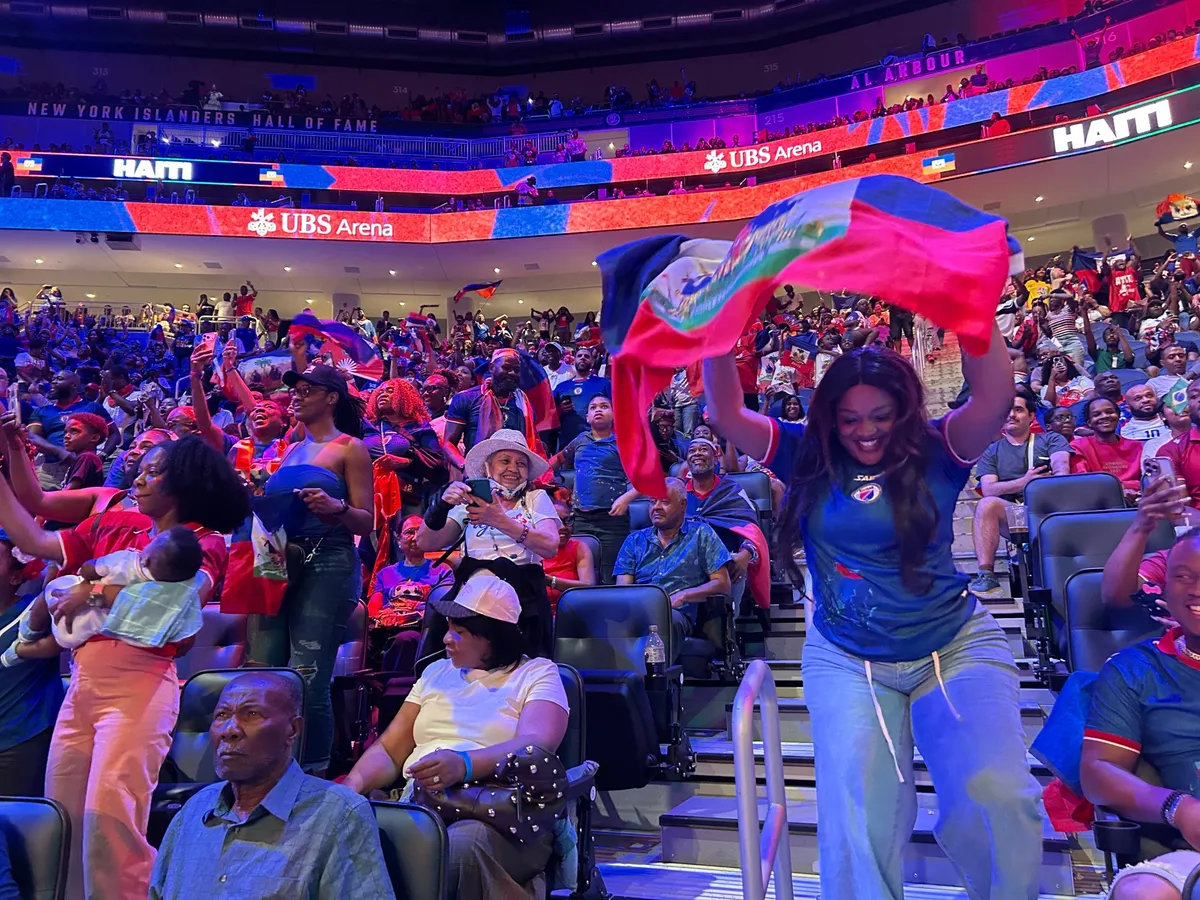
For Haitians in the US, the pride and joy of the World Cup comes with fearHaiti have come and gone at World Cup 2026, but the experience was about more than just football for its supporters.Haitian supporters cheered on their team at a World Cup watch party in New York, despite losing to Brazil [Lauren Ong/Al Jazeera]Published On 25 Jun 2026New York — Fifty-two years separated Haiti’s last two World Cup goals from the two scored against Morocco on Wednesday. For 52-year-old Murielle Lodvil, the wait spanned her entire lifetime.She was one of the many watching from the pockets of New York’s Little Haiti, where bars and restaurants fell quiet as fans watched the match unfold on screens before it burst into further chaos: an equaliser, a goal and then another equaliser in the frantic first half.Recommended Stories list of 4 itemslist 1 of 4Mexico maintain perfect World Cup record, top group and eliminate Czechialist 2 of 4South Africa stun South Korea to reach World Cup knockouts for the first timelist 3 of 4Morocco come back after historic Haiti goals to reach World Cup last 32list 4 of 4Vinicius nets twice and Neymar returns as Brazil ease by Scotlandend of listHaiti went into the last group match with Morocco with elimination already sealed, after losing to both Scotland and Brazil in Group C. Haiti would concede twice more, but the result did little to diminish the occasion for Murielle.As a birthday gift to herself, she bought tickets for her and 41-year-old sister, Barbara Albert, to watch Haiti face Brazil last week.“That is why Haiti participating on this world stage was so special to me,” she said. “Every moment of this experience counts, ending with two goals, even with the outcome.”Ms Albert said the experience at the Brazil match underscored the pride many supporters felt simply seeing Haiti return to the World Cup stage.“The representation was really good. We’re proud of our Haitian community. We really showed up for them,” she said.The sense of pride was also visible at the UBS Arena in Elmont, New York last Wednesday. The state is home to the country’s second-largest Haitian community, home to about 113,000 Haitian residents, according to the US Census Bureau in 2024.Last week, an hour before Haiti faced Brazil, the Haitian flags were already gone. The Brazil flags, handed out alongside them at the door, remained half-stacked on distribution tables.Thousands in wigs, Haitian jerseys and flags draped over their shoulders had filled the nearly sold-out, 19,000 seat stadium, with a handful in Brazilian yellow and green. Amid the sea of red and blue was Maude Schwartz, who waved a Haitian flag as she danced into the arena alongside her family, pumping her hands up in the air.The 58-year-old Pilates studio owner, who moved to the US from Haiti in 1990 on a student visa, had come seeking a taste of the World Cup atmosphere. While her twin sons were at the match, she was satisfied with a $10 ticket to the watch party.“Oh my goodness, my entire family is here,” she said, gesturing at the crowd around her.But not everyone that wanted to be here could make it. “I have a niece who has repeatedly been denied a visa to come to the United States,” she said.Her experience reflects broader constraints facing Haitian supporters. A travel ban imposed by the Trump administration, which began last year and was expanded in January, kept some supporters like Maude’s niece from attending.Supporters dressed in red and blue dominate the stands as they stream in for the match [Lauren Ong/Al Jazeera]Even players were affected. The defensive midfielder Woodensky Pierre, who lives in Haiti, was unable to travel to the United States to join the national team until 10 days before Haiti’s opening match against Scotland on June 13th.“This is a world event and people should not be denied entry to this country,” said 55 year old Jean-Marc, a former player in the Long Island Football League dressed in a Haitian jersey and a wig dyed in the national colours. Born in the US to Haitian parents, he spent part of his childhood in Haiti before returning in 1986, following the fall of the Duvalier regime many called a dictatorship.Watching Haiti compete in the country he has lived in for decades, he called it a “momentous event for all Haitians”.An arena full of gasps and sighs as Brazil scored three goals before half-time [Lauren Ong/Al Jazeera]‘Afraid of a raid’Back in Flatbush, the Brooklyn neighbourhood that many call Little Haiti, Nadege Fleurimond has thrown open the doors of her Haitian-Caribbean restaurant, BunNan, for every Haiti match, offering those priced out of the stadium, a way in.She came to the United States from Haiti as a seven-year-old and has watched immigration uncertainty touch nearly every Haitian family she knows. Watching Haiti’s World Cup run in the country where she built her life carried its own weight.“I am Haitian, and I am also American,” she said. “The United States gave me opportunities, education and the ability to build businesses and create jobs. Haiti gave me my roots, my values, my resilience and my culture,” she added.“It’s a reminder that immigrants don’t have to choose one identity over the other,” she added.For Fleurimond, who grew up hearing more stories about what Haiti couldn’t do than what it could, the team’s appearance alone in the World Cup was enough.“It was proof that we belong in rooms and on stages people often count us out of,” she said.
SRCAl Jazeera
LANGEN
LEANCenter
WORDS916
ENT11
THU · 2026-06-25 · 13:11 GMTBRIEF NSR-2026-0625-87335
NSR-2026-0625-87335News Report·EN·Human Interest
For Haitians in the US, the pride and joy of the World Cup comes with fear
Haitian supporters in the US experienced a mix of pride and fear during the 2026 World Cup, despite Haiti's early elimination. Many gathered in New York's Little Haiti and at the UBS Arena to cheer on their team, celebrating their return to the World Cup stage and the goals scored after a 52-year drought.
Lauren OngAl JazeeraFiled 2026-06-25 · 13:11 GMTLean · CenterRead · 4 min
Al JazeeraFIG 01
Reading time
4min
Word count
916words
Sources cited
3cited
Entities identified
11entities
Quality score
100%
§ 01
Briefing Summary
AI-generatedNEWSAR · AI
Haitian supporters in the US experienced a mix of pride and fear during the 2026 World Cup, despite Haiti's early elimination. Many gathered in New York's Little Haiti and at the UBS Arena to cheer on their team, celebrating their return to the World Cup stage and the goals scored after a 52-year drought. However, the joy was tempered by the reality of immigration challenges, with some fans unable to attend due to visa denials and travel bans. Players also faced travel delays, impacting their preparation. For Haitian immigrants and their families in the US, the tournament highlighted their dual identity and the ongoing uncertainties surrounding immigration.
Confidence 0.90Sources 3Claims 5Entities 11
§ 02
Article analysis
Model · rule-basedFraming
Human Interest
Tone
Measured
AI-assessed
CalmNeutralAlarmist
Factuality
0.60 / 1.00
Mixed
LowHigh
Sources cited
3
Well sourced
FewMany
§ 03
Key claims
5 extracted01
Barbara Albert stated that Haiti's representation at the World Cup was 'really good' and that they 'really showed up for them'.
quoteBarbara Albert
Confidence
1.00
02
Murielle Lodvil described Haiti's participation in the World Cup as 'so special' and that 'every moment of this experience counts'.
quoteMurielle Lodvil
Confidence
1.00
03
The state of New York is home to the country's second-largest Haitian community, with about 113,000 residents in 2024.
statisticUS Census Bureau
Confidence
1.00
04
Haitian supporters watched the World Cup match in New York's Little Haiti.
factual
Confidence
1.00
05
Haiti scored two goals against Morocco in the World Cup, marking their first goals in 52 years.
statistic
Confidence
1.00
§ 04
Full report
4 min read · 916 words§ 05
Entities
11 identifiedKey playerOppositionContextPositiveNeutralNegative
Organizations1
Locations7
§ 06
Keywords & salience
8 termsworld cup
1.00
haitian community
0.90
national pride
0.80
haiti
0.70
football
0.60
representation
0.50
us
0.50
new york
0.40
§ 07
Topic connections
Interactive graph Network visualization showing 23 related topics
View Full Graph Person Organization Location Event|Click node to navigate|Edge numbers = shared articles