The US supreme court has found in favor of the former Monsanto company in a ruling that is expected to block thousands of lawsuits filed by people alleging the key ingredient in the weed killer Roundup causes cancer.The decision was made in a 7-2 vote, with Justice Brett Kavanaugh offering the majority opinion and justice Ketanji Brown Jackson writing the dissenting opinion, joined by justice Neil Gorsuch.The case, Monsanto-v-durnell" class="entity-link entity-event" data-entity-id="152664" data-entity-type="event">Monsanto v Durnell, specifically dealt with the question of whether a federal law that gives the Environmental Protection Agency (EPA) regulatory authority over pesticides preempts state claims that a company failed to warn users of certain product risks when the EPA itself has not required such warnings.“Fifra expressly preempts Durnell’s state-law failure-to-warn claim,” reads the opinion written by justice Brett Kavanaugh, pointing to the Federal Insecticide, Fungicide and Rodenticide Act (Fifra).In her dissenting opinion, justice Jackson said: “Fifra expressly limits States’ authority to regulate pesticide labels, but it does not eliminate that authority,” adding that “Fifra’s preemption clause does not block state-law claims where the violation of state law is also a violation of Fifra.”“In accepting Monsanto’s argument and holding that Durnell’s failure-to-warn claim is preempted, the Court misunderstands Fifra’s requirements, misinterprets the scope of Fifra’s preemption, and ultimately leaves Durnell without a remedy for the significant harms he has suffered,” she wrote.The case at the heart of the decision deals with Monsanto’s glyphosate – a weedkilling chemical used in the popular Roundup brand and numerous other herbicide products sold by the former Monsanto company, which is now owned by Germany’s Bayer.The chemical has been scientifically linked to cancer in multiple studies, and was classified a probable human carcinogen by an arm of the World Health Organization in 2015.Bayer has spent the last decade fighting more than 100,000 lawsuits filed by people who developed non-Hodgkin lymphoma they blamed on exposure to the glyphosate weedkillers, and the company has paid out billions of dollars in jury awards and settlements. All of the cases include allegations that the company failed to warn that glyphosate could cause cancer.Bayer maintains that its products don’t cause cancer, and also asserts that under the Fifra) the EPA is the key authority for determining if its product necessitated a cancer warning. The EPA has not required such a warning and has taken the position that glyphosate is “unlikely” to be carcinogenic, so the company cannot be held liable for failing to warn, according to Bayer’s argument.In the Thursday ruling, the supreme court upheld this argument. “In accordance with EPA’s view that glyphosate is not likely to cause cancer in humans, EPA has not required labels on glyphosate-based pesticides like Roundup to include a cancer warning,” the decision says.Bayer praised the ruling while environmental and public health groups groups criticized it.In a statement, Bayer described the ruling as “good for science, farmers, and industries that depend on regulatory clarity for innovation”.The ruling “should help significantly contain the Roundup litigation after nearly a decade of legal battles”, Bayer wrote in its statement. “The ruling should result in the dismissal of current warning-based claims and bar future failure-to-warn claims.”In a statement, Patti Goldman, senior attorney at environmental legal nonprofit Earthjustice, said: “The fact that EPA approved a pesticide label does not mean a product is safe, and it should not become a shield for companies that fail to warn about cancer risks, neurological harm, and other serious dangers.”The court’s decision means the failure-to-warn claims included in several thousand lawsuits pending against Monsantocannot go forward. Similarly, thousands of such claims pending against pesticide maker Syngenta cannot proceed. In the Syngenta cases, plaintiffs allege they developed Parkinson’s disease due to exposure to the company’s paraquat weed killer. Syngenta maintains that the evidence linking paraquat to Parkinson’s disease is “fragmentary” and “inconclusive”.“Once again, the Supreme Court has sided with big business over people and the environment,” said Tarah Heinzen, legal director of green advocacy group Food and Water Watch, in a statement.Nathan Donley, the environmental health science director at the environmental non-profit Center for Biological Diversity, said: “This Trump-blessed ruling preventing Americans’ from seeking justice for serious health problems linked to an EPA-approved pesticide means that now, more than ever, we need an EPA that protects people instead of foreign pesticide companies.”“The need to profoundly reform our industry-captured system of pesticide regulation could not be clearer,” he said.Farmer-led advocacy group Farm Action said that though it is disappointed with the decision, “this fight is far from over.”“No corporation should be allowed to use its market power or political influence to put itself above the law,” the organization’s president Angela Huffman said in a statement. “We will continue defending the fundamental right to seek justice.”This story is co-published with the New Lede, a journalism project of the Environmental Working Group
SRCThe Guardian - World News
LANGEN
LEANCenter-Left
WORDS794
ENT12
THU · 2026-06-25 · 15:50 GMTBRIEF NSR-2026-0625-87376
NSR-2026-0625-87376News Report·EN·Legal & Judicial
US supreme court blocks thousands of lawsuits over Roundup maker’s pesticide warning labels
The US Supreme Court ruled 7-2 in favor of the former Monsanto company in *Monsanto v. Durnell*, a case concerning lawsuits alleging Roundup's weedkiller causes cancer.
Carey Gillam and Dharna NoorThe Guardian - World NewsFiled 2026-06-25 · 15:50 GMTLean · Center-LeftRead · 4 min
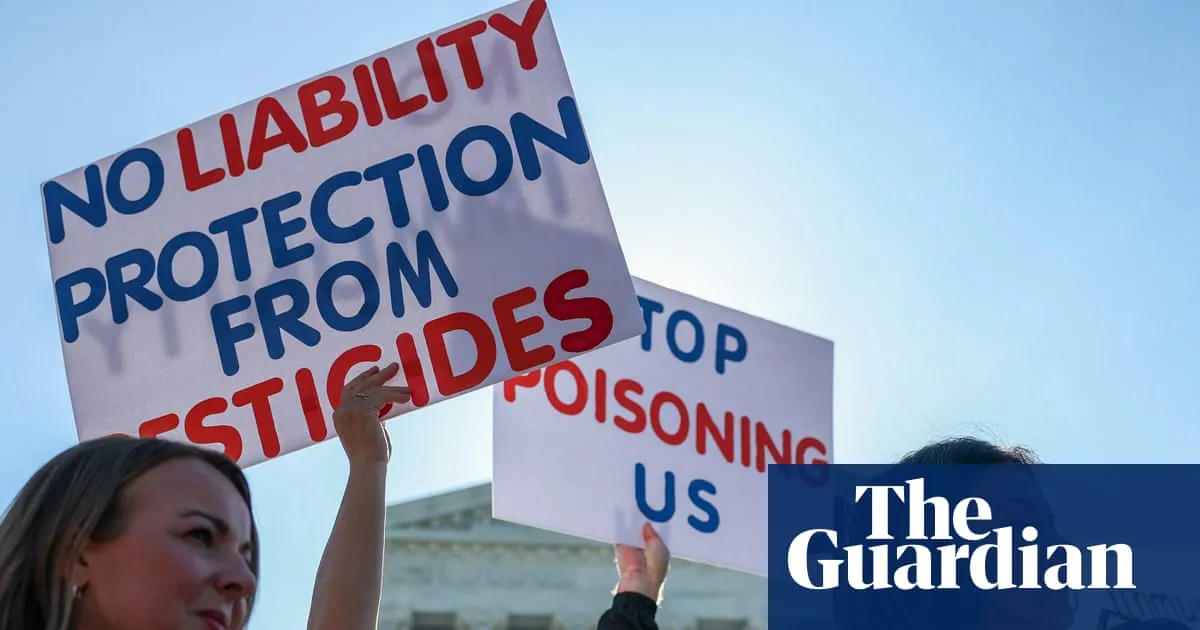
The Guardian - World NewsFIG 01
Reading time
4min
Word count
794words
Sources cited
4cited
Entities identified
12entities
Quality score
100%
§ 01
Briefing Summary
AI-generatedNEWSAR · AI
The US Supreme Court ruled 7-2 in favor of the former Monsanto company in *Monsanto v. Durnell*, a case concerning lawsuits alleging Roundup's weedkiller causes cancer. The majority opinion, written by Justice Kavanaugh, held that the Federal Insecticide, Fungicide, and Rodenticide Act (FIFRA) preempts state-law failure-to-warn claims when the Environmental Protection Agency (EPA) has not required such warnings. This decision is expected to block thousands of lawsuits against Bayer (which owns Monsanto) and Syngenta, as well as future claims. Justices Jackson and Gorsuch dissented, arguing FIFRA does not eliminate states' authority to regulate labels or block claims where state law violations also violate FIFRA. Bayer praised the ruling for providing regulatory clarity, while environmental groups criticized it for siding with corporations over public health.
Confidence 0.90Sources 4Claims 5Entities 12
§ 02
Article analysis
Model · rule-basedFraming
Legal & Judicial
Public Health
Tone
Measured
AI-assessed
CalmNeutralAlarmist
Factuality
0.80 / 1.00
Factual
LowHigh
Sources cited
4
Well sourced
FewMany
§ 03
Key claims
5 extracted01
Bayer maintains Roundup does not cause cancer and that the EPA's stance on glyphosate's safety prevents liability for failure to warn.
factualBayer
Confidence
1.00
02
Glyphosate, Roundup's key ingredient, has been linked to cancer in multiple studies and classified as a probable carcinogen by WHO.
factualarticle
Confidence
1.00
03
Justice Jackson's dissent argues FIFRA does not eliminate state authority to regulate labels and that the majority misunderstands FIFRA's scope.
quoteJustice Ketanji Brown Jackson
Confidence
1.00
04
The ruling, based on a 7-2 vote, holds that federal pesticide law (FIFRA) preempts state claims for failure to warn when EPA hasn't required such warnings.
factualarticle
Confidence
1.00
05
US Supreme Court ruled in favor of Monsanto (now Bayer) in lawsuits alleging Roundup's key ingredient causes cancer.
factualarticle
Confidence
1.00
§ 04
Full report
4 min read · 794 words§ 05
Entities
12 identifiedKey playerOppositionContextPositiveNeutralNegative
Organizations6
Locations1
§ 06
Keywords & salience
10 termsus supreme court
1.00
glyphosate
1.00
roundup
1.00
cancer lawsuits
0.90
pesticide warning labels
0.90
preemption
0.80
fifra
0.80
monsanto
0.70
epa
0.60
bayer
0.50
§ 07
Topic connections
Interactive graph No topic relationship data available yet. This graph will appear once topic relationships have been computed.