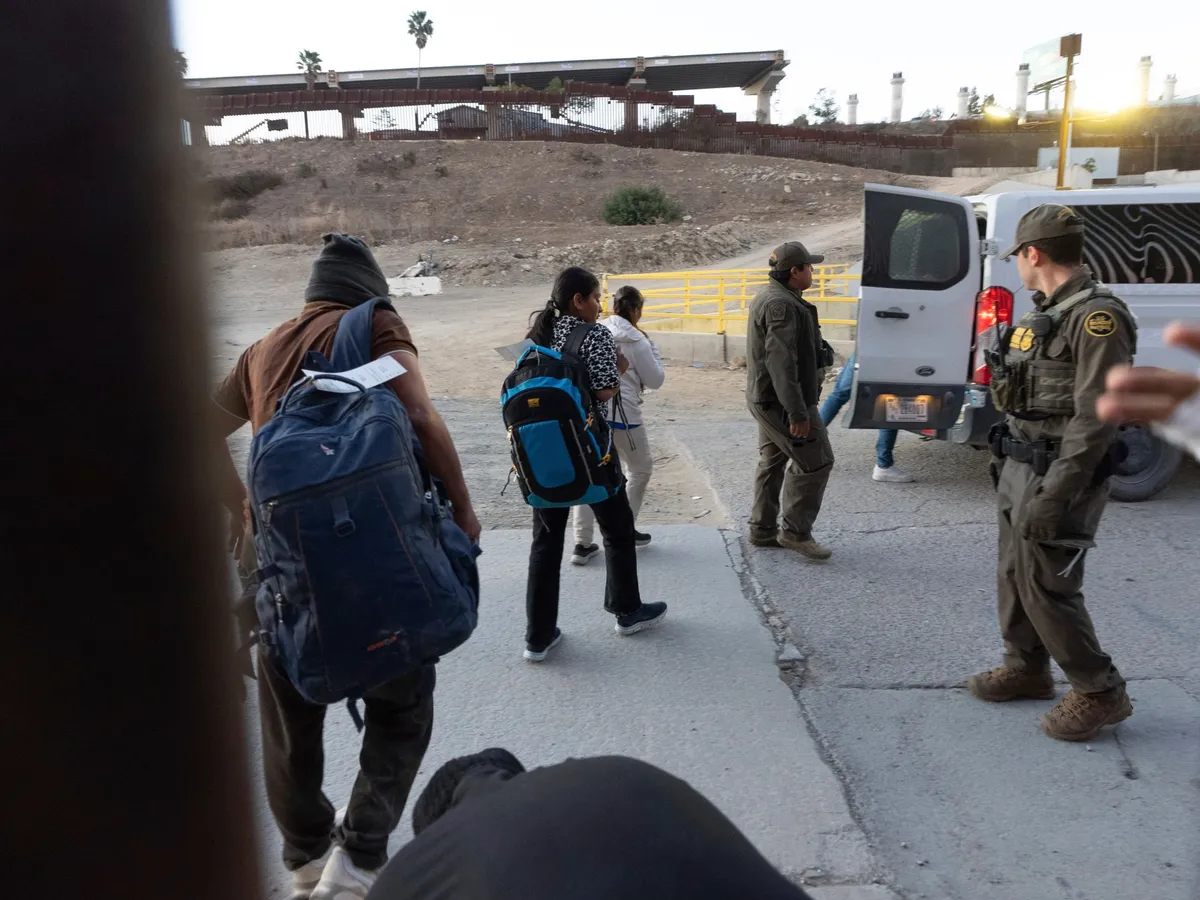
The court’s three liberal justices dissented, saying the ruling ‘circumvents’ US law by allowing agents to prevent asylum seekers from making a claim.asylum seekers make their way to a US Border Patrol van in January 2025 in San Diego, California, the US [File: Gregory Bull/AP Photo]Published On 25 Jun 2026The United States Supreme Court has ruled that government officials can turn away asylum seekers at the southern border with Mexico if they have not yet set foot on US soil.The ruling on Thursday clears the way for the administration of President Donald Trump to revive a controversial policy known as “metering”, in which immigration agents physically block those seeking asylum from crossing the border.Recommended Stories list of 3 itemslist 1 of 3US appeals court rejects Trump’s ban on asylum seekers, teeing up appeallist 2 of 3Minorities at World Cup fear ICE threat and how US immigration is enforcedlist 3 of 3Judge strikes down Trump bar on asylum, visa processing for 39 countriesend of listRights groups have argued that the practice is a way of bypassing domestic law requiring the US to grant the right to apply for asylum to anyone arriving in the country. They also point out that physically blocking individuals from seeking asylum incentivises more dangerous routes.The 6-3 ruling broke down along ideological lines, with the court’s six conservative justices ruling in favour and the three liberal justices dissenting.In the majority opinion, Justice Samuel Alito pointed to the provision of the Immigration and Nationality Act (INA) that says a foreigner who “arrives in the United States” may apply for asylum and must be inspected by a federal immigration official.“The wisdom of the policy of metering alien arrivals at the southern border is not before us,” Alito wrote. “We decide only that an alien standing in Mexico does not ‘arriv[e] in the United States’. The INA neither entitles such an alien to apply for asylum nor requires an immigration officer to inspect him.”The ruling reverses a lower court’s decision that found the practice of “metering” illegal. The Trump administration, which has taken a hardline approach to all forms of immigration to the US, had appealed the lower court’s decision.The practice predates Trump, with former President Barack Obama using “metering” to turn people away at the southern border in the final year of his presidency, amid a dramatic uptick in crossings.Trump formalised the strategy during his first term, allowing border agents to decline asylum claims when they deem they no longer have the necessary resources to process them. The administration of US President Joe Biden ended the practice in 2021.In a scathing dissent, Justice Sonia Sotomayor said the majority’s ruling allows the White House to “circumvent” legal procedures designed to assure every asylum case is individually assessed.She also underscored the cruelty of authorities refusing asylum seekers who escaped persecution and arrived at the US border, only to be turned away.“They may do so even if the asylum seeker is at the threshold of a port of entry designated to receive all noncitizens who seek entrance into the country. Even if the port of entry has ample capacity to inspect that person, including an available asylum officer trained to process asylum applications,” she wrote.“Even if the asylum seeker is certain to be persecuted, or killed, if she is turned away.”Sotomayor further said the majority’s “illogical interpretation is driven almost entirely by a fixation on a single word: ‘in.'” She argued the majority failed to consider the “statutory context and history” of how the word is used.The ruling comes shortly after a federal judge in early June ruled the Trump administration must lift a separate blanket pause on processing asylum cases, which the administration had imposed due to what it called a border “emergency”.Haiti and Syria TPS rulingIn another immigration ruling on Thursday, the top court cleared the way for the Trump administration to strip legal protections from hundreds of thousands of Syrians and Haitians living in the US with Temporary Protected Status (TPS).The status is granted when it is deemed unsafe for citizens of a country to return to their homelands, in light of armed conflict, political instability or natural disaster.About 350,000 Haitians and 6,100 Syrians are believed to currently be living in the US under TPS. Following Thursday’s ruling, those with TPS were subject to losing their work authorisation and could be subject to deportation.Justice Alito again wrote the majority opinion, saying that the US law on TPS “plainly bars” judicial review of the executive branch’s decision.Alito also opposed a lower court’s finding that Trump’s actions towards Haitians were likely motivated by “racial animus”.Plaintiffs in that case had pointed to Trump’s campaign comments, including spreading unfounded claims that Haitians living in Ohio were killing and eating pets.
SRCAl Jazeera
LANGEN
LEANCenter
WORDS787
ENT12
THU · 2026-06-25 · 16:15 GMTBRIEF NSR-2026-0625-87410
NSR-2026-0625-87410News Report·EN·Legal & Judicial
US Supreme Court paves way for government to block asylum seekers at border
The US Supreme Court has ruled that government officials can prevent asylum seekers from filing claims if they have not yet physically entered the United States. This 6-3 decision, with conservative justices in the majority and liberal justices dissenting, allows the revival of a policy called "metering," where agents physically block individuals at the border.
Joseph StepanskyAl JazeeraFiled 2026-06-25 · 16:15 GMTLean · CenterRead · 4 min
Al JazeeraFIG 01
Reading time
4min
Word count
787words
Sources cited
3cited
Entities identified
12entities
Quality score
100%
§ 01
Briefing Summary
AI-generatedNEWSAR · AI
The US Supreme Court has ruled that government officials can prevent asylum seekers from filing claims if they have not yet physically entered the United States. This 6-3 decision, with conservative justices in the majority and liberal justices dissenting, allows the revival of a policy called "metering," where agents physically block individuals at the border. Liberal justices argued this circumvents US law, which requires the right to apply for asylum. The ruling reverses a lower court decision and was appealed by the Trump administration. In a separate immigration decision, the court also cleared the way for the Trump administration to end Temporary Protected Status for hundreds of thousands of Haitians and Syrians.
Confidence 0.90Sources 3Claims 5Entities 12
§ 02
Article analysis
Model · rule-basedFraming
Legal & Judicial
Human Rights
Tone
Measured
AI-assessed
CalmNeutralAlarmist
Factuality
0.70 / 1.00
Factual
LowHigh
Sources cited
3
Well sourced
FewMany
§ 03
Key claims
5 extracted01
Justice Sotomayor stated the majority’s ruling allows the White House to “circumvent” legal procedures for asylum cases.
quoteJustice Sonia Sotomayor
Confidence
1.00
02
Justice Alito stated that an alien standing in Mexico does not ‘arriv[e] in the United States’ according to the INA.
quoteJustice Samuel Alito
Confidence
1.00
03
Rights groups argue the practice bypasses domestic law requiring the US to grant the right to apply for asylum to anyone arriving.
factualRights groups
Confidence
1.00
04
The ruling allows the administration to revive a controversial policy known as “metering”.
factual
Confidence
1.00
05
US Supreme Court ruled government officials can turn away asylum seekers at the southern border if they have not yet set foot on US soil.
factual
Confidence
1.00
§ 04
Full report
4 min read · 787 words§ 05
Entities
12 identifiedKey playerOppositionContextPositiveNeutralNegative
People4
Organizations3
§ 06
Keywords & salience
8 termsasylum seekers
1.00
us supreme court
0.90
border policy
0.80
metering
0.80
immigration law
0.70
southern border
0.60
trump administration
0.50
dissenting opinion
0.40
§ 07
Topic connections
Interactive graph No topic relationship data available yet. This graph will appear once topic relationships have been computed.