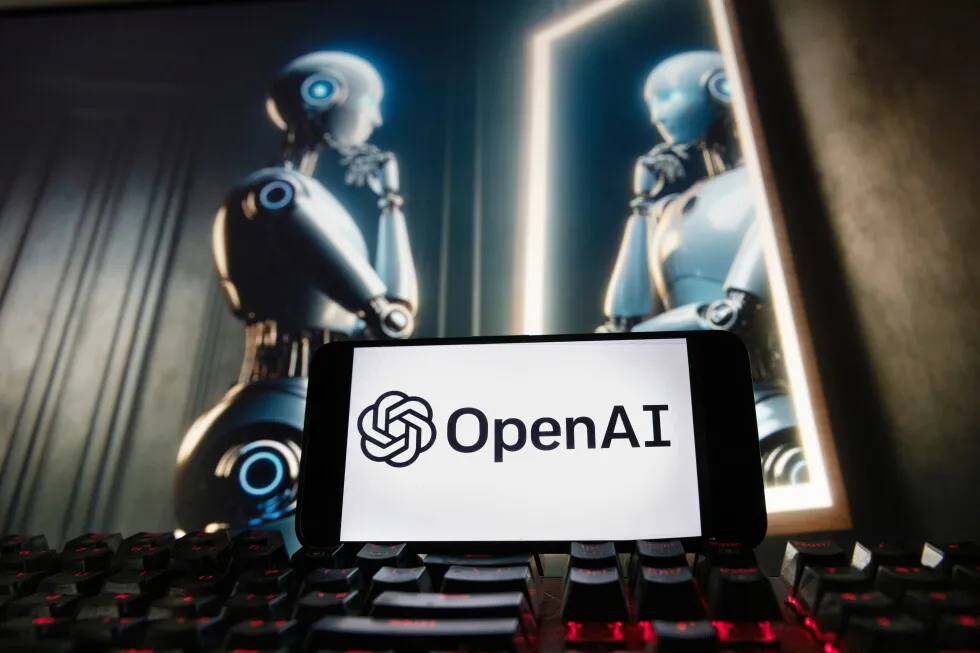
The OpenAI logo is displayed on a cellphone with an image on a computer monitor generated by ChatGPT’s Dall-E text-to-image model, Dec. 8, 2023, in Boston. (AP Photo/Michael Dwyer, File) By MATT O’BRIEN Updated 8:12 PM MESZ, June 26, 2026 Add AP News on Google Add AP News as your preferred source to see more of our stories on Google. Share Share Facebook Copy Link copied Print Email X LinkedIn Bluesky Flipboard Pinterest Reddit ChatGPT maker OpenAI said Friday it is restricting the release of its new Artificial Intelligence model at the request of President Donald Trump’s administration, the latest in an unprecedented government vetting of AI products that could pose cybersecurity risks. OpenAI said its new AI product, called GPT-5.6 Sol, would only be available for now to a “small group of trusted partners” approved by the Trump administration. “We don’t believe this kind of government access process should become the long-term default,” OpenAI said in a statement. The company said it viewed the testing period as a temporary step on the “path to broader availability in the coming weeks.” OpenAI’s staggered release of a powerful new AI system follows actions the government took earlier this month against OpenAI rival Anthropic, maker of the Claude chatbot. Anthropic took offline two new AI models, known as Fable 5 and Mythos 5, just days after publicly releasing them to comply with a Trump directive blocking their use by foreign nationals. The White House said Friday it continues to collaborate with frontier AI labs on addressing the challenges of scaling the fast-growing technology. Fear grips Haitian communities after Supreme Court ruling unwinds protection from deportation 4 MIN READ Black women’s non-profit awards grants to local Southern groups as part of joy-filled tour 3 MIN READ DC reaches court settlement with man detained while protesting troops’ patrol with Darth Vader song 2 MIN READ Officials have grown increasingly concerned since Anthropic warned earlier this year that its Mythos model was adept at finding software flaws in a way that could be weaponized by malicious hackers and threaten critical computer networks around the world. Trump earlier in June signed an executive order on AI oversight that established a framework for the federal government to vet the national security risks of the most advanced AI systems for up to 30 days before their public release. The order described participation by AI developers as voluntary but the framework has not yet been fully developed. San Francisco-based OpenAI said its new Sol model “is better at helping people find and fix vulnerabilities” than it is at carrying out cyberattacks and does not cross the company’s own risk threshold. But it acknowledged there could be unforeseen risks especially if its model is combined with other tools. “That uncertainty, along with the model’s broader step change in capabilities, is why we are pairing the model’s increased capabilities with stronger safeguards and a phased release,” the company said Friday. A broad group of cybersecurity experts has criticized the government’s actions that led Anthropic to shut down Fable, which the company had pitched as a safer version of Mythos. It’s now been unavailable for two weeks. “I just want to say that pretty much nobody in the cybersecurity industry believes that there’s any factual basis for this action,” Stanford University cybersecurity expert Alex Stamos said on a call with reporters earlier this week. Stamos, the chief product officer at AI security company Corridor and a former chief security officer at Facebook parent Meta, said he reviewed an analysis of research on Fable by Anthropic’s primary cloud computing backer, Amazon, and didn’t find any risks that aren’t present with other publicly available AI models, including those made in China. “If the administration is honest about wanting the United States to beat China in this race, then this is about the dumbest thing they could possibly do,” Stamos said. OpenAI CEO Sam Altman spoke with U.S. Commerce Secretary Howard Lutnick about the model release Wednesday, part of a series of negotiations in recent weeks between AI industry executives and Trump officials. Anthropic has also been part of those talks but its CEO Dario Amodei has had a more contentious relationship with the Trump administration. The Pentagon designated Anthropic as a national security risk for raising ethical and safety concerns about AI usage in war, and Trump himself ordered federal agencies to stop using Claude. Anthropic responded with a lawsuit that is still working its way through federal courts. MATT O’BRIEN O’Brien covers the business of technology and Artificial Intelligence for The Associated Press. mailto
SRCAssociated Press (AP)
LANGEN
LeanCenter
WORDS761
ENT12
FRI · 2026-06-26 · 17:23 GMTBRIEF NSR-2026-0626-87715
NSR-2026-0626-87715News Report·EN·National Security
OpenAI limits its newest ChatGPT product to Trump-approved customers during cybersecurity review
OpenAI is temporarily restricting access to its new AI product, GPT-5.6 Sol, to a select group of U.S. government-approved partners at the request of the Trump administration.
Associated Press (AP)Filed 2026-06-26 · 17:23 GMTLean · CenterRead · 4 min
Associated Press (AP)FIG 01
Reading time
4min
Word count
761words
Sources cited
3cited
Entities identified
12entities
NEWSAR · AI
OpenAI is temporarily restricting access to its new AI product, GPT-5.6 Sol, to a select group of U.S. government-approved partners at the request of the Trump administration. This decision follows an unprecedented government review of AI products for potential cybersecurity risks. OpenAI stated that while Sol is designed to help find and fix vulnerabilities, they acknowledge potential unforeseen risks. This move mirrors recent government actions against OpenAI rival Anthropic, which was directed to take down two of its AI models due to concerns about their potential misuse by malicious hackers. The Trump administration has implemented a framework for vetting advanced AI systems for national security risks, though participation by developers is voluntary. OpenAI views this restricted release as a temporary measure before broader availability.
Confidence 0.90Sources 3Claims 5Entities 12
Framing
National Security
Technology
Tone
Measured
AI-assessed
CalmNeutralAlarmist
Factuality
0.80 / 1.00
Factual
LowHigh
Sources cited
3
Well sourced
FewMany
01
Trump signed an executive order on AI oversight establishing a framework for the federal government to vet national security risks of advanced AI systems.
factualAP News
Confidence
0.95
02
Anthropic took offline two new AI models, Fable 5 and Mythos 5, to comply with a Trump directive blocking their use by foreign nationals.
factualAP News
Confidence
0.90
03
OpenAI is restricting the release of its new AI model, GPT-5.6 Sol, at the request of the Trump administration due to cybersecurity risks.
factualOpenAI
Confidence
0.90
04
The Trump administration is implementing an unprecedented government vetting process for AI products that could pose cybersecurity risks.
factualAP News
Confidence
0.85
05
Officials are concerned because Anthropic warned that its Mythos model could find software flaws weaponizable by malicious hackers.
factualAP News
Confidence
0.80
§ 04
Full report
4 min read · 761 wordsKey playerOppositionContextPositiveNeutralNegative
Organizations4
openai
1.00
artificial intelligence
1.00
cybersecurity
0.90
government vetting
0.80
ai products
0.70
trump administration
0.70
gpt-5.6 sol
0.60
national security risks
0.50
anthropic
0.40
ai oversight
0.40
§ 07
Connections
Who appears together in the newsIn this articleWider coverageLine weight = articles in common
Laying out network…
Strongest ties articles in common
- 15,001
- 1,409
- 1,179
- 810
- 795
- 337