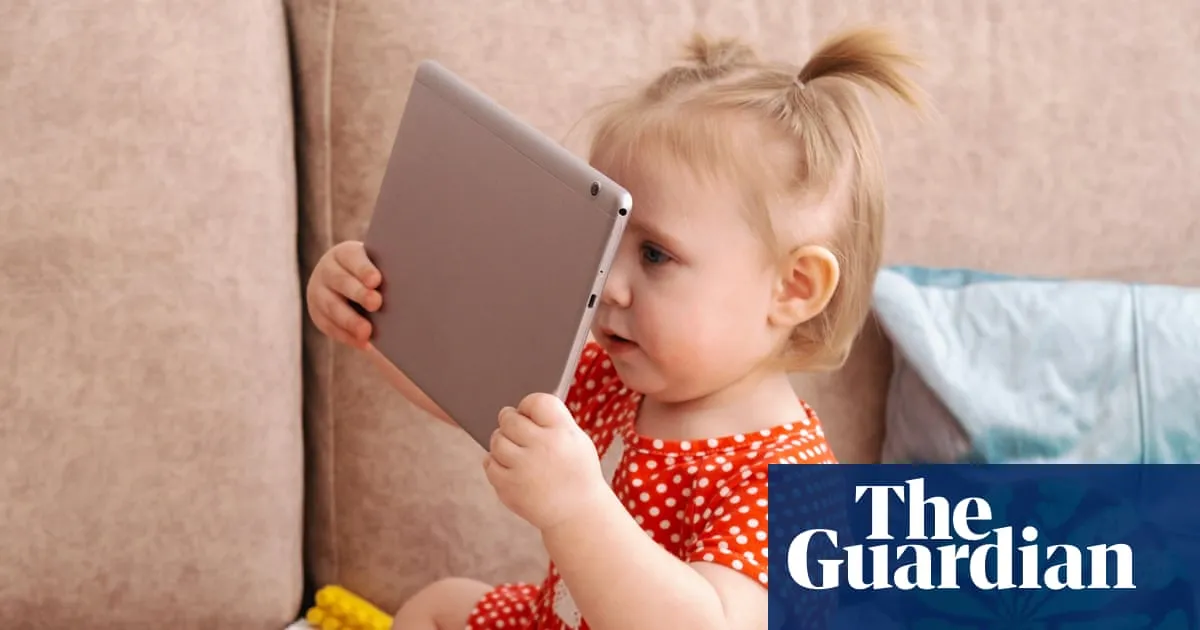
screen time for babies and toddlers under the age of two has been linked with long-term negative effects on health and quality of life and should be avoided, according to a landmark study.It warns that using screens during that period may lead to wide-ranging developmental concerns and calls for further urgent investigation of the risks smartphones, tablets and other digital devices pose to infants.With the focus on teenagers’ digital habits and government plans to ban under-16s from social media, researchers are concerned about a “baby blind spot” in policy at a time when screen use has become embedded in everyday parenting.Rafe Clayton, a senior lecturer in media and communication at the University of Leeds, who co-led the research, said parents – lacking guidance on their own screen use – were “inadvertently teaching children and babies to develop unhealthy habits and relationships with screen devices”.“This has to change,” he said.The study, described as the most comprehensive review yet of all available global research on the subject, calls on the government to reconsider its recently published guidance on screen time for under-fives.That recommends avoiding screen time for the under-twos but caveats the advice by adding, “other than shared activities that encourage bonding, interaction and conversation”.The new study, however, lays bare a wide range of potential harms associated with screen time for babies, including reduced opportunities to bond with parents and caregivers, less time for physical play with other children and limited language development.It says screen use at such a young age may increase overstimulation and difficulty sleeping, and have implications for eye health and childhood obesity. There are also concerns that infants are turning to digital devices for comfort and soothing, rather than to a parent.The review, conducted by researchers from four UK universities known as the Action on Digital Device Immersive Conditions Team, did not establish causal links between screen use and specific developmental conditions. However, it was emphatic that “no under-twos should receive regular intentional screen time. Passive exposure is societally unavoidable, so adding deliberate use compounds risk without any meaningful benefit.”It recommends that any official guidance that points under-twos towards regular “shared screen time, screen time for learning, screen time for communication and/or screen time for children experiencing disabilities/learning difficulties, should be reconsidered, since it may be misinterpreted by parents and caregivers to indicate safety or even encouragement.“This could potentially lead caregivers to believe that screen time for the under-twos is without developmental harm, which may result in an exacerbation of developmental delays and isolating behaviours for those who are already at greater risk.”As a result of their findings, the research team – from the universities of Leeds, Leeds Trinity, Loughborough and Aston – are calling for a “baby screen-time risk assessment” to help services provide targeted support for families where developmental vulnerabilities may be emerging.Carmen Clayton, professor of family and cultural dynamics at Leeds Trinity University and co-lead of the research, said: “The government must consider how to engage with families better about problematic screen use, whilst being sensitive to the fear of judgment that many parents face when opening up about such issues.”Andrea Leadsom, a former Conservative minister and founder of the 1,001 Critical Days Foundation, said: “This landmark review is a wake-up call. The evidence increasingly suggests that screens offer limited benefits for babies and may carry significant risks during the first 1,001 days, the most important period of human development.”She said parents should not be blamed for a problem they did not create. “The responsibility cannot rest solely on their shoulders. That is why every family should have access to a Best Start family hub, where they could access trusted advice and practical help during their baby’s earliest years.”Leadsom said technology companies should play their part. “Parents should not be presented with content that is labelled or promoted as suitable for babies when the evidence points to the contrary.”The children’s commissioner for England, Rachel de Souza, who helped draw up the government guidance, said it was intended to support – not replace – parental judgment.“For children under two, the recommendation to avoid screen time is clear, but acknowledges the realities of our world today and that some shared screen use in a limited number of circumstances, such as video-calling relatives or supported learning, is perfectly normal.”A Department for Education spokesperson said: “We’re proud of our first-of-its-kind screen time guidance for parents of under-fives, which provides clear, trusted support on an issue we know can be challenging for families.”
SRCThe Guardian - World News
LANGEN
LEANCenter-Left
WORDS743
ENT10
SAT · 2026-06-27 · 07:00 GMTBRIEF NSR-2026-0627-87856
NSR-2026-0627-87856News Report·EN·Public Health
Screen time can damage under-twos’ development, landmark study suggests
A landmark study suggests that screen time for babies and toddlers under two years old is linked to long-term negative effects on development, health, and quality of life, and should be avoided. Researchers from four UK universities reviewed global research and found potential harms including reduced bonding, less physical play, limited language development, overstimulation, sleep difficulties, and implications for eye health and obesity.
Sally Weale Education correspondentThe Guardian - World NewsFiled 2026-06-27 · 07:00 GMTLean · Center-LeftRead · 3 min
The Guardian - World NewsFIG 01
Reading time
3min
Word count
743words
Sources cited
2cited
Entities identified
10entities
Quality score
100%
§ 01
Briefing Summary
AI-generatedNEWSAR · AI
A landmark study suggests that screen time for babies and toddlers under two years old is linked to long-term negative effects on development, health, and quality of life, and should be avoided. Researchers from four UK universities reviewed global research and found potential harms including reduced bonding, less physical play, limited language development, overstimulation, sleep difficulties, and implications for eye health and obesity. The study calls for urgent investigation into the risks of digital devices for infants and urges reconsideration of current government guidance that allows for some shared screen time. The researchers advocate for a "baby screen-time risk assessment" to support vulnerable families and suggest technology companies should not promote content as suitable for babies if evidence suggests otherwise.
Confidence 0.90Sources 2Claims 5Entities 10
§ 02
Article analysis
Model · rule-basedFraming
Public Health
Technology
Tone
Mixed Tone
AI-assessed
CalmNeutralAlarmist
Factuality
0.70 / 1.00
Factual
LowHigh
Sources cited
2
Limited
FewMany
§ 03
Key claims
5 extracted01
Parents, lacking guidance, are inadvertently teaching children and babies to develop unhealthy habits and relationships with screen devices.
quoteRafe Clayton
Confidence
0.90
02
No under-twos should receive regular intentional screen time; passive exposure is unavoidable, but deliberate use compounds risk without meaningful benefit.
factualAction on Digital Device Immersive Conditions Team
Confidence
0.85
03
Screen time for babies and toddlers under two has been linked with long-term negative effects on health and quality of life.
factuallandmark study
Confidence
0.80
04
Using screens during the under-two period may lead to wide-ranging developmental concerns.
factuallandmark study
Confidence
0.75
05
Screen use at a young age may increase overstimulation, difficulty sleeping, and have implications for eye health and childhood obesity.
factualnew study
Confidence
0.70
§ 04
Full report
3 min read · 743 words§ 05
Entities
10 identifiedKey playerOppositionContextPositiveNeutralNegative
Organizations3
Locations1
§ 06
Keywords & salience
8 termsscreen time
1.00
child development
0.90
under-twos
0.80
digital devices
0.70
parenting
0.60
developmental concerns
0.50
landmark study
0.40
health effects
0.40
§ 07
Topic connections
Interactive graph No topic relationship data available yet. This graph will appear once topic relationships have been computed.