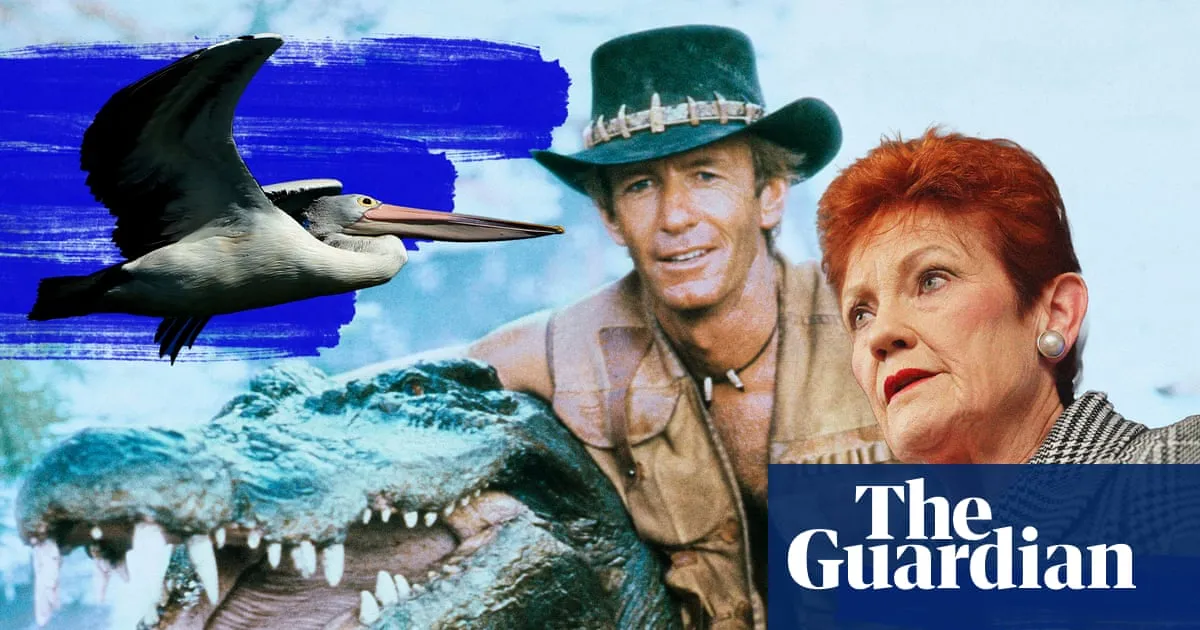
Paul Hogan, Pauline Hanson and a pelican. On Sunday the Australian actor reportedly called the senator a ‘pelican’ after being cited as an example of ‘monoculture’. Composite: Getty Images / Paramount / Guardian Design View image in fullscreen Paul Hogan, Pauline Hanson and a pelican. On Sunday the Australian actor reportedly called the senator a ‘pelican’ after being cited as an example of ‘monoculture’. Composite: Getty Images / Paramount / Guardian Design Analysis Paul Hogan has reportedly called Pauline Hanson a ‘pelican’. Please explain? Penry Buckley Crocodile Dundee was held up by the One Nation leader as an exemplar of ‘Australian monoculture’. Hoges had other ideas Get our breaking news email, free app or daily news podcast In one swift rhetorical blow, Crocodile Dundee has disarmed Pauline Hanson’s latest attack on multiculturalism. But his weapon of choice has left some scratching their heads. Australian politics has spent a week recovering from the rightwing One Nation leader’s attempt to explain her controversial concept of “Australian monoculture”, first introduced at this month’s National Press Club address. On Wednesday, in a Senate speech, the One Nation leader said: “Bring back Paul Hogan and Norman Gunston. These are the essential features of Australian monoculture, and there’s nothing remotely exclusionary about them.” In response, Crocodile Dundee star Hogan, tracked down by the Australian-financial-review" class="entity-link entity-organization" data-entity-id="123112" data-entity-type="organization">Australian Financial Review to Venice Beach, California, reached for a bird metaphor. “She’s a pelican, yeah,” he reportedly said (adding that Hanson “sounds very much like this stupid boofhead over here, Trump”). Hogan’s role in the Australian vernacular is contested. The 86-year-old national treasure is yet to fully recover from urging Americans to “throw another shrimp on the barbie”. But he’s a deep well of Australian slang, and is credited by academics for giving “G’day” international prominence. Fair dinkum. So going back to “pelican”, what does he mean exactly? Well, Hogan has prior form. In 1986’s Crocodile Dundee itself, his titular character tells a New York driver: “Get on the right side of the road, ya pelican!” Another Australian actor, Russell Crowe, reportedly tweeted after the Rabbitohs’ 2014 NRL grand final win that one of the club’s sponsors was a “pelican” after he was overhead to back the opposing team, the Canterbury-Bankstown Bulldogs. The executive said he had been misconstrued, and Crowe deleted the tweet. View image in fullscreen Two innocent penguins, who would very much like to be excluded from this narrative. Photograph: Jenny Evans/Getty Images Its usage as an insult goes back much further. In Act III scene 4 of King Lear, the eponymous character says of the grasping, power-hungry Goneril and Regan “‘twas this flesh begot/Those pelican daughters”. The New Oxford Shakespeare says of this line: “young pelicans supposedly fed on their mother’s blood”. Was Hogan reaching to Shakespeare to criticise Hanson’s ruthless political ambition? It seems … unlikely. Australians are of course no strangers to using native wildlife, and particularly birds, as insults: see also galah, bin chicken, drongo. A specific entry for “pelican” is absent from the Australian National Dictionary, but the consensus online is that it means a fool or a clown, based on perceptions of the bird as slow-moving, with an ungainly physiognomy. Of course, this is all quite unfair to an animal that BirdLife Australia calls “highly mobile”, that works cooperatively in groups “to drive fish into a concentrated mass”, and can “soar to heights of up to 3,000m” – all positive qualities for a potential prime minister. Indeed, the bird has steadily risen in the polls in Guardian Austalia’s Bird of the Year, partly thanks to the public awareness campaigns of reporter Matilda Boseley. 2:27 Bird of the year 2023: why the pelican deserves to win, according to a pelican – video Insult or not, of course, it’s all grist to the mill for Hanson’s controversy-publicity machine. But, according to the AFR’s reporting, Hogan did not mean it as a compliment. “She’s living in the past, obviously,” he also said of Hanson. “How can [Australia] be a monoculture? We’re all migrants, except the Aboriginals, who as far as we know have been [in Australia] for 60,000 years.” He added: “I want to die in Australia – in a multicultural Australia!” So much for the monoculture? That’s not a knife, Pauline. That’s a knife. Explore more on these topics Australian politics Pauline Hanson Paul Hogan Birds Australian film analysis Share Reuse this content
SRCThe Guardian - World News
LANGEN
LEANCenter-Left
WORDS728
ENT12
SUN · 2026-06-28 · 07:41 GMTBRIEF NSR-2026-0628-88034
NSR-2026-0628-88034News Report·EN·Human Interest
Paul Hogan has reportedly called Pauline Hanson a ‘pelican’. Please explain?
Pauline Hanson, leader of One Nation, cited actor Paul Hogan as an example of "Australian monoculture" in a recent Senate speech. In response, Hogan, speaking from California, reportedly called Hanson a "pelican." This term has historical usage as an insult, often implying foolishness or clownishness, and was previously used by Hogan in the film *Crocodile Dundee*.
Penry BuckleyThe Guardian - World NewsFiled 2026-06-28 · 07:41 GMTLean · Center-LeftRead · 3 min
The Guardian - World NewsFIG 01
Reading time
3min
Word count
728words
Sources cited
3cited
Entities identified
12entities
Quality score
100%
§ 01
Briefing Summary
AI-generatedNEWSAR · AI
Pauline Hanson, leader of One Nation, cited actor Paul Hogan as an example of "Australian monoculture" in a recent Senate speech. In response, Hogan, speaking from California, reportedly called Hanson a "pelican." This term has historical usage as an insult, often implying foolishness or clownishness, and was previously used by Hogan in the film *Crocodile Dundee*. Hogan also stated that Australia cannot be a monoculture, as it is comprised of migrants and Indigenous peoples, and expressed his desire to die in a multicultural Australia.
Confidence 0.90Sources 3Claims 4Entities 12
§ 02
Article analysis
Model · rule-basedFraming
Human Interest
Political Strategy
Tone
Mixed Tone
AI-assessed
CalmNeutralAlarmist
Factuality
0.60 / 1.00
Mixed
LowHigh
Sources cited
3
Well sourced
FewMany
§ 03
Key claims
4 extracted01
Hogan's character in Crocodile Dundee called a New York driver a 'pelican'.
factualCrocodile Dundee (film)
Confidence
1.00
02
Pauline Hanson cited Paul Hogan as an example of 'Australian monoculture'.
quotePauline Hanson
Confidence
1.00
03
The term 'pelican' has been used as an insult dating back to Shakespeare's King Lear.
factualNew Oxford Shakespeare
Confidence
0.90
04
Paul Hogan reportedly called Pauline Hanson a 'pelican'.
quotePaul Hogan
Confidence
0.90
§ 04
Full report
3 min read · 728 words§ 05
Entities
12 identifiedKey playerOppositionContextPositiveNeutralNegative
People4
Organizations5
§ 06
Keywords & salience
8 termsaustralian monoculture
1.00
pauline hanson
0.90
paul hogan
0.90
pelican
0.80
multiculturalism
0.70
australian politics
0.60
crocodile dundee
0.50
australian slang
0.40
§ 07
Topic connections
Interactive graph Network visualization showing 51 related topics
View Full Graph Person Organization Location Event|Click node to navigate|Edge numbers = shared articles