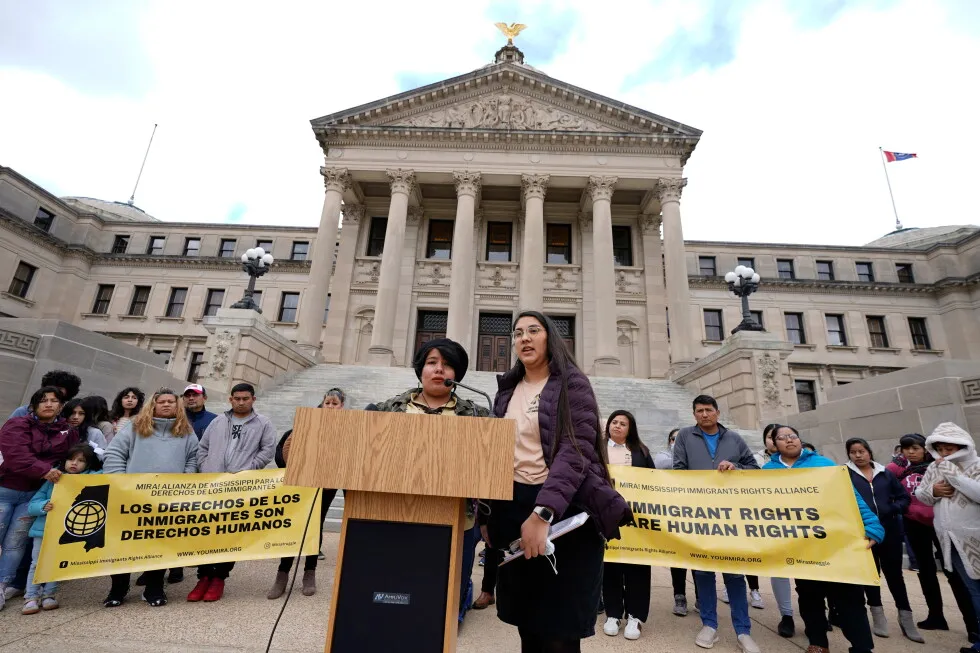
A new law could create a list of immigrants illegally living in Mississippi. Advocates are alarmed 1 of 3 | Yaritza Herrera, left, a young mother in central Mississippi, speaks about her concerns regarding legislative proposals affecting immigrants and migrants, as Loida Ventura Paz of the Mississippi-immigrants-rights-alliance" class="entity-link entity-organization" data-entity-id="154178" data-entity-type="organization">Mississippi Immigrants’ Rights Alliance translates from Spanish to English, during a news briefing before entering the Mississippi-capitol" class="entity-link entity-location" data-entity-id="154181" data-entity-type="location">Mississippi Capitol and lobbying lawmakers about those proposals, in Jackson, Wednesday, Jan. 25, 2023. (AP Photo/Rogelio V. Solis, File) 2 of 3 | The Mississippi-capitol" class="entity-link entity-location" data-entity-id="154181" data-entity-type="location">Mississippi Capitol is seen in Jackson, Miss., on July 6, 2020. (AP Photo/Rogelio V. Solis, File) 3 of 3 | A group of immigrants attend a news conference held by the Mississippi Immigrants Rights Alliance regarding legislative proposals affecting immigrants and migrants in Mississippi, Wednesday, Jan. 25, 2023, at the Capitol in Jackson, Miss. (AP Photo/Rogelio V. Solis, File) By DAVID A. LIEB Updated 5:58 AM MESZ, June 28, 2026 Leer en español Add AP News on Google Add AP News as your preferred source to see more of our stories on Google. Share Share Facebook Copy Link copied Print Email X LinkedIn Bluesky Flipboard Pinterest Reddit A new Mississippi law will authorize the state’s top law enforcement agency to compile a list of all immigrants illegally living in the state. What’s to be done with that information is a bit open-ended. But the law set to take effect Wednesday is sparking alarm among immigrant advocates, who fear it could become a new tactic to target immigrants in conjunction with President Donald Trump’s plan to deport millions of people lacking legal approval to live in the U.S. The law says the state Department of Public Safety “may use all reasonable lawful investigative means available” to determine the number and identities of all “illegal aliens” in Mississippi. That includes collecting their names, addresses, country of origin and whether they are an adult or minor. It also includes noting any criminal history and the date, location and status of Deportation proceedings. ✕ Independent journalism depends on readers like you AP has no shareholders, no corporate owners and no paywall. Help us keep our journalism available to anyone by registering for free. Create a free account Sign in to existing account How we use your information Help with registration Continue without registering The department is directed to share information on those suspected of violating laws with state and local authorities. The measure neither requires nor prohibits the database from being shared with U.S. Immigration and Customs Enforcement. Humor laurels for comedian Bill Maher as the Kennedy Center navigates Trump-era upheaval 4 MIN READ America split from monarchy 250 years ago. Trump’s presidency is testing how far it’s come 7 MIN READ Trump presses Syria to take on Hezbollah, raising alarm in Lebanon and Israel 5 MIN READ Republican state Sen. Angela Hill, who sponsored the measure, said states have a right and obligation to assist the U.S. government in discouraging illegal Immigration, which she said facilitates crimes such as human and drug trafficking. The new law “seems like commonsense to me,” Hill said. “In order to address the problems caused by illegal Immigration, we need to understand the magnitude of the problem. Identifying the number and identity of illegal aliens in Mississippi is a concrete way to better understand the problem.” Nationwide, states already have enacted more than 100 Immigration-related laws this year, according to an Associated Press tally. In Republican-led states, those measures generally have aligned with Trump’s agenda by requiring local sheriffs to sign cooperative agreements with ICE, reinforcing eligibility restrictions for public benefits and directing election clerks to check voter rolls against the federal Systematic Alien Verification for Entitlements system in an attempt to flag noncitizens. Democratic-led states generally have pushed back against Trump with new laws banning cooperative pacts with ICE, forbidding ICE tactics like wearing masks and restricting Immigration enforcement actions in schools, hospitals and other sensitive locations without judicial warrants. The closest thing to Mississippi’s new law appears to be a 2021 executive order by Republican Florida Gov. Ron DeSantis. That measure directed the Florida Department of Law Enforcement to “use all lawful investigative means available” to determine the number and identities of all “illegal aliens” who had been transported from the nation’s southwest border to Florida. The Florida agency did not respond to an AP request for information about the results of the executive order. Trump’s administration, meanwhile, has stepped up enforcement of a decades-old federal law that requires noncitizens to register with the U.S. government. The Mississippi law envisions more than a one-time count. It prescribes an ongoing effort to keep track of immigrants illegally in the state for the next two years. That could get complicated as people overstay visas, apply for new forms of legal status and move into and out the state. “You can be undocumented today, and then have status tomorrow, and then lose it again next month, and then regain it three months from now,” said Efrén Olivares, vice president of litigation and legal strategy at the National Immigration Law Center, a nonprofit that advocates for low-income immigrants. “It’s practically unworkable, but it’s also very worrisome, because it’s eerily reminiscent of other countries that have created lists of certain groups of people,” Olivares said. State officials will need to come up with “a credible and fairly foolproof way of correctly determining someone’s Immigration status,” said Jessica Vaughan, director of policy studies at the Center for Immigration Studies, a nonprofit think tank that supports restrictions on Immigration. But Vaughan said the law “makes a lot of sense,” adding that it “raises the likelihood that someone’s illegal presence is going to come to the attention of federal authorities.” Advocates say the law could break trust with police Mississippi has one of the country’s smallest percentages of immigrants illegally residing in the state — fewer than 28,000 people, amounting to less than 1% of its population — according to a report by the American Immigration Council, which used 2023 Census Bureau data. The new law “is very concerning for a bunch of different reasons,” including the potential to redirect law enforcement resources away from protecting the public to investigating people from foreign countries who may be contributing to the economy, said Victoria Francis, deputy director of state and local initiatives for the American Immigration Council, a nonprofit that advocates on behalf of immigrants. “A mandate like this invites profiling and turning entire communities into targets,” Francis said. The law could undermine trust between police and residents, said Lydia Grizzell, policy and advocacy manager for the American Civil Liberties Union of Mississippi. “That increases the likelihood of individuals not reaching out to law enforcement when it’s needed – and that is opposite of the mission,” she said. DAVID A. LIEB Lieb covers issues and trends in state governments across the U.S. He’s reported about government and politics for The Associated Press for 30 years. twitter mailto
SRCAssociated Press (AP)
LANGEN
LEANCenter
WORDS1 158
ENT10
SUN · 2026-06-28 · 10:53 GMTBRIEF NSR-2026-0628-88074
NSR-2026-0628-88074News Report·EN·Social Justice
A new law could create a list of immigrants illegally living in Mississippi. Advocates are alarmed
A new Mississippi law authorizes the state's Department of Public Safety to compile a list of immigrants living in the state without legal status. The law, effective Wednesday, directs the department to use lawful investigative means to identify individuals, collecting information such as names, addresses, country of origin, and criminal history.
Associated Press (AP)Filed 2026-06-28 · 10:53 GMTLean · CenterRead · 5 min
Associated Press (AP)FIG 01
Reading time
5min
Word count
1 158words
Sources cited
1cited
Entities identified
10entities
Quality score
100%
§ 01
Briefing Summary
AI-generatedNEWSAR · AI
A new Mississippi law authorizes the state's Department of Public Safety to compile a list of immigrants living in the state without legal status. The law, effective Wednesday, directs the department to use lawful investigative means to identify individuals, collecting information such as names, addresses, country of origin, and criminal history. This measure is raising concerns among immigrant advocates who fear it could lead to increased targeting of immigrants, particularly in light of federal deportation plans. State Senator Angela Hill, the law's sponsor, stated the list is intended to help understand the scope of illegal immigration and its associated crimes. The law mandates sharing information on suspected violators with state and local authorities, but does not specify whether the database can be shared with U.S. Immigration and Customs Enforcement.
Confidence 0.90Sources 1Claims 5Entities 10
§ 02
Article analysis
Model · rule-basedFraming
Social Justice
Legal & Judicial
Tone
Mixed Tone
AI-assessed
CalmNeutralAlarmist
Factuality
0.70 / 1.00
Factual
LowHigh
Sources cited
1
Limited
FewMany
§ 03
Key claims
5 extracted01
The measure neither requires nor prohibits the database from being shared with U.S. Immigration and Customs Enforcement.
factual
Confidence
1.00
02
The law requires collecting names, addresses, country of origin, and whether individuals are adults or minors.
factual
Confidence
1.00
03
The law directs the state Department of Public Safety to determine the number and identities of all 'illegal aliens' in Mississippi.
factual
Confidence
1.00
04
A new Mississippi law authorizes the state’s top law enforcement agency to compile a list of all immigrants illegally living in the state.
factual
Confidence
1.00
05
Immigrant advocates fear the law could become a tactic to target immigrants in conjunction with deportation plans.
quoteImmigrant advocates
Confidence
0.90
§ 04
Full report
5 min read · 1 158 words§ 05
Entities
10 identifiedKey playerOppositionContextPositiveNeutralNegative
People3
Organizations2
Locations3
§ 06
Keywords & salience
8 termsimmigrant list
1.00
illegal immigration
0.90
mississippi law
0.90
immigrant advocates
0.80
deportation
0.70
law enforcement
0.60
state agency
0.50
investigative means
0.40
§ 07
Topic connections
Interactive graph Network visualization showing 51 related topics
View Full Graph Person Organization Location Event|Click node to navigate|Edge numbers = shared articles