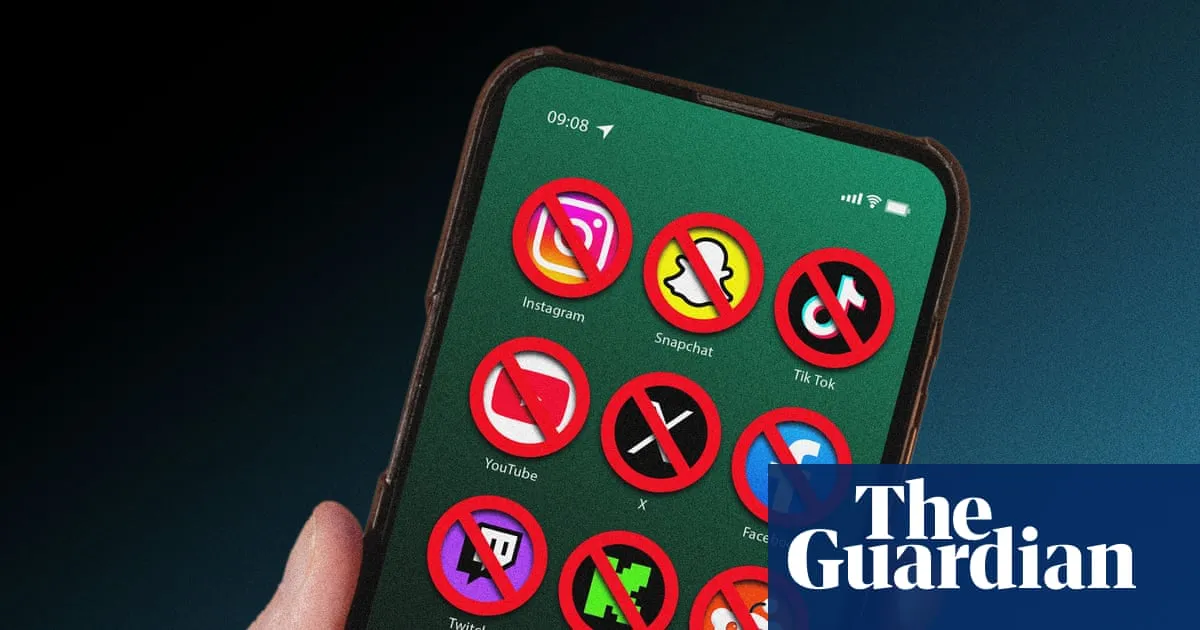
Arturo Béjar, a former employee turned whistleblower at Mark Zuckerberg’s Meta, has talked to parents around the world. He says they share the same perspective: they dread the day their children are old enough to go online.Governments appear to be listening too. This month the UK became the latest country to state that it would set a minimum age of 16 for accessing major social media platforms. Social media bans are becoming a legislative trend after the precedent set by Australia last year, when it imposed an age limit on platforms including Meta’s Instagram and Facebook, Google’s YouTube, Elon Musk’s X, TikTok and Snapchat.“I’ve spoken to parents from several countries, and I have yet to meet a parent of young kids who is not dreading when they’re old enough to go online. Or a young person who has not experienced something awful and preventable,” Béjar said.In the US, tech companies have been lobbying against the Kids Online Safety Act. Photograph: Hollie Adams/ReutersBéjar, 55, was a senior engineer and consultant at Meta. He was a witness at recent trials in the US that ruled Meta was liable for deliberately designing addictive products and had misled consumers about the safety of its platforms. The trial in California in particular received coverage that will not have dissuaded politicians around the world from taking action.“They [social media platforms] keep showing the world why we can’t trust them,” he said.Meta said it disagreed with the verdicts and would appeal, and said the “profoundly complex” issue of teenagers’ mental health could not be reduced to a single cause, adding that it remained committed to building “safe, supportive environments for young people”.People’s lack of trust is manifesting itself in action. Indonesia and Malaysia have introduced bans for under-16s on certain platforms, while Austria, France and Norway are also looking at age restrictions. Brazil has introduced a blanket mobile phone ban in schools, and children under the age of 16 are allowed to access social media only if it is linked to a parent’s account.The UK plans to have a ban in place by spring 2027, while Canada is also going to bar under-16s from platforms unless those apps implement adequate safeguards. In the US, the home of the big powers in social media and of the first amendment, there is no prospect of a federal-level ban.But the US aside, it seems the debate over whether social media causes harm, and what should be done about it, has swung decisively. The UK government had appointed an independent academic expert panel to look at the effect of social media on teenagers and, so far, its findings are “nuanced”. Nonetheless, Keir Starmer chose to take action.A source at one tech company affected by the UK ban expressed frustration that some rivals had worked harder on safety than others, making what they viewed as rushed and disproportionately heavy regulation more likely.“It’s hard to sell your safety measures to politicians when there is not enough consistency among your peers,” said the source, adding that the end result was a situation such as the ban in Australia, which they said did not encourage safer platform design and had high levels of circumvention. “You’re throwing the baby out with the bathwater.”Meanwhile, a tech industry flush with cash continues to lobby against restrictions. In the European Union, big tech companies spent approximately €150m (£130m) on lobbying last year, an increase of a third in just two years, with social media high on the agenda – although AI was the biggest focus for tech meetings with the European Commission. Meta was the biggest spender at €10m, according to the campaign groups Corporate Europe Observatory and LobbyControl. One EU lawmaker said tech companies were “bombarding” Brussels with messages challenging social media age bans.In the US, tech companies have been lobbying against the Kids Online Safety Act (Kosa), which is under consideration in the Senate and would require social media platforms to put in place measures to prevent certain harms to children, such as from compulsive use of their platforms.Meta is the highest spending tech lobbyist in the US, according to the campaign group Issue One, and has one lobbyist for every six members of Congress. Between 2020 and 2024 big tech companies spent a combined $260m on federal lobbying. Commenting on its lobbying for a change to Kosa that would reportedly give tech companies immunity from certain lawsuits alleging child harm, Meta said it wanted “uniform national standards for online youth safety”.Recent trials in the US ruled Meta was liable for deliberately designing addictive products. Photograph: Tony Avelar/APDonald Trump’s White House has been consistently critical of tech regulation abroad, including the prospect of a “disproportionate” social media age ban in the UK. A ban seems extremely unlikely on big tech’s home turf, given the combination of political gridlock, the legal barrier of the first amendment and big tech’s status as part of the US economic establishment.Darrell West, a senior fellow at the Brookings Institution, a US thinktank, said state bans were “not likely on a widespread basis” and at a federal level the possibility was low “because too many legislators oppose government regulation of technology”.Theo Bertram, the director of the Social Market Foundation thinktank and a former TikTok executive, as well as a former adviser to two former UK prime ministers, said tech companies should view the UK announcement as a global “tipping point”. “The history of legislation is you have one or two outliers. And then when you start to get countries that have a regulatory influence in the world, like the UK, joining countries like Australia – then it becomes a tipping point.”The normal pattern with legislation, said Bertram, was that you have a cycle of calls for change, followed by careful consultation and then a law being implemented. And that’s it for five to 10 years. Populism had not only sped up the process, he said, but it had made the cycle seemingly endless.“In an age of populism these companies are suffering criticism as well, not just mainstream politicians. Tech companies are losing public opinion and politicians are going to move on that.”He added: “A fundamental worry that tech companies have is that tech regulation is becoming a topic that’s driven by public sentiment rather than expert and evidence-led policymaking.”Summarising the work so far of its expert panel, the UK government said there were “known harms” from social media, particularly to “high-risk” individuals, but there were also benefits. Nonetheless, it is not the only country that has decided the risks outweigh the benefits for under-16s.“Young people deserve online spaces that are designed for them,” said Béjar.But patience is running out. Increasingly, there is one policy of choice for dealing with social media platforms and teenagers: closure.
SRCThe Guardian - World News
LANGEN
LEANCenter-Left
WORDS1 122
ENT12
SUN · 2026-06-28 · 10:00 GMTBRIEF NSR-2026-0628-88079
NSR-2026-0628-88079News Report·EN·Public Health
‘Tech firms are losing the public’: social media age bans near tipping point
Governments globally are increasingly implementing minimum age restrictions for social media access, with the UK recently announcing a 16-year-old minimum. This legislative trend follows Australia's precedent, which imposed age limits on major platforms like Meta, Google, TikTok, and X.
Dan Milmo Global technology editorThe Guardian - World NewsFiled 2026-06-28 · 10:00 GMTLean · Center-LeftRead · 5 min
The Guardian - World NewsFIG 01
Reading time
5min
Word count
1 122words
Sources cited
3cited
Entities identified
12entities
Quality score
100%
§ 01
Briefing Summary
AI-generatedNEWSAR · AI
Governments globally are increasingly implementing minimum age restrictions for social media access, with the UK recently announcing a 16-year-old minimum. This legislative trend follows Australia's precedent, which imposed age limits on major platforms like Meta, Google, TikTok, and X. These actions are partly driven by concerns from parents and whistleblowers, such as former Meta employee Arturo Béjar, who highlight the negative impacts of social media on young people. Despite tech firms lobbying against these curbs, with significant spending in the EU and US, countries like Indonesia, Malaysia, Austria, France, and Norway are also considering or enacting age restrictions. The US, however, faces political and legal barriers to federal-level bans.
Confidence 0.90Sources 3Claims 5Entities 12
§ 02
Article analysis
Model · rule-basedFraming
Public Health
Legal & Judicial
Tone
Mixed Tone
AI-assessed
CalmNeutralAlarmist
Factuality
0.70 / 1.00
Factual
LowHigh
Sources cited
3
Well sourced
FewMany
§ 03
Key claims
5 extracted01
The UK has set a minimum age of 16 for accessing major social media platforms.
factualArticle
Confidence
0.95
02
Several countries, including Indonesia, Malaysia, Austria, France, and Norway, are introducing or considering age restrictions for social media.
factualArticle
Confidence
0.90
03
Meta was found liable for deliberately designing addictive products and misleading consumers about platform safety in US trials.
factualArticle
Confidence
0.90
04
Parents globally dread their children reaching an age to go online due to negative experiences.
quoteArturo Béjar
Confidence
0.90
05
Social media bans are becoming a legislative trend globally.
factualArticle
Confidence
0.85
§ 04
Full report
5 min read · 1 122 words§ 05
Entities
12 identifiedKey playerOppositionContextPositiveNeutralNegative
People3
Organizations7
§ 06
Keywords & salience
10 termssocial media bans
1.00
age restrictions
0.90
tech firms
0.80
public trust
0.70
meta
0.60
addictive products
0.60
legislative trend
0.50
teenagers' mental health
0.50
whistleblower
0.40
kids online safety act
0.40
§ 07
Topic connections
Interactive graph Network visualization showing 8 related topics
View Full Graph Person Organization Location Event|Click node to navigate|Edge numbers = shared articles