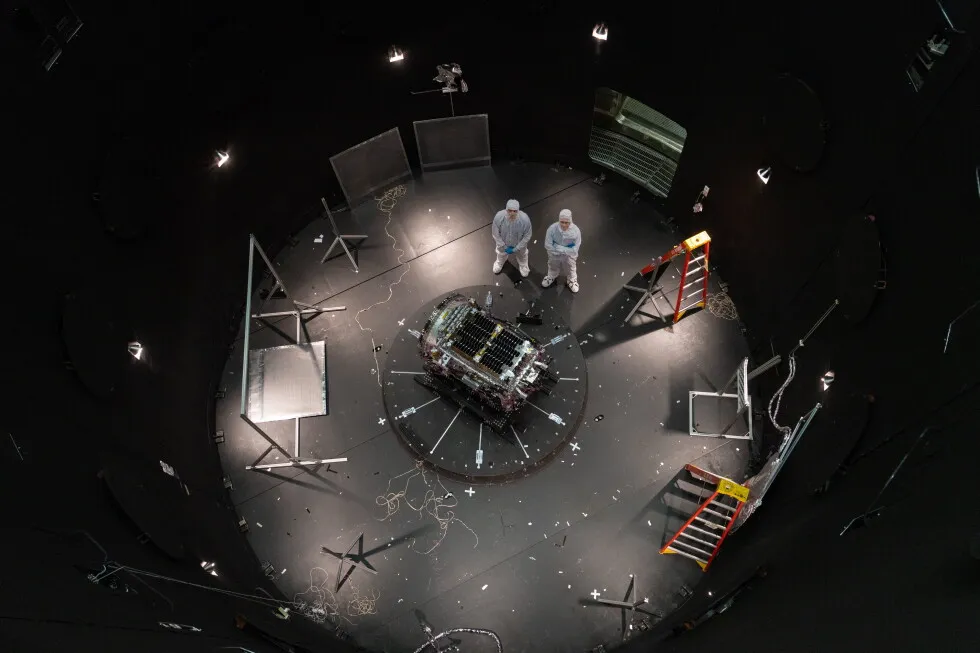
This photo provided by NASA shows Kieran Wilson, LINK’s principal investigator, and Hunter Robertson, a space systems engineer, both at Katalyst Space, standing next to their spacecraft inside the SES (Space Environment Simulator) at NASA’s Goddard Space Flight Center in Greenbelt, Md., April 17, 2026, ahead of thermal vacuum testing. (Sophia Roberts/NASA via AP) Updated [hour]:[minute] [AMPM] [timezone], [monthFull] [day], [year] CAPE CANAVERAL, Fla. (AP) — NASA is racing to save an aging telescope from falling back to Earth with a daring rescue mission. The $30 million salvage operation gets underway as soon as this week with the planned launch of a robotic lifesaver. NASA hired startup Katalyst Space Technologies to boost the Swift Observatory to a higher orbit where it can continue hunting for some of the universe’s biggest explosions. A three-armed spacecraft built by Katalyst will chase after Swift once it takes off from an atoll in the Pacific’s Marshall Islands aboard an airplane-launched Pegasus rocket. Liftoff could occur as early as Tuesday.Scanning the cosmos since its launch in 2004, Swift has been sinking faster and faster because of recent intense solar activity. It needs to get to a higher, more stable orbit as soon as possible to survive.NASA’s Hubble Space Telescope — also at risk — could be next. Like Swift, Hubble is losing altitude as the sun erupts with one flare after another. Katalyst Space CEO Ghonhee Lee said his company’s next-generation robot, still in development, could save the day for the much bigger Hubble in a couple years. 1 MIN READ 1 MIN READ 1 MIN READ Only China has attempted a mission like the upcoming one, successfully boosting a satellite into a higher graveyard orbit four years ago.“This is the first American space robot to go up and do anything like this,” Lee told The Associated Press. “NASA has all these big senior observatories … all of them can benefit from a service like this. So what we’re proving with this mission is this is a new play in the playbook that’s available.” It will take Katalyst’s autonomous spacecraft, named Link, about a month to rendezvous with Swift and catch it, and another couple months to raise its orbit from the current 224 miles (360 kilometers) to the desired 373 miles (600 kilometers). The 1.6-ton (1.4-metric ton) gamma ray observatory must be above 185 miles (300 kilometers) for the rescue to work. It’s expected to reach that point of no return in October, according to the latest estimates. Roughly the size of a small kitchen refrigerator with a 40-foot (12-meter) solar wingspan, Link sports three arms with a reach of just over 3 feet (1 meter). Each arm has two finger-like pinching grippers that resemble the hands of a Lego mini figure. If all goes well, Swift could be back in business by September, according to Lee.Worth hundreds of millions of dollars, Swift was never designed to be repaired, let alone retrieved by hands — human or otherwise. That’s what makes this so challenging, according to company officials, who stress there is no guarantee it will work.NASA signed a contract with Katalyst last September with only two requests: It has to be a rush job, but please don’t make things worse. Nine months later, the company is ready to rumble.“I have to be honest. No one thought it was going to be possible. No one thought we would get as far as we’ve already gotten today,” said Shawn Domagal-Goldman, NASA’s astrophysics director.NASA has bought a little more time for Swift, turning off all scientific instruments to slow its descent. Observations ceased in February. NASA’s science mission chief Nicky Fox said it’s worth the effort.“If we let Swift reenter, we would lose that telescope. We would lose a lot of capability,” she said. “We don’t currently have the budget to build another one to replace that.”While everything cannot be saved in space, Swift is special, said Domagal-Goldman. True to its name, Swift is designed to pivot quickly to capture late-breaking astronomical events such as gamma ray bursts and exploding stars. With more discoveries expected by the Webb Space Telescope and soon-to-launch Roman Space Telescope, Swift, if saved, would be busier than ever as “NASA’s first responder.”Katalyst sees Swift as the jumping-off point for a new repair business in space. The company’s next-generation robotic rescuer, scheduled to fly next year, will tackle satellites as high as 22,300 miles (35,800 kilometers) up. Lee envisions hundreds of robots in orbit one day, not only fixing and hoisting satellites but also refueling them and building solar farms, data centers and other platforms. Thirty-six-year-old Hubble, which received repeat servicing by spacewalking astronauts during the shuttle era, could follow in 2028 with a life-extending Katalyst boost. “It’s a national treasure,” Fox said. “People love Hubble.”___This story corrects spacecraft name to Link. ___The Associated Press Health and Science Department receives support from the Howard Hughes Medical Institute’s Department of Science Education and the Robert Wood Johnson Foundation. The AP is solely responsible for all content.
SRCAssociated Press (AP)
LANGEN
LEANCenter
WORDS833
ENT12
SUN · 2026-06-28 · 12:53 GMTBRIEF NSR-2026-0628-88086
NSR-2026-0628-88086News Report·EN·Technology
NASA races to save Swift telescope from falling back to Earth with daring rescue mission
NASA is undertaking a $30 million mission to save the Swift Observatory from falling back to Earth. The startup Katalyst Space Technologies has been hired to launch a robotic spacecraft, named Link, to boost Swift into a higher, more stable orbit.
By
MARCIA DUNNAssociated Press (AP)Filed 2026-06-28 · 12:53 GMTLean · CenterRead · 4 min
Associated Press (AP)FIG 01
Reading time
4min
Word count
833words
Sources cited
3cited
Entities identified
12entities
Quality score
100%
§ 01
Briefing Summary
AI-generatedNEWSAR · AI
NASA is undertaking a $30 million mission to save the Swift Observatory from falling back to Earth. The startup Katalyst Space Technologies has been hired to launch a robotic spacecraft, named Link, to boost Swift into a higher, more stable orbit. Intense solar activity has caused Swift, launched in 2004, to lose altitude rapidly, with a point of no return expected in October. Link, equipped with three arms, will rendezvous with Swift and raise its orbit over several months, aiming to have Swift operational again by September. This mission marks the first American attempt at such a robotic space rescue, with potential implications for future satellite servicing and the possibility of saving other aging observatories like the Hubble Space Telescope.
Confidence 0.90Sources 3Claims 5Entities 12
§ 02
Article analysis
Model · rule-basedFraming
Technology
Human Interest
Tone
Mixed Tone
AI-assessed
CalmNeutralAlarmist
Factuality
0.80 / 1.00
Factual
LowHigh
Sources cited
3
Well sourced
FewMany
§ 03
Key claims
5 extracted01
The Swift telescope has been sinking faster due to intense solar activity and needs a higher orbit to survive.
factual
Confidence
1.00
02
NASA hired startup Katalyst Space Technologies to boost the Swift Observatory to a higher orbit.
factual
Confidence
1.00
03
NASA is launching a robotic lifesaver mission to save the Swift telescope from falling back to Earth.
factual
Confidence
1.00
04
This mission is the first American space robot to perform such a rescue, with China having previously boosted a satellite to a higher orbit.
factualGhonhee Lee
Confidence
0.90
05
NASA's Hubble Space Telescope is also at risk of falling due to solar activity and could be a future candidate for a similar rescue mission.
factual
Confidence
0.90
§ 04
Full report
4 min read · 833 words§ 05
Entities
12 identifiedKey playerOppositionContextPositiveNeutralNegative
People3
Organizations5
§ 06
Keywords & salience
10 termsrescue mission
1.00
swift telescope
1.00
katalyst space technologies
0.90
orbital mechanics
0.80
spacecraft
0.70
solar activity
0.60
robotic lifesaver
0.50
hubble space telescope
0.50
higher orbit
0.40
gamma ray observatory
0.40
§ 07
Topic connections
Interactive graph Network visualization showing 9 related topics
View Full Graph Person Organization Location Event|Click node to navigate|Edge numbers = shared articles