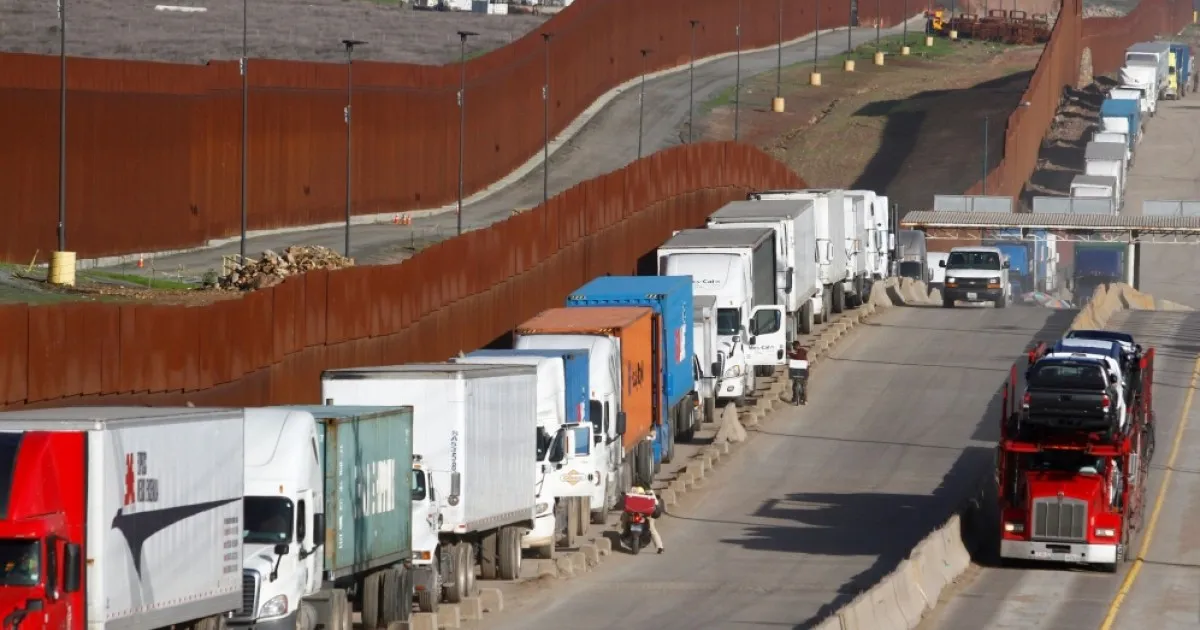
EDITOR'S ANALYSISUS President Donald Trump has warned he would ‘rather not have’ the free-trade agreement ahead of its July 1 review.Both Canada and Mexico have said they want the USMCA trade agreement to continue, but the Trump administration has voiced scepticism [File: Jorge Duenes/Reuters]Published On 28 Jun 2026Vancouver, Canada – As the trade agreement between the United States, Mexico and Canada comes up for its first joint mandatory review on July 1, experts say the chances of it being renewed have reduced, given how mercurial US President Donald Trump can be.Trump had pushed for a new deal during his first term to replace the North America Free Trade Agreement, or NAFTA.Recommended Stories list of 4 itemslist 1 of 4New York City freezes rents for one million regulated apartmentslist 2 of 4Trump threatens tariffs for countries that levy digital tax on US firmslist 3 of 4US federal judge questions DOJ decision to drop Adani chargeslist 4 of 4US strikes Iran in response to drone strike on commercial shipend of listThe result was the USMCA agreement, which came into effect on July 1, 2020, and is slated to expire after 16 years.Now, on the USMCA’s sixth anniversary, the three countries involved are set to decide whether the trade deal should continue for another 16 years.But it is unclear what the outcome of the review process might be, and critics warn that the uncertainty it creates could generate complications for businesses.If all three countries fail to commit to an extension, it triggers an annual review process, which would put the USMCA up for debate every year until 2036.“We may get mandatory annual reviews, but that also means that uncertainty prevails, and that’s a negative for decision-making for businesses,” said Tony Stillo, director of Canada Economics at Oxford Economics, an advisory firm. “It’s a definite dampener, for sure.”That, however, is the situation analysts currently expect to result from the July review.“The most likely scenario is that it will go into an annual renewal process,” said Vina Nadjibulla, vice president and head of research at the Canada" class="entity-link entity-organization" data-entity-id="11736" data-entity-type="organization">Asia Pacific Foundation of Canada, a nonprofit think tank.But she added that the dynamics of July’s negotiations remain unclear. She pointed to a lingering question: “Is nothing agreed till everything is agreed, or is incremental change acceptable?”In the worst case, any party could give six months’ notice and cancel the trade agreement altogether.Nadjibulla noted that Trump might be leaning in that direction. “He has said he wished [the USMCA] didn’t exist,” she said.Trump himself told reporters this month that he felt the US did not need the trade deal.“I don’t know that I’m going to renew it,” he said on June 10, before signalling he is open to negotiation with the deal’s other parties. “We’re talking to them. We’ll see if we do something.”A week later, Trump voiced further ambiguity about the US stance. “I would rather not have the agreement, but I may sign it,” he said during his visit to Paris.Protection against tariffs?Unlike Trump, the leaders of Canada and Mexico have said they want the trade agreement to continue.The USMCA has been particularly beneficial to the two countries in the wake of the tariffs that Trump unleashed last year, after taking office for a second term. Goods traded under the agreement have been largely exempt from the added taxes.But Trump has used different legal tools to tax even USMCA-compliant goods. His administration has, for example, turned to Section 232 of the Trade Expansion Act, which allows economic penalties on products that “threaten to impair” US security.He has invoked that law to impose 50 percent tariffs on Canadian steel, aluminium, and copper, as well as 25 percent tariffs on non-US content of USMCA-compliant automobiles. There has also been a 10 percent tax added to some lumber products.Products outside the USMCA’s protections were subject to particularly steep tariffs, though.The Trump administration formerly used the International Emergency Economic Powers Act (IEEPA) to impose sweeping tariffs worldwide, until the US Supreme Court ruled such taxes to be unconstitutional in February.But the White House responded to the Supreme Court ruling by issuing a 10 percent global tariff, using Section 122 of the Trade Act, which allows the US to address “large and serious” balance-of-payments deficits.The Trump administration has threatened to raise that rate to 15 percent in the coming months, though those tariffs are currently facing legal challenges.It has also proposed additional tariffs on both Canada and Mexico, accusing them of failing to enforce measures to stop forced labour.Mexico and Canada are two of the US’s largest trading partners. Until recently, Canada, for instance, sent nearly 80 percent of its exports to the US.The USMCA has allowed much of that trade to be shielded from Trump’s shifting tariff policies.But analysts like Stillo in Canada warn that having the USMCA subject to an annual review process could weaken the trading bloc’s economies.“Annual reviews will be ‘a big headwind’,” he told Al Jazeera.Canada is likely to push for tariff relief as part of the USMCA review, a critical issue for the country’s economic outlook, according to Stillo.“Our view of the economy improving in the second half of this year and into next year was based on a drop in tariffs,” he said.A risk to US exportsBut the USMCA has also been a boon for US businesses, which export products such as automotive parts, aircraft, petroleum and computers to Canada and Mexico.According to a data analysis from the Peterson Institute of International Economics, the majority of exports from some US states go to Canada and Mexico and are shipped under the USMCA.For instance, North Dakota exported 89.9 percent of its goods to Canada and Mexico last year. Michigan was at 64.9 percent, Iowa was at 50 percent, and Arizona was at 39 percent. All of four states voted for Trump in the 2024 election.Overall, the US also relies heavily on exports to Canada and Mexico in certain product categories. Exports like auto parts, aircraft and oil products generated more than $10bn last year in sales to Canada and Mexico, underscoring the importance of those trading partners.For instance, 75.6 percent of US exports of parts and accessories for tractors, public transport vehicles, cars and similar automotive devices went to the two neighbouring countries.The analysis’s authors, Gary Hufbauer and Ye Zhang, wrote that the outcome of the USMCA review could have significant consequences for those US industries and states.If, for example, Trump cancelled the trade pact, it would enable the US to impose more tariffs on Canadian and Mexican products. That, in turn, might cause those countries to retaliate with their own tariffs — or look for domestic or third-party substitutes to US goods.“There is a danger to US exports on terminating USMCA,” Hufbauer told Al Jazeera.While the broader US economy might be able to weather the uncertainty, specific businesses and states could suffer, according to his analysis.But Hufbauer warned that the fallout might not end there. A failed USMCA review could cause long-lasting damage to cross-border relations.“The bigger impact on the US is the disruption of our alliances and friendships around the world. The political side is far larger than the economic one in this,” Hufbauer said.Stillo, for his part, sees the USMCA review as taking place amid a broader global restructure, as traditional alliances are tested.“We are in a much more fractured world. It’s not quite de-globalisation, but we are definitely seeing a breaking down in regional blocs,” Stillo said.
SRCAl Jazeera
LANGEN
LEANCenter
WORDS1 235
ENT10
SUN · 2026-06-28 · 14:52 GMTBRIEF NSR-2026-0628-88119
NSR-2026-0628-88119Analysis·EN·Economic Impact
If USMCA is not renewed, analysts expect uncertainty for businesses
As the USMCA trade agreement undergoes its mandatory July 1 review, analysts anticipate business uncertainty due to President Trump's expressed desire to potentially not renew it. While Canada and Mexico wish to continue the deal, Trump has voiced skepticism, stating he "would rather not have" it.
Megha BahreeAl JazeeraFiled 2026-06-28 · 14:52 GMTLean · CenterRead · 5 min
Al JazeeraFIG 01
Reading time
5min
Word count
1 235words
Sources cited
2cited
Entities identified
10entities
Quality score
100%
§ 01
Briefing Summary
AI-generatedNEWSAR · AI
As the USMCA trade agreement undergoes its mandatory July 1 review, analysts anticipate business uncertainty due to President Trump's expressed desire to potentially not renew it. While Canada and Mexico wish to continue the deal, Trump has voiced skepticism, stating he "would rather not have" it. If all three nations do not commit to an extension, the agreement will trigger annual reviews, creating ongoing uncertainty for businesses. This situation is considered the most likely outcome, though the exact negotiation dynamics remain unclear. In a worst-case scenario, any party could cancel the agreement with six months' notice. The USMCA has provided some protection against tariffs, but Trump has utilized other legal tools to impose taxes on goods, even those compliant with the agreement.
Confidence 0.90Sources 2Claims 5Entities 10
§ 02
Article analysis
Model · rule-basedFraming
Economic Impact
Political Strategy
Tone
Measured
AI-assessed
CalmNeutralAlarmist
Factuality
0.40 / 1.00
Mixed
LowHigh
Sources cited
2
Limited
FewMany
§ 03
Key claims
5 extracted01
The USMCA agreement came into effect on July 1, 2020, and is slated to expire after 16 years.
factual
Confidence
1.00
02
US President Donald Trump has stated he would 'rather not have' the USMCA agreement.
quoteDonald Trump
Confidence
0.90
03
If the USMCA is not renewed, uncertainty will prevail, which is negative for business decision-making.
quoteTony Stillo
Confidence
0.90
04
The most likely scenario for the USMCA review is an annual renewal process.
predictionVina Nadjibulla
Confidence
0.70
05
The chances of the USMCA being renewed have reduced due to US President Donald Trump's mercurial nature.
predictionexperts
Confidence
0.70
§ 04
Full report
5 min read · 1 235 words§ 05
Entities
10 identifiedKey playerOppositionContextPositiveNeutralNegative
§ 06
Keywords & salience
7 termsusmca
1.00
trade agreement
0.90
renewal uncertainty
0.80
donald trump
0.70
business complications
0.60
annual review process
0.50
nafta
0.40
§ 07
Topic connections
Interactive graph No topic relationship data available yet. This graph will appear once topic relationships have been computed.