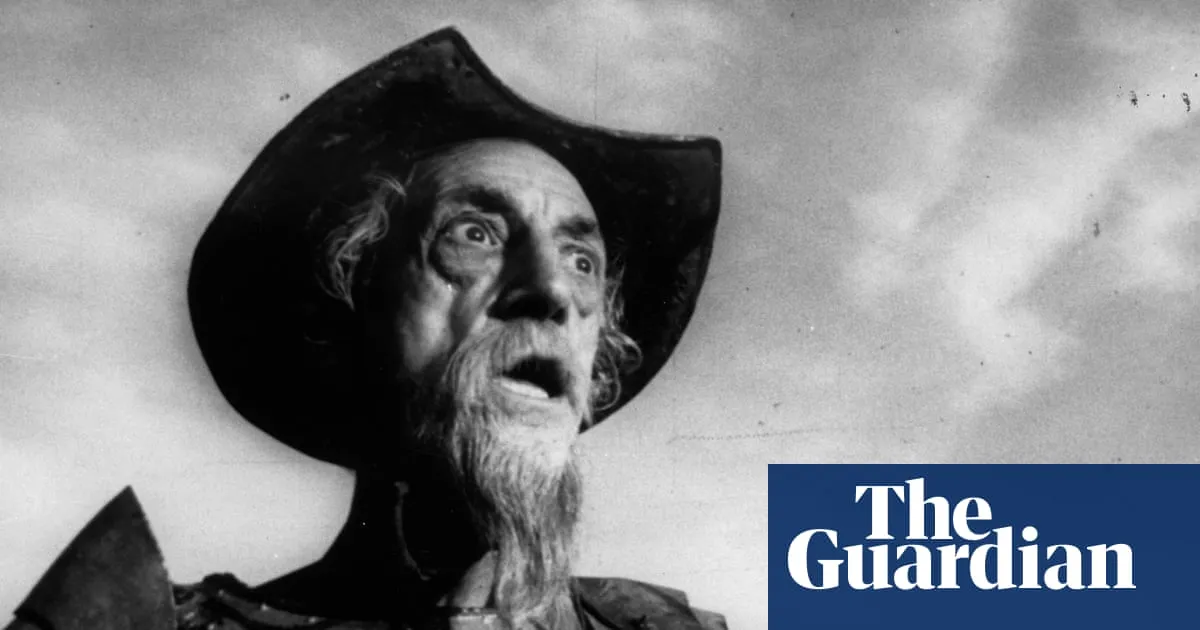
More than 70 years after he shot the first few frames, Orson Welles’s ambitious project to put Don Quixote on the big screen may finally be completed thanks to a consortium of European film archivists.Oja Kodar, the American film-maker’s partner and collaborator, has given her blessing to the project led by archives in France, Spain and Italy, along with the Munich film museum, to produce a coherent film out of 30 hours of footage scattered among them.Welles’s reworking of the classic novel by Miguel de Cervantes began in 1957 as a film for television backed by Frank Sinatra but the scheme fell through. After that, Welles worked on it almost to the day he died in 1985, shooting scenes in Mexico, Italy and Spain whenever he could find a backer.The team tasked with reconstructing the film, led by Esteve Riambau, a Welles authority and former head of the Catalan film archive, have their work cut out. To begin with, the Cineteca Nazionale in Rome must digitalise 50,000 metres (164,000ft) of negative to add to the 50,000 metres of 16mm and 35mm film held by Spain and the 80 minutes of 35mm footage in France.“We don’t have a complete script but enough to reconstruct it,” Riambau said. “Half the material is in the form of a negative in Rome which has to be printed before we can see it.”Orson Welles during the shooting of Don Quixote. Photograph: RGR Collection/AlamyAs scenes were shot in three countries from 1956 to 1976, the project had to be viewed as a work in progress, he added. “It would be surprising to discover that every scene has been shot but I think there’s enough. It’s hard to say what [Welles] wanted definitively because in the script there are alternative scenes, but we’ll work with what we have.“We’re not going to invent anything or use special effects to fill in the gaps. We’re not working with hypotheses. The idea is to show the original in so far as it’s possible, but it’s like working on a mosaic where there are missing pieces.”First published in 1605, Cervantes’s novel tells the story of Don Quixote, a minor noble who has a series of adventures as he lives out a fantasy life as a chivalrous knight accompanied by his sidekick, Sancho Panza. It is considered the first modern novel.The film is hardly a faithful version of Cervantes’s work. “There are some opening scenes that are faithful to the book but there are others that are, shall we say, enhanced,” Riambau said. “For example, the scene with the puppet theatre in the novel where Don Quixote thinks the heroine is in danger and takes out his sword and starts cutting off heads, in the film it’s set in a cinema in Mexico where he attacks the screen to save the heroine.”Cervantes’s novel tells the story of Don Quixote’s adventures with his sidekick, Sancho Panza, Photograph: HandoutMost of the footage is in black and white, although some scenes were shot in colour in Andalucía. The soundtrack is also incomplete but, where it exists, the parts of Don Quixote and Sancho Panza are voiced by Welles himself.skip past newsletter promotionafter newsletter promotionWelles co-wrote, produced, directed and starred in his first film, Citizen Kane (1941), which to this day regularly tops polls of the greatest films of all time. He went on to make The Third Man (1949), in which he also played the lead, A Touch of Evil (1958) and A Man for All Seasons (1966), among many other film and stage productions.“For me, Welles is much more than a film-maker, he’s more like Michelangelo,” said Riambau, who is in no doubt that Don Quixote will be a significant addition to Welles’s already extensive body of work.Welles called the project his bambino (baby) and wrote several versions of the screenplay, suggesting he was unsure how to finish it. Just how long it will take his successors to complete it is an open question.Riambau said Welles had joked that he was going to change the film’s title to “when are you going to finish Don Quixote?”“So I would say the same, ‘when are we going to see the reconstruction of Don Quixote?’ And the answer is: I think we’ll need at least until 2028.”
SRCThe Guardian - World News
LANGEN
LEANCenter-Left
WORDS710
ENT12
MON · 2026-06-29 · 10:00 GMTBRIEF NSR-2026-0629-88334
NSR-2026-0629-88334News Report·EN·Human Interest
Done Quixote? Film archivists on quest to finish Orson Welles passion project
European film archivists are working to complete Orson Welles's long-gestating film adaptation of "Don Quixote." Over 70 years after Welles began shooting, a consortium of archives in France, Spain, and Italy, along with the Munich film museum, are collaborating to assemble a coherent film from approximately 30 hours of scattered footage. Oja Kodar, Welles's partner, has approved the project.
Stephen Burgen in BarcelonaThe Guardian - World NewsFiled 2026-06-29 · 10:00 GMTLean · Center-LeftRead · 3 min
The Guardian - World NewsFIG 01
Reading time
3min
Word count
710words
Sources cited
2cited
Entities identified
12entities
Quality score
100%
§ 01
Briefing Summary
AI-generatedNEWSAR · AI
European film archivists are working to complete Orson Welles's long-gestating film adaptation of "Don Quixote." Over 70 years after Welles began shooting, a consortium of archives in France, Spain, and Italy, along with the Munich film museum, are collaborating to assemble a coherent film from approximately 30 hours of scattered footage. Oja Kodar, Welles's partner, has approved the project. Welles worked on the film intermittently from 1957 until his death in 1985, facing funding challenges. The reconstruction team, led by Welles authority Esteve Riambau, faces the task of digitizing and piecing together material from multiple countries, aiming to present the film as faithfully as possible to Welles's vision, with an estimated completion by 2028.
Confidence 0.90Sources 2Claims 5Entities 12
§ 02
Article analysis
Model · rule-basedFraming
Human Interest
Technology
Tone
Measured
AI-assessed
CalmNeutralAlarmist
Factuality
0.70 / 1.00
Factual
LowHigh
Sources cited
2
Limited
FewMany
§ 03
Key claims
5 extracted01
The film is not a faithful version of Cervantes's novel, with some scenes being 'enhanced'.
quoteEsteve Riambau
Confidence
0.90
02
There is enough material to reconstruct the film, though not a complete script, and alternative scenes exist.
quoteEsteve Riambau
Confidence
0.90
03
The Cineteca Nazionale in Rome must digitize 50,000 meters of negative, adding to existing footage held by Spain and France.
factual
Confidence
0.90
04
The project involves reconstructing a coherent film from 30 hours of footage scattered among archives in France, Spain, and Italy, along with the Munich film museum.
factual
Confidence
0.90
05
Orson Welles's Don Quixote project may finally be completed by European film archivists.
factual
Confidence
0.90
§ 04
Full report
3 min read · 710 words§ 05
Entities
12 identifiedKey playerOppositionContextPositiveNeutralNegative
People6
§ 06
Keywords & salience
8 termsdon quixote
1.00
orson welles
1.00
film archivists
0.90
passion project
0.80
film restoration
0.70
miguel de cervantes
0.60
film footage
0.50
cinematography
0.40
§ 07
Topic connections
Interactive graph No topic relationship data available yet. This graph will appear once topic relationships have been computed.