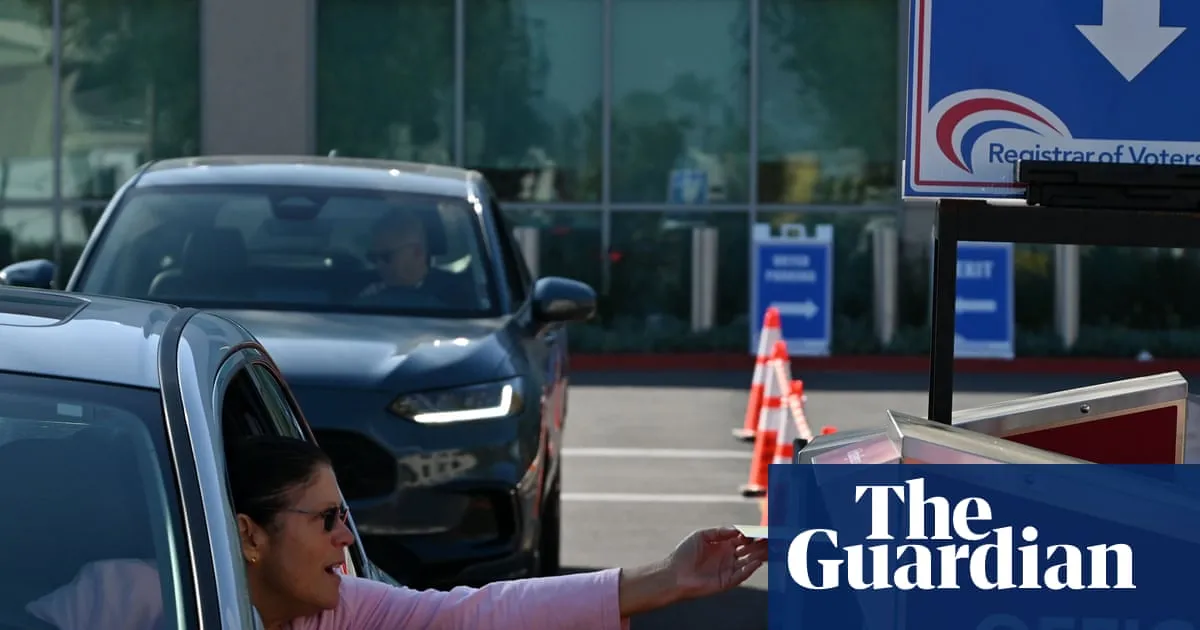
The US supreme court sided against national Republicans and Donald Trump’s administration to allow mail-in ballots that arrive after election day to be counted, upholding the law in more than a dozen states.The Republican National Committee (RNC) had challenged a Mississippi state law allowing mailed ballots to be counted if they arrive within five business days of election day, so long as they were postmarked by election day.“Nothing in the federal election-day statutes requires ballots to be received by election day,” the conservative justice Amy Coney Barrett wrote in the 5-4 opinion.Barrett joined Chief Justice John Roberts and the three liberal justices – Sonia Sotomayor, Elena Kagan and Ketanji Brown Jackson – in delivering the majority opinion. Justices Samuel Alito wrote a dissenting opinion, which Clarence Thomas and Neil Gorsuch joined and Brett Kavanaugh joined in part.The decision to side against the president and Republican party is seen as a surprise after other supreme court decisions this term have upended election processes. The court decided earlier this term to allow Louisiana to effectively dismantle the Voting Rights Act, depriving Black voters of their ability to elect members of Congress of their choosing and setting off a frenzy of gerrymandering across the south.The new decision will maintain state laws that allow ballots postmarked by election day to be counted later, affirming the role of states in setting election laws. Fourteen states, Washington DC and three US territories have similar laws that allow for late-arriving ballots to be counted.Some states, including Mississippi, changed their laws in 2020, during the Covid-19 pandemic. Mississippi, a red state, defended its ability to set its own procedures for elections against the challenge from the Republican party, which argued that the grace period after election day violates federal laws that set election day for the first Tuesday of November.Trump and some Republicans continually cast doubt on mail voting, a process used by millions in both parties in most states to cast ballots more conveniently. There are checks and balances in place to ensure mailed ballots are valid, including signature verification. In March, however, records show Trump voted by mail in the special election for House district 87, which encompasses his Mar-a-Lago golf club, according to the Palm Beach county supervisor of elections website.Nevertheless, the president has called for an end to mail voting, though he does not have the power to actually end it himself. Election processes in the US are run by local jurisdictions based on local and state laws and policies.On Monday, voting rights advocates praised the supreme court decision, saying it protected voters from disenfranchisement and prevented chaos by upholding the rights of states.“A ballot mailed on time is a vote cast on time, and the court just affirmed what’s been true for over a century,” said Sophia Lin Lakin, director of the ACLU’s Voting Rights Project. “These voters did everything right – they followed the rules and got their ballots in the mail. They shouldn’t lose their voice because a postal truck ran late, and now they won’t. This is how it’s supposed to work: states decide how to count their voters’ ballots, and that authority is intact heading into November.”A ruling against Mississippi and late-arriving ballots could have created confusion for voters and elections officials with midterm primaries and elections underway.But, voting rights groups warned, the rare victory doesn’t detract from the assault on voting from the Trump administration. Trump has sought to override state and local laws on elections via executive orders, which have largely been blocked by the courts, in a crusade against mail voting by making unsubstantiated claims of widespread fraud.Trump railed against the ruling in a post on Truth Social on Monday, calling it a “tremendous loss”. He used the loss to again call for Congress to pass the Save America Act, which would require proof of citizenship for voters, among a host of changes that will create hurdles for voting access and disenfranchise potentially millions of voters. He has refused to sign other legislation, most recently a bipartisan housing bill, unless Congress moves the Save Act forward.“There is no excuse for a politician, or otherwise, to be against the above three requirements. There is only one reason to oppose – CHEATING!” he wrote, before calling out specific senate Republicans by name and claiming there was a “communist movement” taking place in the country. The RNC also called on Congress to pass the Save America Act.“Democrats are inviting chaos at the ballot box by allowing elections to drag on for days and weeks after voters cast their ballots,” RNC Chairman Joe Gruters said. “Republicans are not going to be deterred by this decision, and the RNC will keep fighting to have elections end on Election Day as Americans want.”The Republicans bringing the lawsuit had contended that the word “election” in federal statutes should mean both when a ballot is cast and when it is received, therefore making it so all ballots counted needed to be received on election day.During oral arguments in Watson v Republican National Committee in March, the supreme court’s conservative justices laid out hypothetical situations to probe the limits of counting ballots after election day, and nodded to the potential for election fraud.Several justices also questioned whether a voter could recall their ballot through the mail and change their vote – a hypothetical practice that Mississippi solicitor general Scott Stewart said does not happen, claiming “nobody cited a single example in history”.In the decision on Monday, Barrett wrote that “plaintiffs’ policy arguments about election integrity and voter confidence are properly directed to legislatures, not courts … and regardless, plaintiffs’ definition of ‘election’ would do little to address the concerns they identify”.The plaintiffs had also argued that historical precedent and practice underscored their argument that ballots should be received by election day in order to be counted. But, Barrett wrote, these historical examples did not tie directly into modern statutes.During the oral arguments, liberal justices pointed to federal laws that allow for grace periods, while noting that a ruling here could also implicate early voting, another common practice.“You’re basically saying there are two things that have to happen, and they have to happen on election day, and it’s the casting of the vote and the receipt of the vote,” Kagan told Paul Clement, who is arguing on behalf of the Libertarian party of Mississippi.In a dissenting opinion, Alito wrote that election day is set for the second Tuesday of November, and all voting must commence by that day. Allowing ballots to arrive after election day violates that, he argued.“Election day is a specified date, not a span of multiple days,” Alito wrote. “The election-day statutes require that federal elections occur on that date. Under the challenged Mississippi law, however, the collection of ballots continues for five more days, and therefore the ‘election’ is not held until the end of that period.” This article was amended on 29 June 2026 to correct some misspelled names
SRCThe Guardian - World News
LANGEN
LEANCenter-Left
WORDS1 158
ENT12
MON · 2026-06-29 · 16:18 GMTBRIEF NSR-2026-0629-88429
NSR-2026-0629-88429News Report·EN·Legal & Judicial
US supreme court upholds law to count mail-in ballots arriving after election day
The US Supreme Court upheld laws in over a dozen states that allow mail-in ballots arriving after Election Day to be counted, provided they were postmarked by Election Day. The Republican National Committee had challenged a Mississippi law with this provision.
Rachel LeingangThe Guardian - World NewsFiled 2026-06-29 · 16:18 GMTLean · Center-LeftRead · 5 min
The Guardian - World NewsFIG 01
Reading time
5min
Word count
1 158words
Sources cited
4cited
Entities identified
12entities
Quality score
100%
§ 01
Briefing Summary
AI-generatedNEWSAR · AI
The US Supreme Court upheld laws in over a dozen states that allow mail-in ballots arriving after Election Day to be counted, provided they were postmarked by Election Day. The Republican National Committee had challenged a Mississippi law with this provision. In a 5-4 decision, the Court, with Justice Amy Coney Barrett writing the majority opinion, stated that federal statutes do not require ballots to be received by Election Day. This ruling affirms states' authority to set their own election procedures. The decision contrasts with other recent Supreme Court rulings that have altered election processes. Voting rights advocates praised the decision, while Donald Trump and the RNC criticized it and reiterated calls for legislation requiring ballots to be received on Election Day.
Confidence 0.90Sources 4Claims 5Entities 12
§ 02
Article analysis
Model · rule-basedFraming
Legal & Judicial
Political Strategy
Tone
Measured
AI-assessed
CalmNeutralAlarmist
Factuality
0.80 / 1.00
Factual
LowHigh
Sources cited
4
Well sourced
FewMany
§ 03
Key claims
5 extracted01
Donald Trump has expressed doubt about mail voting but voted by mail himself in a 2024 special election.
factual
Confidence
1.00
02
Fourteen states, Washington DC, and three US territories have similar laws for late-arriving ballots.
factual
Confidence
1.00
03
Justice Amy Coney Barrett wrote the 5-4 majority opinion, joined by Chief Justice Roberts and liberal justices.
factual
Confidence
1.00
04
The Republican National Committee challenged a Mississippi law that allowed ballots postmarked by election day but received within five days after to be counted.
factual
Confidence
1.00
05
US Supreme Court upheld a law allowing mail-in ballots arriving after election day to be counted.
factual
Confidence
1.00
§ 04
Full report
5 min read · 1 158 words§ 05
Entities
12 identifiedKey playerOppositionContextPositiveNeutralNegative
People9
Organizations2
Locations1
§ 06
Keywords & salience
9 termsmail-in ballots
1.00
election day
0.90
us supreme court
0.80
voting rights
0.70
state laws
0.70
republican party
0.60
election processes
0.50
donald trump
0.50
signature verification
0.40
§ 07
Topic connections
Interactive graph Network visualization showing 48 related topics
View Full Graph Person Organization Location Event|Click node to navigate|Edge numbers = shared articles