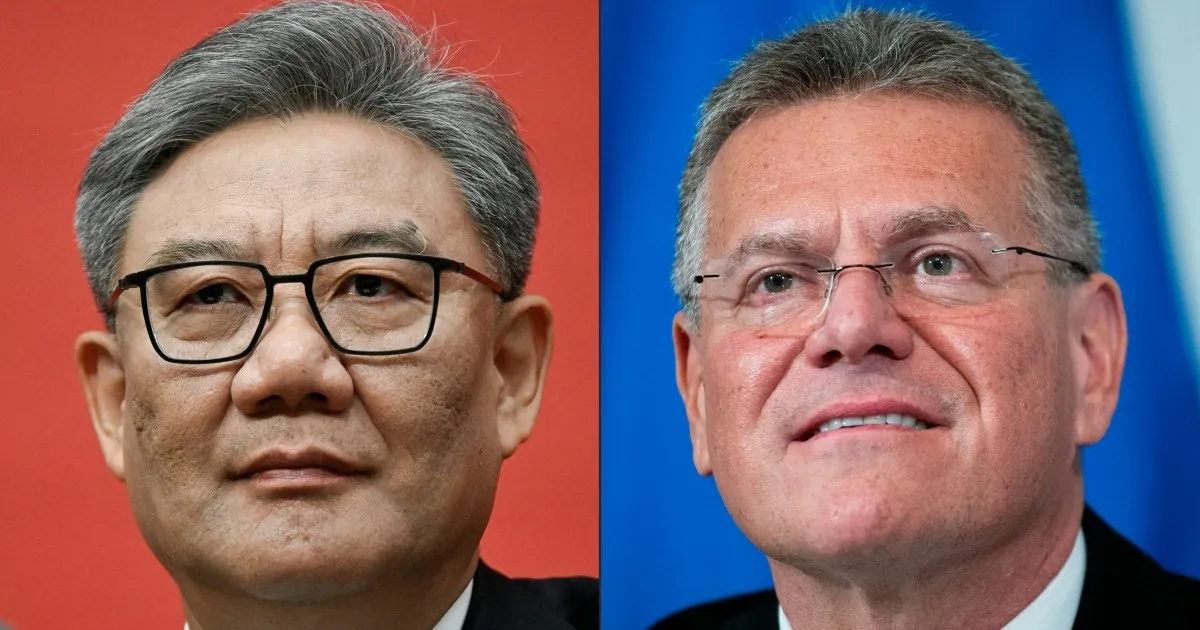
EDITOR'S ANALYSISTalks between EU trade commissioner and Chinese commerce minister come as bloc seeks to limit influx of Chinese imports.China's Minister of Commerce Wang Wentao (L) attending a news conference of the Central Committee of the China" class="entity-link entity-organization" data-entity-id="7909" data-entity-type="organization">Communist Party of China (CPC) in Beijing on October 24, 2025, and European Union trade commissioner Maros Sefcovic speaking before signing a memorandum of understanding for a strategic partnership on critical minerals at the State Department in Washington, DC, on April 24, 2026 [File: Pedro Pardo and Annabelle Gordon/AFP]Published On 30 Jun 2026As European Union trade commissioner Maros Sefcovic hosted Chinese Commerce Minister Wang Wentao in Brussels for talks on Monday, the Slovak diplomat was all smiles.But behind the diplomatic niceties, Sefcovic’s message to China rang out loud and clear.Recommended Stories list of 4 itemslist 1 of 4Anxiety turns to joy as Brazil qualifies for the Final 16list 2 of 4Sixty-six years on: The promise of DRC independence remains unfulfilledlist 3 of 4Migrants in South Africa fear violence ahead of June 30 deadlinelist 4 of 4Keiko Fujimori leads in Peruvian presidential race as vote count concludesend of listAddressing the media after a marathon day of negotiations with Wang, Sefcovic may not have literally said “enough is enough,” but he hardly needed to.“China’s exports to the EU keep rising, while our market share in China keeps shrinking,” Sefcovic said.“This trend is not sustainable. The status quo is not an option.”For a long time, Europe was seen as the Transatlantic counterargument to United States President Donald Trump’s protectionism, defending free commerce and trade against a rising populist tide.That now feels like a distant memory.Chinese firms’ rapidly growing footprint in Europe, facilitated by China’s huge subsidisation of industry and economies of scale, has rattled European firms and shaken the bloc’s leaders into action.In a speech to the G7 last year, European Commission President Ursula von der Leyen dubbed Chinese industry’s growing dominance overseas a “new China shock”.While there is a variety of views among EU member states about how far the bloc should go to push back against the wave of Chinese goods flooding into the market, there is broad alignment on the need to take action to safeguard domestic industry.“The mood has shifted because there is real danger for European companies and everyone is starting to realise it,” Philippe Le Corre, a professor of international relations and Asian studies at ESSEC Business School in Cergy, France, told Al Jazeera.“This is the new normal,” Le Corre added.“There is no reason the Europeans should be sitting on the side, waiting for the Americans and the Chinese to find a compromise on big issues. The EU needs its own policies including vis-a-vis China.”China’s trade surplus with the EU hit 360.6 billion euros ($411bn) in 2025 – the equivalent of 1 billion euros a day and up 15 percent from the previous year.Chinese firms now dominate Europe’s supply of goods in a host of critical sectors, including solar panels, rare earths, chemicals, and industrial robots.Meanwhile, Chinese companies are increasingly challenging some of Europe’s most prized legacy companies on their home turf, particularly car makers.EU tariffs of up to 35.3 percent on Chinese electric vehicles have done little to slow the advance of popular brands such as BYD, Geely and Chery.In May, Chinese models surpassed 10 percent of total auto sales in the bloc for the first time, according to Dataforce.The fallout for many of Europe’s top car brands, some of the most enduring symbols of European industrial innovation and design, has been devastating.Last week, German media reported that Volkswagen was preparing to cut as many as 100,000 jobs – about 15 percent of its workforce – in what would be the biggest restructuring in the history of the global automative industry.BMW has announced plans to cut about 5 percent of its workforce by the end of 2026, while fellow luxury brand Mercedes-Benz has paused employee bonuses and offered thousands of workers voluntary redundancy.China has rejected accusations that it encourages industrial overcapacity to flood the international market and threatened to retaliate if the EU takes action to correct the perceived trade imbalance.“China is able to cope with a situation where China-EU economic and trade relations deteriorate further or even slide to the freezing point,” Yuyuantantian, a social media account linked to Chinese state media, warned before Sefcovic and Wang’s talks.“China does not want to go that far but it is not afraid to go that way.”Among other measures under consideration, EU has proposed overhauling the Cyber Security Act to bar Chinese firms from critical infrastructure; drafted legislation, the Industrial Accelerator Act, that would prioritise EU-made goods in public procurement; and floated plans to force European companies in sensitive industries to source components from at least three different suppliers.Several other measures targeting Chinese imports are due to take effect on July 1, including a reduction in the duty-free quota for imported steel and a 3-euro ($3.42) customs charge on small parcels.While EU member states are coalescing around a tougher line on China, the bloc is also widely seen as eager to avoid a full-blown trade war with the world’s second-largest economy.Following Monday’s talks with Wang, Sefcovic touted their “constructive” dialogue and expressed optimism that Brussels and Beijing were “starting to understand each other better”.“That is why today’s talks – and the ones to follow – matter. They help us avoid unnecessary tension,” he said.Sefcovic and Wang said in a joint media release that they identified four “workstreams” for their next round of negotiations in October, including export controls and trade and investment balancing.Sefcovic and Wang said they also agreed to establish a joint trade monitoring mechanism “with a view to improving transparency, enhancing mutual trust and managing trade frictions”.For Europe, the hope will be that China accepts meaningful concessions to keep its access to the European market, averting a damaging trade war.While EU leaders are concerned about Chinese retaliation, they are unlikely to settle for face-saving or non-substantive measures due to the stakes for European industry, said Alicia Garcia-Herrero, chief economist for the Asia Pacific at Natixis in Hong Kong.“The number of job losses and so on is so huge that it would be surprising to me,” Garcia-Herrero told Al Jazeera.
SRCAl Jazeera
LANGEN
LEANCenter
WORDS1 029
ENT12
TUE · 2026-06-30 · 08:30 GMTBRIEF NSR-2026-0630-88616
NSR-2026-0630-88616Analysis·EN·Economic Impact
EU gets tough on China as trade imbalance stokes deindustrialisation fears
The European Union is intensifying its stance on trade with China due to a widening trade imbalance and fears of deindustrialization. EU Trade Commissioner Maros Sefcovic met with Chinese Commerce Minister Wang Wentao to address the unsustainable trend of rising Chinese exports to the EU while the EU's market share in China shrinks.
John PowerAl JazeeraFiled 2026-06-30 · 08:30 GMTLean · CenterRead · 5 min
Al JazeeraFIG 01
Reading time
5min
Word count
1 029words
Sources cited
2cited
Entities identified
12entities
Quality score
100%
§ 01
Briefing Summary
AI-generatedNEWSAR · AI
The European Union is intensifying its stance on trade with China due to a widening trade imbalance and fears of deindustrialization. EU Trade Commissioner Maros Sefcovic met with Chinese Commerce Minister Wang Wentao to address the unsustainable trend of rising Chinese exports to the EU while the EU's market share in China shrinks. This comes as Chinese firms, supported by significant state subsidies, increasingly dominate critical sectors in Europe, including solar panels, rare earths, and electric vehicles. The influx of Chinese electric vehicles, despite EU tariffs, has significantly impacted European automakers, with reports of major job cuts at companies like Volkswagen and BMW. The EU is considering measures such as barring Chinese firms from critical infrastructure and prioritizing EU-made goods in public procurement. China has rejected accusations of overcapacity and warned of retaliation if the EU takes action.
Confidence 0.90Sources 2Claims 5Entities 12
§ 02
Article analysis
Model · rule-basedFraming
Economic Impact
Diplomatic
Tone
Mixed Tone
AI-assessed
CalmNeutralAlarmist
Factuality
0.70 / 1.00
Factual
LowHigh
Sources cited
2
Limited
FewMany
§ 03
Key claims
5 extracted01
The EU needs its own policies, including vis-a-vis China, and should not wait for the US and China to find compromises.
quotePhilippe Le Corre
Confidence
1.00
02
European Commission President Ursula von der Leyen described the growing dominance of Chinese industry overseas as a 'new China shock'.
quoteUrsula von der Leyen
Confidence
1.00
03
China's trade surplus with the EU reached 360.6 billion euros ($411bn) in 2025, a 15% increase from the previous year.
statistic
Confidence
1.00
04
EU trade commissioner stated that China's exports to the EU are rising while the EU's market share in China is shrinking.
quoteMaros Sefcovic
Confidence
1.00
05
There is a broad alignment among EU member states on the need to take action to safeguard domestic industry against Chinese goods.
factual
Confidence
0.90
§ 04
Full report
5 min read · 1 029 words§ 05
Entities
12 identifiedKey playerOppositionContextPositiveNeutralNegative
People3
Organizations3
Locations4
§ 06
Keywords & salience
10 termseu china trade
1.00
deindustrialisation fears
0.90
chinese imports
0.80
trade imbalance
0.70
domestic industry
0.60
new china shock
0.50
subsidisation of industry
0.50
maros sefcovic
0.40
wang wentao
0.40
protectionism
0.40
§ 07
Topic connections
Interactive graph Network visualization showing 51 related topics
View Full Graph Person Organization Location Event|Click node to navigate|Edge numbers = shared articles