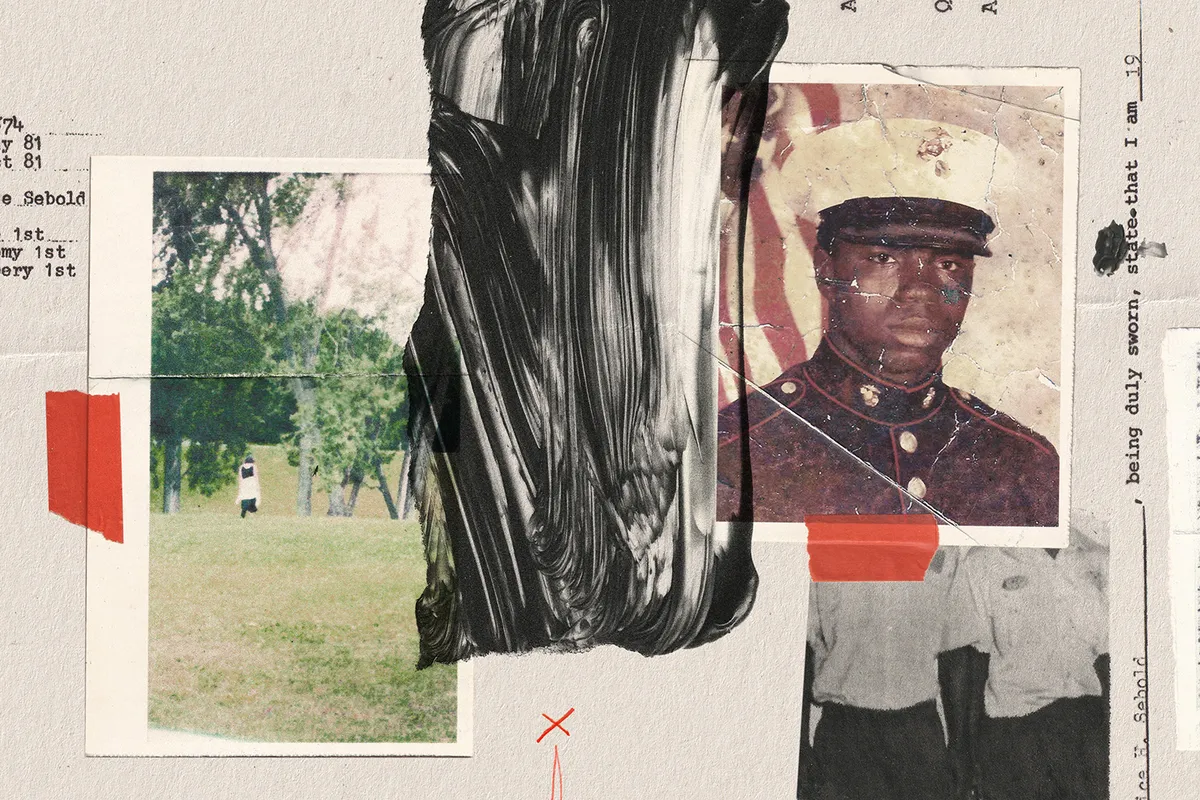
Vanessa Saba for ProPublica It took less than a day for the detective to give up on the case. A patrol officer had reported a harrowing, violent midnight rape in a Syracuse, New York, park. Hospital records recounted that the victim, an 18-year-old freshman at Syracuse-university" class="entity-link entity-organization" data-entity-id="144432" data-entity-type="organization">Syracuse University, was “crying uncontrollably.” Her face was bruised, and she had scratches on her neck. Her hymen had been lacerated in two places. Her urine was “grossly bloody,” according to the hospital report, and there was semen inside her. At 8 on the morning after the assault, after the victim looked fruitlessly through books of mug shots in hopes of identifying her assailant, Syracuse detective George Lorenz interviewed her. She had been awake most of the night for a first police interview, followed by forensic and medical exams: everything from gathering physical evidence of the rape to X-rays of her skull because the attacker had pounded her head on a brick walkway. To alleviate the pain from her injuries, she had been given Demerol, a powerful opioid. Lorenz, a burly 17-year veteran of the department who had worked as a meat cutter and truck driver before becoming a police officer, seemed annoyed that she had trouble staying awake, according to her subsequent account. “That’s inconsequential, just the facts,” he barked when he thought she was providing extraneous detail. The detective was dubious that a rape had occurred, according to his preliminary report. “It is this writer’s opinion, after interview of the victim, that this case, as presented by the victim, is not completely factual,” he wrote. After speaking to the male student whom the victim had been visiting before she was attacked, the detective checked the crime scene for anything his colleagues, who had recovered a knife and the victim’s glasses, might have missed. That was the totality of Lorenz’s investigation. Five hours after receiving the case, in a report marked 13:00 on May 8, 1981, he placed it in the “inactive file pending further info.” The consequences of that decision are still playing out nearly a half-century later. Alice Sebold returned to campus for the fall semester that year, aware that nobody was looking for her rapist. She happened to encounter a man on the street and, with a jolt of terrified recognition, was certain she recognized her attacker. Sebold brought him to the attention of the police. Her testimony convicted the man, who spent 16 years in prison and nearly 23 more as a registered sex offender. Sebold was no ordinary survivor. At a time when few even reported rapes, she publicly described her experience in searing detail — in op-eds, on “Oprah” and then in a memoir about the attack and its aftermath — inspiring others to speak out rather than live in silent shame. That memoir, “Lucky,” was published in 1999, then sold a million copies after her first novel, “The Lovely Bones,” became a publishing phenomenon and, later, a Hollywood movie. Years after that, an attempt to turn “Lucky” into a movie led screenwriters and producers to examine the badly flawed police work and prosecution stemming from the assault of Sebold. The details had been sitting in plain sight in Sebold’s memoir. The case publicly disintegrated in 2021 when a judge vacated the conviction of Anthony Broadwater and Syracuse’s district attorney said in court that the prosecution “should never have happened.” Involving, as it did, a white woman accusing a poor Black man of rape, and coming back to court a year after the convulsions caused by the murder of George Floyd, the news detonated in the media, with Sebold vilified even after she apologized to Broadwater. The case was yet another reminder, if reminder was needed, of the racism in the U.S. justice system. And what had once been a central identity for Sebold — a person who had built a voice and a career out of standing up to sexual violence — suddenly turned on its head. As all of those details unspooled in court, on television, and in the pages of The New York Times and the Syracuse press , two former colleagues of mine began to report on the case. One detail lost in the frenzy raised the question of how many other victims had been left behind and what else the police might have missed: The district attorney said in court that there had been other rapes in the same park where Sebold had been attacked, including one a little over a week after Broadwater’s conviction. The DA expressed frustration that “nobody might have put two and two together back then.” My former colleagues moved on to other projects and publications. Eventually my editors asked me to pick up where they left off. What could we uncover if we tried today to investigate the case that the Syracuse police never truly investigated — Sebold’s — as well as any others that may have been related? Could we untangle how things went so wrong and perhaps even point to a potential culprit? And if the authorities had bungled the case this badly, what mistakes had they made in other cases and what could be learned from those errors? As an investigative reporter with almost two decades at ProPublica, many of those years focused on criminal justice, I have delved into countless cases gone wrong. On one occasion, I set out to report an article on a man unjustly convicted of murder — a case where an appeals court had belatedly found prosecutorial misconduct serious enough to overturn his conviction — only to have the man confess to me that in fact he had pulled the trigger. He recounted the victim’s dying words and told me, “I did what I had to do.” Sebold’s case would turn out to be far more complex than that one, and its layers and effects far broader than what emerged in the wake of the exoneration. There were even more turns — including civil litigation that continues to this day — in what was already a baroque narrative. Or so I would learn after I embarked on what became two and a half years of reporting, trying to excavate the Syracuse criminal justice system in an era before DNA evidence and cellphones, before the Police Department even had computers, a time in which cities all over the country were grappling with a massive rise in violent crime. Reconstructing the truth decades after the fact, needless to say, is even harder than trying to pin it down in the moment. What’s clear is that no part of the system in Syracuse at the time could be depended on. Police brushed off rapes. Prosecutors bungled confessions or were defeated at trial. Judges overlooked irregularities. And one of the most powerful institutions in the city, Syracuse-university" class="entity-link entity-organization" data-entity-id="144432" data-entity-type="organization">Syracuse University, seemed more interested in suppressing news of a rape epidemic than solving it. There were police reports of sexual assaults near the campus marked “no press.” A former detective testified that the files were marked that way at the university’s request. In this atmosphere, at least one serial rapist was on the streets — and sexual assaults that closely resembled Sebold’s continued for years, even while Broadwater was behind bars. Meanwhile, the case gnawed at former Syracuse detective Paul Clapper. He wondered whether the wrong man had been sent to prison. After he left the force, he raised the name of a confessed and convicted rapist who closely matched the physical description of Sebold’s assailant but committed most of his crimes indoors rather than outside. That man’s record was lengthy and violent. I eventually found myself knocking on his battered door, wondering whether, at long last, I had found the true perpetrator. Or was I falling into the same trap that the Syracuse criminal justice system had tumbled into when it wrongly convicted Anthony Broadwater 44 years ago? 1 When Alice Sebold arrived as a college freshman in 1980, Syracuse was a city in decline. It had risen a century and a half earlier because of its proximity to the Erie Canal, then for decades was the site of factories for companies like General Electric and Carrier Corp. By the 1970s, those companies were closing facilities. Poverty climbed and the city’s population dwindled, emptying rows of Victorian homes that had housed generations of working-class families. Syracuse’s downtown, already severed by the interstate highway, withered. One institution, however, was flourishing: Syracuse-university" class="entity-link entity-organization" data-entity-id="144432" data-entity-type="organization">Syracuse University. Enrollment surged, its sports teams excelled and new buildings rose. The university was a bubble inside the city, according to former students. Sebold was drawn by the school’s distinguished poetry program. Raised in a household of voracious readers in suburban Philadelphia, her father a professor of Spanish at the University of Pennsylvania and her mother having worked for magazines, Sebold disdained the university’s frat culture. She preferred to skip the keg parties in her dorm and instead lounged in the basement of the art building, drinking endless cups of instant coffee and reading Emily Dickinson. Alice Sebold, then a Syracuse-university" class="entity-link entity-organization" data-entity-id="144432" data-entity-type="organization">Syracuse University student, at her typewriter Courtesy of Alice Sebold Just after midnight, on May 8, 1981, the last night of her freshman year, she was attacked. Sebold was crossing through Thornden Park on her way back to her dorm from a friend’s apartment. A stranger grabbed her from behind as she walked along a brick path. He put one hand over her mouth and threatened her with a knife. “I’ll kill you if you scream,” he said. Over a period of more than an hour, according to police reports and Sebold’s memoir, the assailant bludgeoned Sebold with his fists, pounded her skull into the brick and choked her. Sebold frantically searched for words to deter him: She told him she was a virgin, then an orphan. She offered him the $8 she had in her back pocket. He laughed and said he wasn’t interested in that. He forced her to kiss him, then to undress. He made clear she was not his first victim. “You’re the worst bitch I’ve ever done this to,” he said. Then, when he was done, he fell asleep on top of her. She tried to escape, but he woke up and offered a tearful apology. “You’re a good girl,” he said. “I’m so sorry.” He told her to kiss him good night and called her beautiful. “It was a date to him,” she wrote in “Lucky.” Just as quickly, he reverted to hostility. The attacker pocketed her $8 after all. He let her go, then asked her name as she walked away. “Alice,” she told him, writing later, “I didn’t have a name other than my own to say.” “Nice knowing you, Alice,” he said. “See you around sometime.” 2 Thornden Park, where Sebold had been assaulted, was both a refuge and a menacing locale adjacent to the university. Once the estate of a salt baron, the rolling 76-acre park had broad fields — with tennis courts, a pool and an earthen amphitheater — as well as dense clusters of maple and oak trees that provided dark, isolated enclaves where an attack might go unnoticed. The park had been the site of two sexual attacks seven months before Sebold’s rape. A third had occurred a block away. The reports in those cases had also been quickly consigned to the inactive file. One woman had told police that a man dragged her into a wooded section of the park. When she resisted, the report stated, he “began to punch her in the face” and “ordered her to remove her pants.” As with Sebold’s case, the police report was dismissive. One officer asserted that the victim was “retarded” and had run away from a nearby halfway house. The staff there said that she had complained of a similar incident two weeks prior and that she was having “difficulty adjusting.” The case was put on ice just hours after it had been reported. Crime scene photos after the assault on Sebold depict Thornden Park, the tunnel where she was raped, and the knife and glasses (hers) recovered by Syracuse police. Onondaga County District Attorney Four days later, another young woman was making her way across Thornden Park when a man in a ski cap grabbed her by the neck and put a knife to her face. As she squirmed and tried to push him off, the man struggled to pull off his pants and hers. The woman suddenly realized the weapon was just a table knife, so she screamed as loud as she could and he ran away. There was no indication in the police reports that these attacks might have been connected. Nor was there much evidence of public alarm. I found no articles about any of these October 1980 assaults in newspaper archives. Trying to piece this information together was daunting and complicated. My colleagues and I made more than two dozen requests for all manner of law enforcement records from the Syracuse district attorney’s office, Police Department, the state prison system, local jails, archives and courts. Many were initially denied. After appeals, I wound up with thousands of pages of documents. There was little or no organization among them, and some were scrawled in barely decipherable handwriting. Even the redactions were haphazard, with some names still visible. I started to map out the attacks around Thornden Park, using police reports and stray newspaper clips for some of the later ones. The numbers and proximity were jarring. More than a dozen women reported being raped or attacked by strangers within half a square mile over four years. Women were being sexually assaulted in their dorm rooms and in student apartments, walking out of grocery stores or on their way to the library. A nursing student was attacked at the same spot as Sebold, on the same day that her roommate was raped in their shared apartment. A freshman was raped in a sorority house by a man who broke in through a window. The descriptions of the perpetrators were often eerily similar. They frequently carried a knife. And several were roughly the same height, weight and race. It appeared that there was a public safety crisis emanating from the park area, with no sign of urgency from law enforcement. 3 Syracuse’s criminal justice system was chaotic during the 1980s and ’90s. One prosecutor would get into a scuffle, on live TV, with a candidate who had just won the race for DA. The police crime lab would lose its accreditation. The doctor who led the county medical examiner’s office resigned after an investigation found he had routinely removed organs from corpses without consent from the victims’ families. His employees had posed playfully for photos over the body of a woman who had died by suicide. Given the level of dysfunction — and the fact that DNA evidence hadn’t yet come into use in the early ’80s — rape was particularly difficult to investigate. Survivors were wary, corroborating evidence hard to find. The Syracuse Police Department had no separate sex crimes unit at the time, and officers were still using typewriters. “We were doing everything from homicide to robberies,” one supervisor of detectives during this era told me. He remembered nights with 18 felonies and fewer than a dozen detectives to work them. “A person with a knife in their back or a guy who got shot is going to take priority over a two-week-old rape case,” he said. “A person with a knife in their back or a guy who got shot is going to take priority over a two-week-old rape case,” one supervisor of detectives said. There was another impediment in those days: Syracuse-university" class="entity-link entity-organization" data-entity-id="144432" data-entity-type="organization">Syracuse University. I found a police report from 1980 on which someone had scrawled the words “NO PRESS.” A 19-year-old university student had been walking near Thornden Park when she, too, was attacked by a man with a knife. She got away by biting him when he tried to force her to perform oral sex. The “no press” designation on police reports was not unusual, according to deposition testimony by Clapper, the former Syracuse detective, who would play a crucial role in the Broadwater saga. “No press,” Clapper testified in 2025, “means that Syracuse-university" class="entity-link entity-organization" data-entity-id="144432" data-entity-type="organization">Syracuse University put their foot down and said no press for any kind of rape, robbery, burglary that’s anywhere in the area of Syracuse-university" class="entity-link entity-organization" data-entity-id="144432" data-entity-type="organization">Syracuse University.” The university had influence in the Police Department, according to Clapper, and an obvious interest in making the campus seem safe: “If your little daughter wants to go to school at SU and calls the police, and says, How is the crime around Syracuse-university" class="entity-link entity-organization" data-entity-id="144432" data-entity-type="organization">Syracuse University? ‘No crime around there.’ There’s five girls raped within, let’s say, a six-month period … between campus and Thornden Park. And if it’s marked ‘no press,’ it’s like it never happened.” 4 Sebold’s case had been placed in the inactive file. That meant the police weren’t searching for her assailant. But she couldn’t help herself. According to Sebold’s memoir, she walked the university campus, “looking for Him.” “I was very aware that he could be around any corner,” she told me decades later. A sense of “hypervigilance” coursed through her like “a bunch of electrical wires,” she said. Five months after the crime, Sebold saw a man on a street filled with restaurants and bars near the university. She felt a sudden, visceral certainty: “right height, right build, something in his posture.” She wrote that the man walked up to her and said, “Hey girl, don’t I know you from somewhere?” He then began nonchalantly chatting with a police officer across the street. (Both Broadwater and the officer would testify that they said “don’t I know you” to each other.) When Sebold reported the sighting to the authorities a few hours later, Clapper recognized himself as the cop she saw and Anthony Broadwater as the man he was talking to. Broadwater, then 20, had grown up as one of six children of a janitor who worked for Syracuse-university" class="entity-link entity-organization" data-entity-id="144432" data-entity-type="organization">Syracuse University. After a brief stint in the Marines, he was working as a telephone wiring installer. Growing up, Broadwater told me, he’d had run-ins with the police and had served time in juvenile detention for theft. (Clapper had known Broadwater since he was a boy, he would testify years later. When asked if he had ever known him “to be involved in anything like rape,” Clapper replied, “No.”) Anthony Broadwater during his time in the Marines U.S. Marine Corps via The New York Times/Redux Broadwater was arrested. He vociferously protested his innocence and did whatever he could to prove it. He volunteered a pubic hair for comparison to one found on Sebold after the rape, and he agreed to participate in a lineup. When Broadwater saw the other lineup participants, he began to worry. None of them looked much like him. They were all too tall or had a lighter complexion or both. He suggested that another inmate closer to his height and build be included to make it more fair. Broadwater’s court-appointed lawyer got the jailer to bring another man down from the detention facility above the police building. Sebold looked at the row of men and picked the person who had just been added to the lineup. The man was standing next to Broadwater. The case should have ended then and there, in the view of the DA today. “You know, she didn’t pick out the wrong guy. She picked out the guy. She picked out the guy that she thought had raped her. And it wasn’t Anthony,” Onondaga County District Attorney William Fitzpatrick told ProPublica. “Case is over. Stop.” But it didn’t stop. 5 The prosecution of Broadwater had been assigned to a young assistant district attorney named Gail Uebelhoer (pronounced EE-bull-hair). Sebold wrote that she felt an immediate connection to Uebelhoer, whom she described as “solid and female” with “sparkling, intelligent eyes.” As Sebold put it in “Lucky,” “She wanted what I wanted: to win.” After Sebold failed to identify Broadwater in the lineup, she could sense that Lorenz, the detective who had overseen the process, was unhappy. (Lorenz died in 2017.) Sebold said she had been scared and confused, torn between the men in positions 4 and 5. Instead of seeking out additional evidence, Uebelhoer asked Sebold to draft an affidavit on the spot, explaining what had happened. Sebold wrote in the affidavit that she had picked No. 5 because that person had been looking at her. Broadwater was in position 4. During a lineup, Sebold identified her assailant as the man on the far right; Broadwater was standing next to him. Onondaga District Attorney/New York Times/Redux The prosecutor then told her it was only natural that she would make such a mistake, according to Sebold’s memoir. “They really worked a number on you. He uses that friend or that friend uses him, in every lineup they do,” Sebold said Uebelhoer told her. “They’re dead ringers.” Both men are adamant that they had never been in a lineup before. Within three hours of the botched lineup, Uebelhoer presented the case against Broadwater to a grand jury. Sebold wrote that she put on “the best show” of her life and several grand jurors “fought back tears.” At least one of them was uneasy about the manner in which Broadwater had been identified, according to a transcript. “When someone is picked out of the lineup, doesn’t it have to be absolutely sure that the person that they picked out of the lineup is the one they’ve seen before?” one grand juror asked Clapper while he was on the witness stand. “That’s correct,” Clapper said. Uebelhoer quashed the discussion. “He really can’t give you an opinion on that,” she told the juror, adding that Clapper hadn’t been present for the lineup. The juror asked about it two more times, but Uebelhoer kept deflecting. Broadwater was indicted on every count she had presented, including rape, sodomy and robbery.
SRCProPublica
LANGEN
LEANCenter-Left
WORDS3 663
ENT8
TUE · 2026-06-30 · 10:30 GMTBRIEF NSR-2026-0630-88641
NSR-2026-0630-88641News Report·EN·Human Interest
“That Guy Is Still Out There”
In 1981, Alice Sebold was raped in Syracuse, New York. The initial police investigation was cursory, with Detective George Lorenz quickly deeming the case "inactive." Sebold later identified Anthony Broadwater as her attacker, leading to his conviction and 16 years in prison.
Joaquin SapienProPublicaFiled 2026-06-30 · 10:30 GMTLean · Center-LeftRead · 15 min
ProPublicaFIG 01
Reading time
15min
Word count
3 663words
Sources cited
1cited
Entities identified
8entities
Quality score
100%
§ 01
Briefing Summary
AI-generatedNEWSAR · AI
In 1981, Alice Sebold was raped in Syracuse, New York. The initial police investigation was cursory, with Detective George Lorenz quickly deeming the case "inactive." Sebold later identified Anthony Broadwater as her attacker, leading to his conviction and 16 years in prison. However, in 2021, Broadwater's conviction was vacated due to flawed police work and prosecution. This revelation highlighted systemic issues within Syracuse's criminal justice system, including potential racial bias and mishandling of evidence. Investigations suggest other rapes occurred in the same park around the same time, and the possibility of a serial rapist being at large was raised. The article explores the decades-long fallout of the initial investigation, the impact on Sebold and Broadwater, and the ongoing search for truth and accountability.
Confidence 0.90Sources 1Claims 5Entities 8
§ 02
Article analysis
Model · rule-basedFraming
Human Interest
Legal & Judicial
Tone
Mixed Tone
AI-assessed
CalmNeutralAlarmist
Factuality
0.70 / 1.00
Factual
LowHigh
Sources cited
1
Limited
FewMany
§ 03
Key claims
5 extracted01
Alice Sebold's memoir 'Lucky' sold a million copies after her novel 'The Lovely Bones' became a phenomenon.
factual
Confidence
1.00
02
Alice Sebold identified her attacker, leading to his conviction and 16 years in prison.
factual
Confidence
1.00
03
Lorenz placed the case in the 'inactive file pending further info' five hours after receiving it.
factual
Confidence
1.00
04
Detective George Lorenz was dubious that a rape had occurred and wrote in his preliminary report that the case was 'not completely factual'.
quoteDetective George Lorenz (preliminary report)
Confidence
1.00
05
A patrol officer reported a violent midnight rape in a Syracuse, New York, park.
factual
Confidence
1.00
§ 04
Full report
15 min read · 3 663 words§ 05
Entities
8 identifiedKey playerOppositionContextPositiveNeutralNegative
Events1
§ 06
Keywords & salience
10 termsrape investigation
1.00
police misconduct
0.90
victim identification
0.80
sexual assault
0.70
syracuse university
0.60
criminal justice system
0.60
sex offender
0.50
case inactivation
0.50
alice sebold
0.40
george lorenz
0.40
§ 07
Topic connections
Interactive graph Network visualization showing 4 related topics
View Full Graph Person Organization Location Event|Click node to navigate|Edge numbers = shared articles