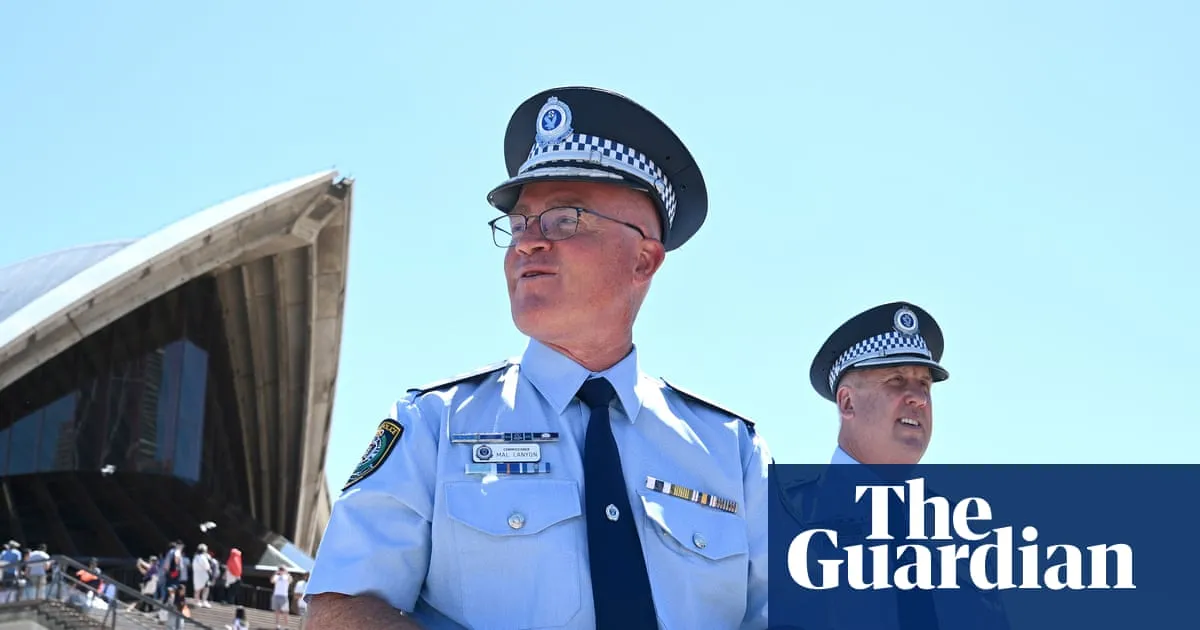
The New South Wales police commissioner has extended a restriction on protests in Sydney for a third time, but narrowed the area it covers in a bid to get “the balance right between community safety and a right to protest” ahead of Invasion Day.On Tuesday afternoon, Mal Lanyon, said the restrictions would no longer include Hyde Park, allowing police to authorise the major annual Invasion Day protest to march from that location to Victoria Park on Monday.Police have also authorised an anti-immigration march, run by March for Australia, from Prince Alfred Park to Moore Park.Where NSW police protest restrictions apply. Where NSW police protest restrictions apply.Lanyon said the 14-day extension to the declaration preventing the authorisation of protests under NSW’s form 1 system would still apply “from Darling Harbour through the north of the CBD ... and then out through Oxford Street and take in all of the eastern suburbs police area command”.Police were given the controversial power last year after the Minns government rushed laws through parliament in the wake of the Bondi terror attack. The power effectively bans the ability for organisers to carry out major protests on the city’s streets without the risk of people being arrested by police.“It’s about getting the balance right between community safety and a right to protest,” Lanyon told reporters, after being asked why Hyde Park had been exempted from the restriction.“I reinforce this is a time for calm. It’s a time for peace. It’s a time for the community to come together. We are still less than six weeks from the most serious and devastating terrorism act ever [committed] in New South Wales.”Laynon was asked if protests around the arrival of Israeli president Isaac Herzog – the date of which is yet to be confirmed – would get authorisation to go ahead from police. He warned in his response that he would be monitoring the “behaviour” of protesters over the next 14 days and the declaration could change again if there was a heightened community risk.Lanyon said there would be 1,500 police deployed to 26 January events and a third of those would be monitoring protests.Lanyon said that the declaration, which has now been in place for almost a month, hadn’t stopped protests or “free speech entirely” and there had 49 “static protests”.Asked if, given that, the laws had any real function or effectiveness, Lanyon said: “it’s taken the heat out of the community.”Protest laws testedThe limits of the declaration were tested on Sunday after a group protesting deaths in custody attempted to march from Hyde Park while the ban for that area was still in place.NSW police assistant commissioner, Peter McKenna, suggested on Sunday police outnumbered the demonstrators, estimating 200 rallied while a “few hundred” police were present or standing by. The crowd was collectively ordered to move on by police. McKenna said if the crowd had kept moving, there “absolutely” could have been arrests.The crowd instead dispersed with no arrests.Facing police lines, the crowd chanted “we’ll be back” and “see you on Invasion Day”.Paul Silva, a rally organiser and nephew of David Dungay Jr, who died in custody, told reporters a crowd 100 times bigger was expected on 26 January.The crowd cheered its loudest when Paddy Gibson, an advocate and researcher, said “we will break the ban”.McKenna on Sunday acknowledged thousands of Australians could attend Invasion Day rallies and make police operations more difficult, especially if crowds wanted conflict with police rather than cooperate.“We’ve got an obligation to enforce the laws. They’re only a temporary law, just remember that,” McKenna said.
SRCThe Guardian - World News
LANGEN
LEANCenter-Left
WORDS592
ENT8
TUE · 2026-01-20 · 06:37 GMTBRIEF NSR-2026-0120-8875
NSR-2026-0120-8875News Report·EN·National Security
NSW protest restrictions extended for parts of Sydney with Invasion Day march set to proceed in CBD
New South Wales Police Commissioner Mal Lanyon has extended protest restrictions in parts of Sydney for 14 days, but narrowed the area to allow the annual Invasion Day march to proceed from Hyde Park to Victoria Park on January 26th. The restrictions, initially implemented after the Bondi terror attack, now apply from Darling Harbour through the north of the CBD, Oxford Street, and the eastern suburbs.
Jordyn BeazleyThe Guardian - World NewsFiled 2026-01-20 · 06:37 GMTLean · Center-LeftRead · 3 min
The Guardian - World NewsFIG 01
Reading time
3min
Word count
592words
Sources cited
4cited
Entities identified
8entities
Quality score
100%
§ 01
Briefing Summary
AI-generatedNEWSAR · AI
New South Wales Police Commissioner Mal Lanyon has extended protest restrictions in parts of Sydney for 14 days, but narrowed the area to allow the annual Invasion Day march to proceed from Hyde Park to Victoria Park on January 26th. The restrictions, initially implemented after the Bondi terror attack, now apply from Darling Harbour through the north of the CBD, Oxford Street, and the eastern suburbs. Police have also authorized an anti-immigration march from Prince Alfred Park to Moore Park. Lanyon stated the extension balances community safety with the right to protest, citing ongoing concerns following the recent terror attack. 1,500 police officers will be deployed for January 26th events, with a third monitoring protests. Lanyon indicated that the restrictions haven't stopped protests entirely, but have reduced community tension.
Confidence 0.90Sources 4Claims 5Entities 8
§ 02
Article analysis
Model · rule-basedFraming
National Security
Human Rights
Tone
Measured
AI-assessed
CalmNeutralAlarmist
Factuality
0.80 / 1.00
Factual
LowHigh
Sources cited
4
Well sourced
FewMany
§ 03
Key claims
5 extracted01
It’s about getting the balance right between community safety and a right to protest.
quoteMal Lanyon
Confidence
1.00
02
There would be 1,500 police deployed to 26 January events and a third of those would be monitoring protests.
statisticMal Lanyon
Confidence
1.00
03
Police have also authorised an anti-immigration march, run by March for Australia, from Prince Alfred Park to Moore Park.
factual
Confidence
1.00
04
The restrictions would no longer include Hyde Park.
factualMal Lanyon
Confidence
1.00
05
NSW police commissioner has extended a restriction on protests in Sydney for a third time.
factualMal Lanyon
Confidence
1.00
§ 04
Full report
3 min read · 592 words§ 05
Entities
8 identifiedKey playerOppositionContextPositiveNeutralNegative
Organizations1
Locations4
§ 06
Keywords & salience
9 termsprotest restrictions
0.90
invasion day
0.80
right to protest
0.70
community safety
0.70
nsw police
0.70
terrorism act
0.60
anti-immigration march
0.50
free speech
0.50
public order
0.40
§ 07
Topic connections
Interactive graph Network visualization showing 6 related topics
View Full Graph Person Organization Location Event|Click node to navigate|Edge numbers = shared articles