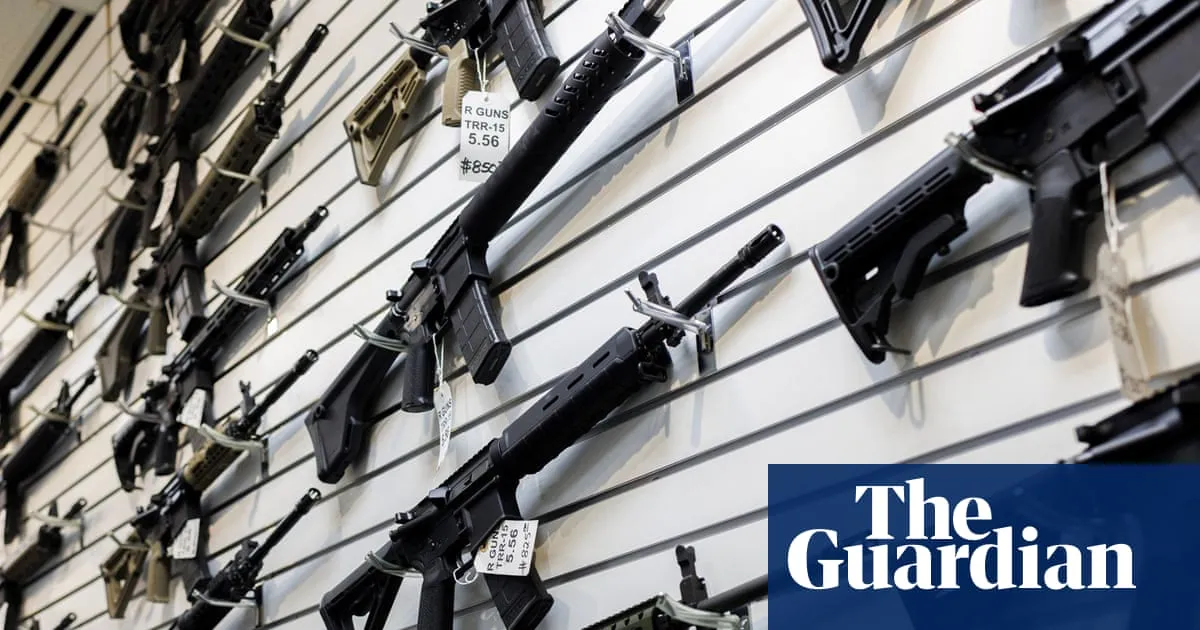
The US supreme court will consider whether bans on semi-automatic rifles, often called assault weapons, violate the Second Amendment.The justices said on Tuesday they will hear appeals challenging bans on the AR-15 and similar semi-automatic firearms in Connecticut and the Chicago area.Similar laws are in place in about a dozen states, covering major cities like New York, Los Angeles and Washington DC. Congress allowed a national assault weapons ban to expire in 2004, but Democrats have supported renewing it in response to a series of mass shootings. States have also continued to pass their own laws, including recent measures in Virginia and Rhode Island.It is the latest high-profile dispute over guns to reach the court since its conservative majority handed down a landmark ruling in 2022 that expanded Second Amendment rights and spawned challenges to firearm laws around the country.Arguments are expected to be heard in the fall.The Connecticut law was passed after a mass shooter used an AR-15 to kill 26 children and educators at Sandy Hook elementary in 2012. The state says the guns are a preferred weapon of mass shooters, and they can be banned because they are similar to military-grade weapons.“These laws are critical public safety measures, and they are consistent with the Second Amendment,” said Janet Carter, managing director of Second Amendment litigation at the gun-control group Everytown Law.Gun rights groups, on the other hand, argue it is unconstitutional to ban semi-automatic rifles, which are legally owned by millions of Americans.“The Second Amendment protects arms in common use for lawful purposes, and it’s hard to argue that a type of rifle that potentially outnumbers Ford F-150 trucks in America doesn’t meet that standard,” said Adam Kraut, executive director of the Second Amendment Foundation.Four conservative justices on the nine-member court, enough to grant review of a case, had signaled that it was only a matter of time before the court took up the issue.The ban in Cook county, Illinois, was first passed in 1993. Lower courts have upheld both laws.“If the Second Amendment does not protect the most popular rifles in the country, it is hard to see how it protects any firearms at all,” aside from handguns kept in the home, the challengers wrote.Attorneys for Cook county, on the other hand, say the measure does pass constitutional muster. “The trauma that assault weapon massacres have inflicted on the public at large has been staggering,” they wrote.The supreme court backed Second Amendment rights in two cases this term, striking down gun carry restrictions in Hawaii and a broad federal ban on gun ownership by marijuana users. They have previously upheld some restrictions, including a law barring people under domestic-violence restraining orders from having guns.
SRCThe Guardian - World News
LANGEN
LEANCenter-Left
WORDS448
ENT12
TUE · 2026-06-30 · 17:53 GMTBRIEF NSR-2026-0630-88760
NSR-2026-0630-88760News Report·EN·Legal & Judicial
US supreme court agrees to hear challenges to assault-weapons bans
The US Supreme Court has agreed to hear challenges to assault weapons bans in Connecticut and the Chicago area. The justices will consider whether prohibitions on AR-15s and similar semi-automatic firearms violate the Second Amendment.
Associated PressThe Guardian - World NewsFiled 2026-06-30 · 17:53 GMTLean · Center-LeftRead · 2 min
The Guardian - World NewsFIG 01
Reading time
2min
Word count
448words
Sources cited
4cited
Entities identified
12entities
Quality score
100%
§ 01
Briefing Summary
AI-generatedNEWSAR · AI
The US Supreme Court has agreed to hear challenges to assault weapons bans in Connecticut and the Chicago area. The justices will consider whether prohibitions on AR-15s and similar semi-automatic firearms violate the Second Amendment. These bans are in place in about a dozen states and major cities, with Democrats supporting renewed national bans following mass shootings. Gun control advocates argue these weapons are military-grade and preferred by mass shooters, while gun rights groups contend that semi-automatic rifles are in common use for lawful purposes and protected by the Second Amendment. The court's decision comes after a 2022 ruling that expanded Second Amendment rights, leading to numerous challenges to firearm laws. Arguments are expected in the fall.
Confidence 0.90Sources 4Claims 5Entities 12
§ 02
Article analysis
Model · rule-basedFraming
Legal & Judicial
Human Interest
Tone
Measured
AI-assessed
CalmNeutralAlarmist
Factuality
0.70 / 1.00
Factual
LowHigh
Sources cited
4
Well sourced
FewMany
§ 03
Key claims
5 extracted01
The Supreme Court previously backed Second Amendment rights in two cases this term, striking down gun carry restrictions and a ban on gun ownership by marijuana users.
factual
Confidence
1.00
02
Adam Kraut (Second Amendment Foundation) argues it is unconstitutional to ban semi-automatic rifles, which are legally owned by millions.
quoteAdam Kraut
Confidence
1.00
03
Janet Carter (Everytown Law) states these laws are critical public safety measures and consistent with the Second Amendment.
quoteJanet Carter
Confidence
1.00
04
The Connecticut law was passed after a mass shooter used an AR-15 to kill 26 children and educators at Sandy Hook elementary in 2012.
factual
Confidence
1.00
05
The US Supreme Court will hear challenges to bans on semi-automatic rifles, often called assault weapons, concerning the Second Amendment.
factual
Confidence
1.00
§ 04
Full report
2 min read · 448 words§ 05
Entities
12 identifiedKey playerOppositionContextPositiveNeutralNegative
Locations8
§ 06
Keywords & salience
10 termssecond amendment
1.00
assault weapons ban
1.00
us supreme court
0.90
semi-automatic rifles
0.80
gun control
0.70
gun rights
0.70
mass shootings
0.60
ar-15
0.50
public safety
0.40
constitutional muster
0.40
§ 07
Topic connections
Interactive graph Network visualization showing 51 related topics
View Full Graph Person Organization Location Event|Click node to navigate|Edge numbers = shared articles