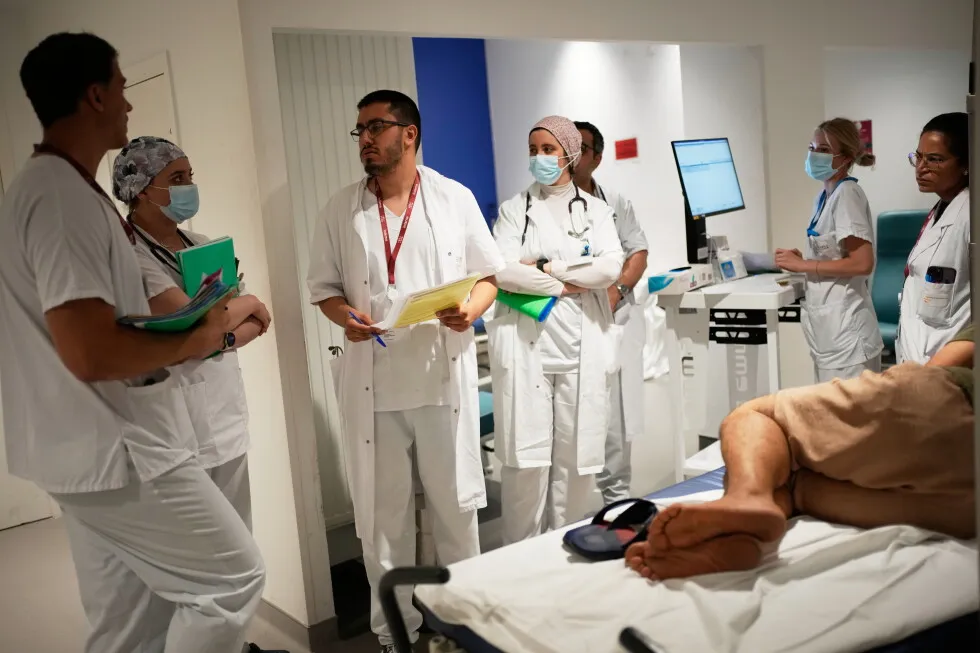
Hospitals in Europe are gearing up for the next heat wave armed with lessons from this one 1 of 6 | At a Paris-region hospital, emergency medics needed it to plunge patients into cold-water baths to speedily bring down their temperatures so they wouldn’t join the growing tally of dead from a record-smashing heat wave. 2 of 6 | Doctors and nurses take care of a patient at the emergency department of the Paris-saclay-hospital" class="entity-link entity-organization" data-entity-id="156126" data-entity-type="organization">Paris-Saclay Hospital, outside Paris, Tuesday June 30, 2026. (AP Photo/Christophe Ena ) 3 of 6 | Paramedics take a patient to the emergency department of the Paris-saclay-hospital" class="entity-link entity-organization" data-entity-id="156126" data-entity-type="organization">Paris-Saclay Hospital, outside Paris, Tuesday June 30, 2026. (AP Photo/Christophe Ena ) 4 of 6 | A patient waits before being treated at the emergency department of the Paris-saclay-hospital" class="entity-link entity-organization" data-entity-id="156126" data-entity-type="organization">Paris-Saclay Hospital, outside Paris, Tuesday June 30, 2026. (AP Photo/Christophe Ena ) 5 of 6 | A heat-protection is set on a window at the emergency department of the Paris-saclay-hospital" class="entity-link entity-organization" data-entity-id="156126" data-entity-type="organization">Paris-Saclay Hospital, outside Paris, Tuesday June 30, 2026. (AP Photo/Christophe Ena ) 6 of 6 | A nurse prepares a bed at the emergency department of the Paris-saclay-hospital" class="entity-link entity-organization" data-entity-id="156126" data-entity-type="organization">Paris-Saclay Hospital, outside Paris, Tuesday June 30, 2026. (AP Photo/Christophe Ena ) 1 of 6 At a Paris-region hospital, emergency medics needed it to plunge patients into cold-water baths to speedily bring down their temperatures so they wouldn’t join the growing tally of dead from a record-smashing heat wave. Add AP News on Google Add AP News as your preferred source to see more of our stories on Google. Share 2 of 6 | Doctors and nurses take care of a patient at the emergency department of the Paris-saclay-hospital" class="entity-link entity-organization" data-entity-id="156126" data-entity-type="organization">Paris-Saclay Hospital, outside Paris, Tuesday June 30, 2026. (AP Photo/Christophe Ena ) 2 of 6 Doctors and nurses take care of a patient at the emergency department of the Paris-saclay-hospital" class="entity-link entity-organization" data-entity-id="156126" data-entity-type="organization">Paris-Saclay Hospital, outside Paris, Tuesday June 30, 2026. (AP Photo/Christophe Ena ) Add AP News on Google Add AP News as your preferred source to see more of our stories on Google. Share 3 of 6 | Paramedics take a patient to the emergency department of the Paris-saclay-hospital" class="entity-link entity-organization" data-entity-id="156126" data-entity-type="organization">Paris-Saclay Hospital, outside Paris, Tuesday June 30, 2026. (AP Photo/Christophe Ena ) 3 of 6 Paramedics take a patient to the emergency department of the Paris-saclay-hospital" class="entity-link entity-organization" data-entity-id="156126" data-entity-type="organization">Paris-Saclay Hospital, outside Paris, Tuesday June 30, 2026. (AP Photo/Christophe Ena ) Add AP News on Google Add AP News as your preferred source to see more of our stories on Google. Share 4 of 6 | A patient waits before being treated at the emergency department of the Paris-saclay-hospital" class="entity-link entity-organization" data-entity-id="156126" data-entity-type="organization">Paris-Saclay Hospital, outside Paris, Tuesday June 30, 2026. (AP Photo/Christophe Ena ) 4 of 6 A patient waits before being treated at the emergency department of the Paris-saclay-hospital" class="entity-link entity-organization" data-entity-id="156126" data-entity-type="organization">Paris-Saclay Hospital, outside Paris, Tuesday June 30, 2026. (AP Photo/Christophe Ena ) Add AP News on Google Add AP News as your preferred source to see more of our stories on Google. Share 5 of 6 | A heat-protection is set on a window at the emergency department of the Paris-saclay-hospital" class="entity-link entity-organization" data-entity-id="156126" data-entity-type="organization">Paris-Saclay Hospital, outside Paris, Tuesday June 30, 2026. (AP Photo/Christophe Ena ) 5 of 6 A heat-protection is set on a window at the emergency department of the Paris-saclay-hospital" class="entity-link entity-organization" data-entity-id="156126" data-entity-type="organization">Paris-Saclay Hospital, outside Paris, Tuesday June 30, 2026. (AP Photo/Christophe Ena ) Add AP News on Google Add AP News as your preferred source to see more of our stories on Google. Share 6 of 6 | A nurse prepares a bed at the emergency department of the Paris-saclay-hospital" class="entity-link entity-organization" data-entity-id="156126" data-entity-type="organization">Paris-Saclay Hospital, outside Paris, Tuesday June 30, 2026. (AP Photo/Christophe Ena ) 6 of 6 A nurse prepares a bed at the emergency department of the Paris-saclay-hospital" class="entity-link entity-organization" data-entity-id="156126" data-entity-type="organization">Paris-Saclay Hospital, outside Paris, Tuesday June 30, 2026. (AP Photo/Christophe Ena ) Add AP News on Google Add AP News as your preferred source to see more of our stories on Google. Share Updated [hour]:[minute] [AMPM] [timezone], [monthFull] [day], [year] ORSAY, France (AP) — Ice. Urgently and in large quantities.At a Paris-region hospital, emergency medics needed it to plunge patients into cold-water baths to speedily bring down their temperatures so they wouldn’t join the growing tally of dead from a record-smashing heat wave. But lacking an ice-making machine, where to get it?A fast-food restaurant helped out last week, saying the hospital could take its ice. Staff also bought ice from the supermarket. The Paris-saclay-hospital" class="entity-link entity-organization" data-entity-id="156126" data-entity-type="organization">Paris-Saclay Hospital has now ordered its own ice machine, eagerly awaited in the emergency department for a future attack of sizzling heat. Whether that hits next week, as France’s weather service says it might, or in summer months ahead, medics and hospital administrators are acutely aware that the battle they’ve just endured will, because of climate change, be followed by others. Just as they brace for the annual flu season, they know that fighting heat waves is becoming their new normal. A patient at the Paris-saclay-hospital" class="entity-link entity-organization" data-entity-id="156126" data-entity-type="organization">Paris-Saclay Hospital’s emergency department on Tuesday June 30, 2026. (AP Photo/Christophe Ena ) A patient at the Paris-saclay-hospital" class="entity-link entity-organization" data-entity-id="156126" data-entity-type="organization">Paris-Saclay Hospital’s emergency department on Tuesday June 30, 2026. (AP Photo/Christophe Ena ) Add AP News on Google Add AP News as your preferred source to see more of our stories on Google. Share So as they catch their breath from what the director of the public hospital described as a “horrible” last week, he and his staff are also gearing up for the next round. 3 MIN READ 4 MIN READ 1 MIN READ “We thought we were ready. We were not actually,” said the director, Cédric Lussiez.“The hospital was working on a 24 hours a day basis because we had to find new solutions in a very short delay,” he said. “We already learned some lessons.” Hospitals are preparing for more inevitable heat waves Efforts to plug some of the holes exposed by the heat wave that shifted eastward to other parts of Europe after battering France, the United Kingdom and other countries are accelerating on a national level, too. When France was baking through its hottest days on record last week, French Prime Minister Sébastien Lecornu announced a 100-million euro ($114-million) spend from this summer on cooling systems for hospitals and other work to keep wards functioning.And at the latest in a series of heat-wave crisis meetings, he said Monday that the government is buying 30,000 air-conditioning units for health facilities, with the first deliveries expected “at the end of the week, beginning of next week.” “It’s an absolute priority for us that, if the heat wave returns, the hospital situation be a lot less strained,” he said. Reflective shielding taped against the sun in an emergency department room at the Paris-saclay-hospital" class="entity-link entity-organization" data-entity-id="156126" data-entity-type="organization">Paris-Saclay Hospital on Tuesday, June 30, 2026. (AP Photo/Christophe Ena ) Reflective shielding taped against the sun in an emergency department room at the Paris-saclay-hospital" class="entity-link entity-organization" data-entity-id="156126" data-entity-type="organization">Paris-Saclay Hospital on Tuesday, June 30, 2026. (AP Photo/Christophe Ena ) Add AP News on Google Add AP News as your preferred source to see more of our stories on Google. Share The World Health Organization on Tuesday described the heat wave as “a dress rehearsal” for summers that “will be harder.” “Europe is warming at more than twice the global average. Heat waves are no longer one-off freak events,” it said. “Every summer we fail to prepare for them is a summer we pay for in lives.”Heart attacks and other heat-exposure emergencies surgeAt the Paris-saclay-hospital" class="entity-link entity-organization" data-entity-id="156126" data-entity-type="organization">Paris-Saclay Hospital, patients suffering from heat exposure started arriving in a surge on June 20, said Dr. Nicolas Gonzales, head of the emergency department.“It was like a big mountain,” he said. “It was like that for seven days. So it was very intense.” “In winter, we know we’ll have influenza epidemics and probably COVID as well. And now, in the summer, we’re going to have the climate crisis,” he said.The first patient he treated in this heat wave was an emergency call-out, for a 50-year-old man in a coma at home and with a temperature of about 40 degrees Celsius (104 Fahrenheit). His family said he seemed fine one minute, but was unconscious the next, Gonzales said. He was rushed to the hospital for critical care. Then came the flood: heart attacks, dehydration, kidney malfunctions and other heat-related problems, impacting all age groups, from children to older people living alone.“Heat is a physical assault. It is a physical assault on the body,” Gonzales said. “And when the body can no longer adapt — or, unfortunately, is no longer able to fight off that assault — you don’t feel it coming, and the heart can stop beating.” Paramedics move a patient into the Paris-saclay-hospital" class="entity-link entity-organization" data-entity-id="156126" data-entity-type="organization">Paris-Saclay Hospital emergency department on Tuesday, June 30, 2026. (AP Photo/Christophe Ena ) Paramedics move a patient into the Paris-saclay-hospital" class="entity-link entity-organization" data-entity-id="156126" data-entity-type="organization">Paris-Saclay Hospital emergency department on Tuesday, June 30, 2026. (AP Photo/Christophe Ena ) Add AP News on Google Add AP News as your preferred source to see more of our stories on Google. Share Hospitals are urgently upgrading heat defensesParis-Saclay Hospital is new and has air-conditioning, but three older hospitals that are part of its group, which Lussiez heads, aren’t so well defended against the heat. It tested them arduously. To prevent medicines from spoiling, they had to be cooled with a temporary solution of electric fans and blocks of ice. Student nurses were recruited to help with the work of keeping patients hydrated. The thermometer hit 33 C (91 F) on the top, most exposed floor of a psychiatric unit, Lussiez said. He’s now urgently equipping that unit with a cool room for patients on each floor and organizing other renovation works and changes, including moving a department for elderly patients to the new hospital.“We’ll be in a better situation next week than we were last week,” he said.___Associated Press journalist Alex Turnbull contributed.
SRCAssociated Press (AP)
LANGEN
LEANCenter
WORDS1 604
ENT7
WED · 2026-07-01 · 06:53 GMTBRIEF NSR-2026-0701-88926
NSR-2026-0701-88926News Report·EN·Public Health
Hospitals in Europe are gearing up for the next heat wave armed with lessons from this one
European hospitals are preparing for future heat waves after being caught unprepared by a recent record-breaking event. At Paris-Saclay Hospital, emergency staff scrambled for ice to treat heatstroke patients, even sourcing it from a fast-food restaurant and supermarkets.
By
JOHN LEICESTERAssociated Press (AP)Filed 2026-07-01 · 06:53 GMTLean · CenterRead · 7 min
Associated Press (AP)FIG 01
Reading time
7min
Word count
1 604words
Sources cited
0cited
Entities identified
7entities
Quality score
100%
§ 01
Briefing Summary
AI-generatedNEWSAR · AI
European hospitals are preparing for future heat waves after being caught unprepared by a recent record-breaking event. At Paris-Saclay Hospital, emergency staff scrambled for ice to treat heatstroke patients, even sourcing it from a fast-food restaurant and supermarkets. The hospital has since ordered its own ice machine, recognizing that combating extreme heat is becoming a new normal due to climate change. French Prime Minister Sébastien Lecornu announced a 100-million euro investment in hospital cooling systems and the purchase of 30,000 air-conditioning units for health facilities. Doctors emphasize that heat waves are a significant physical assault on the body, leading to surges in heart attacks, dehydration, and other heat-related emergencies across all age groups.
Confidence 0.90Claims 4Entities 7
§ 02
Article analysis
Model · rule-basedFraming
Public Health
Human Interest
Tone
Measured
AI-assessed
CalmNeutralAlarmist
Factuality
0.80 / 1.00
Factual
LowHigh
Sources cited
0
No named sources
FewMany
§ 03
Key claims
4 extracted01
The Paris-Saclay Hospital is shown preparing for patients during a heat wave.
factual
Confidence
0.90
02
Emergency medics used cold-water baths to rapidly lower patient temperatures during a recent heat wave.
factual
Confidence
0.90
03
Hospitals in Europe are preparing for future heat waves by applying lessons learned from recent events.
factual
Confidence
0.90
04
A record-smashing heat wave led to a significant number of deaths.
factual
Confidence
0.80
§ 04
Full report
7 min read · 1 604 words§ 05
Entities
7 identifiedKey playerOppositionContextPositiveNeutralNegative
Organizations3
Topics1
§ 06
Keywords & salience
8 termsheat wave
1.00
hospitals
0.90
emergency medicine
0.80
patient care
0.70
europe
0.60
cold-water baths
0.50
temperature regulation
0.40
public health preparedness
0.40
§ 07
Topic connections
Interactive graph Network visualization showing 51 related topics
View Full Graph Person Organization Location Event|Click node to navigate|Edge numbers = shared articles