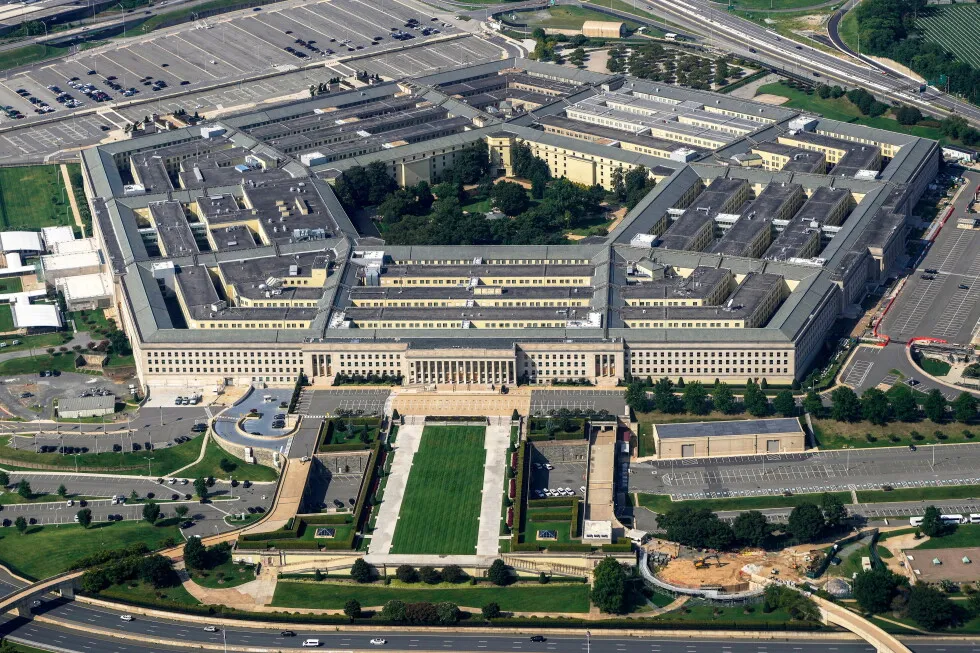
Judge orders Pentagon to lift policy that New York Times journalists be accompanied by an escort 1 of 2 | The Pentagon is viewed from the window of an airplane Aug. 27, 2023, in Washington. (AP Photo/Carolyn Kaster, File) 2 of 2 | Defense Secretary Pete Hegseth listens as President Donald Trump speaks in the Oval Office of the White House during an executive order signing about quantum computing, Monday, June 22, 2026, in Washington. (AP Photo/Jacquelyn Martin) 1 of 2 | The Pentagon is viewed from the window of an airplane Aug. 27, 2023, in Washington. (AP Photo/Carolyn Kaster, File) 1 of 2 The Pentagon is viewed from the window of an airplane Aug. 27, 2023, in Washington. (AP Photo/Carolyn Kaster, File) Add AP News on Google Add AP News as your preferred source to see more of our stories on Google. Share 2 of 2 | Defense Secretary Pete Hegseth listens as President Donald Trump speaks in the Oval Office of the White House during an executive order signing about quantum computing, Monday, June 22, 2026, in Washington. (AP Photo/Jacquelyn Martin) 2 of 2 Defense Secretary Pete Hegseth listens as President Donald Trump speaks in the Oval Office of the White House during an executive order signing about quantum computing, Monday, June 22, 2026, in Washington. (AP Photo/Jacquelyn Martin) Add AP News on Google Add AP News as your preferred source to see more of our stories on Google. Share Updated [hour]:[minute] [AMPM] [timezone], [monthFull] [day], [year] A federal judge has ordered the Defense Department to temporarily halt its requirement that New York Times journalists be accompanied by an official escort, in another setback for the Trump administration’s efforts to restrict media access at the Pentagon.U.S. District Judge Paul L. Friedman in Washington said that policy violated the First Amendment and he issued a preliminary ruling Tuesday barring the requirement while The New York Times continues its legal battle against the department’s restrictions. The order did not specify whether journalists from other organizations would also get relief from that policy.The newspaper in May sued the Defense Department for the second time in five months. The lawsuits have played into an escalating tension between the U.S. media and the Republican administration, both in the public arena and the courts. The Times hailed Friedman’s ruling. “Today’s well-reasoned decision reaffirms the First Amendment rights of the press to cover the Pentagon without restrictions designed to prevent the public from knowing what the military is doing,” said Charlie Stadtlander, a spokesperson. “The court recognized that the Pentagon’s hastily implemented new policy was a clear violation of the Constitution.” 10 MIN READ 3 MIN READ 5 MIN READ Pentagon spokesman Sean Parnell posted on X late Tuesday that the department “strongly disagrees” with Friedman’s decision. “This ruling strips away reasonable security measures and will make it easier for sensitive and classified information to reach our adversaries.” The Times first sued in December over rules imposed by Defense Secretary Pete Hegseth seeking to limit media access.The escort policy was implemented in March after a ruling by Friedman that had struck down earlier restrictions. He said they violated the rights of Times reporter Julian E. Barnes and the paper.The following month, the judge ruled that the interim policy violated his March order. But the escort policy remained in place when an appeals court stayed part of Friedman’s ruling while the government appealed. The appeals process is ongoing.The Times and other outlets walked out of the Pentagon in October rather than agree to Hegseth’s restrictions. They continue to cover the U.S. military from outside the building. A new press corps approved by the department currently occupies the Pentagon space.
SRCAssociated Press (AP)
LANGEN
LEANCenter
WORDS613
ENT12
WED · 2026-07-01 · 13:23 GMTBRIEF NSR-2026-0701-89005
NSR-2026-0701-89005News Report·EN·Legal & Judicial
Judge orders Pentagon to lift policy that New York Times journalists be accompanied by an escort
A federal judge has ordered the Pentagon to temporarily lift its policy requiring New York Times journalists to be accompanied by an escort. U.S.
By
JOCELYN NOVECKAssociated Press (AP)Filed 2026-07-01 · 13:23 GMTLean · CenterRead · 3 min
Associated Press (AP)FIG 01
Reading time
3min
Word count
613words
Sources cited
3cited
Entities identified
12entities
Quality score
100%
§ 01
Briefing Summary
AI-generatedNEWSAR · AI
A federal judge has ordered the Pentagon to temporarily lift its policy requiring New York Times journalists to be accompanied by an escort. U.S. District Judge Paul L. Friedman ruled that the policy violated the First Amendment and issued a preliminary injunction while the newspaper's legal battle against Pentagon media restrictions continues. The New York Times had sued the Defense Department for the second time in five months over these restrictions. The Pentagon stated it strongly disagrees with the ruling, arguing it removes security measures and could endanger classified information. This decision is a setback for the Trump administration's efforts to limit media access.
Confidence 0.90Sources 3Claims 5Entities 12
§ 02
Article analysis
Model · rule-basedFraming
Legal & Judicial
Political Strategy
Tone
Measured
AI-assessed
CalmNeutralAlarmist
Factuality
0.80 / 1.00
Factual
LowHigh
Sources cited
3
Well sourced
FewMany
§ 03
Key claims
5 extracted01
The ruling reaffirms the First Amendment rights of the press to cover the Pentagon without restrictions.
quoteCharlie Stadtlander (spokesperson for The New York Times)
Confidence
1.00
02
The Pentagon spokesman stated the department 'strongly disagrees' with the ruling and that it 'strips away reasonable security measures'.
quoteSean Parnell (Pentagon spokesman)
Confidence
1.00
03
The New York Times sued the Defense Department for the second time in five months.
factualThe New York Times
Confidence
1.00
04
The judge ruled that the policy violated the First Amendment.
factualU.S. District Judge Paul L. Friedman
Confidence
1.00
05
A federal judge ordered the Defense Department to temporarily halt its requirement that New York Times journalists be accompanied by an official escort.
factualU.S. District Judge Paul L. Friedman
Confidence
1.00
§ 04
Full report
3 min read · 613 words§ 05
Entities
12 identifiedKey playerOppositionContextPositiveNeutralNegative
People3
Organizations4
Locations3
§ 06
Keywords & salience
9 termsnew york times
1.00
pentagon
1.00
media access
0.90
first amendment
0.80
federal judge
0.70
policy
0.60
trump administration
0.50
escort requirement
0.50
legal battle
0.40
§ 07
Topic connections
Interactive graph Network visualization showing 22 related topics
View Full Graph Person Organization Location Event|Click node to navigate|Edge numbers = shared articles