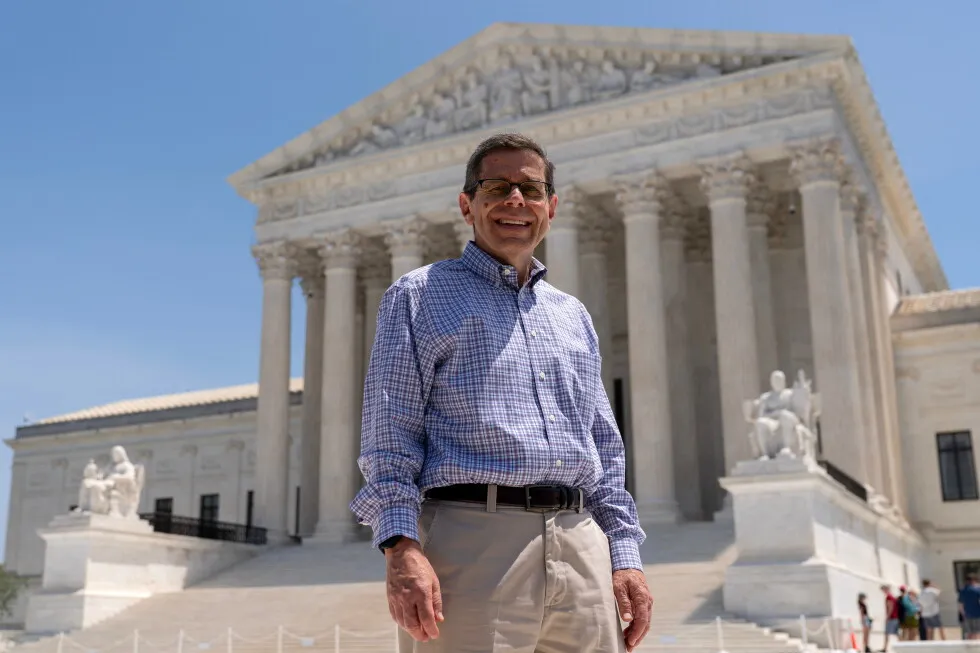
AP’s long-time Supreme Court reporter Mark Sherman reflects on front row seat to legal history 1 of 4 | Mark Sherman poses for a photograph outside of the Supreme Court Tuesday, June 30, 2026, on the last day of the Court term on Capitol Hill, Tuesday, June 30, 2026, in Washington. (AP Photo/Jose Luis Magana) 2 of 4 | The Supreme Court is seen as the Justices release opinions, in Washington, Monday, June 29, 2026. (AP Photo/J. Scott Applewhite) 3 of 4 | A group prays outside of the Supreme Court ahead of the court’s ruling on whether transgender girls and women can play on school athletic teams, Tuesday, June 30, 2026, on Capitol Hill in Washington. (AP Photo/Jose Luis Magana) 4 of 4 | Interns run to deliver documents to the media after a Supreme Court ruling outside the Supreme Court on Capitol Hill, Tuesday, June 30, 2026, in Washington. (AP Photo/Jose Luis Magana) 1 of 4 | Mark Sherman poses for a photograph outside of the Supreme Court Tuesday, June 30, 2026, on the last day of the Court term on Capitol Hill, Tuesday, June 30, 2026, in Washington. (AP Photo/Jose Luis Magana) 1 of 4 Mark Sherman poses for a photograph outside of the Supreme Court Tuesday, June 30, 2026, on the last day of the Court term on Capitol Hill, Tuesday, June 30, 2026, in Washington. (AP Photo/Jose Luis Magana) Add AP News on Google Add AP News as your preferred source to see more of our stories on Google. Share 2 of 4 | The Supreme Court is seen as the Justices release opinions, in Washington, Monday, June 29, 2026. (AP Photo/J. Scott Applewhite) 2 of 4 The Supreme Court is seen as the Justices release opinions, in Washington, Monday, June 29, 2026. (AP Photo/J. Scott Applewhite) Add AP News on Google Add AP News as your preferred source to see more of our stories on Google. Share 3 of 4 | A group prays outside of the Supreme Court ahead of the court’s ruling on whether transgender girls and women can play on school athletic teams, Tuesday, June 30, 2026, on Capitol Hill in Washington. (AP Photo/Jose Luis Magana) 3 of 4 A group prays outside of the Supreme Court ahead of the court’s ruling on whether transgender girls and women can play on school athletic teams, Tuesday, June 30, 2026, on Capitol Hill in Washington. (AP Photo/Jose Luis Magana) Add AP News on Google Add AP News as your preferred source to see more of our stories on Google. Share 4 of 4 | Interns run to deliver documents to the media after a Supreme Court ruling outside the Supreme Court on Capitol Hill, Tuesday, June 30, 2026, in Washington. (AP Photo/Jose Luis Magana) 4 of 4 Interns run to deliver documents to the media after a Supreme Court ruling outside the Supreme Court on Capitol Hill, Tuesday, June 30, 2026, in Washington. (AP Photo/Jose Luis Magana) Add AP News on Google Add AP News as your preferred source to see more of our stories on Google. Share Updated [hour]:[minute] [AMPM] [timezone], [monthFull] [day], [year] Washington (AP) — ____________________________________________________________________________________________________Mark Sherman has covered the Supreme Court for The Associated Press for 20 years during some of the most momentous decisions in history. He retired on Tuesday, the last day of the court term, and reflects on his experience. He has witnessed how by both happenstance and design the court has moved to the ideological right.____________________________________________________________________________________________________ At the end of my first term covering the Supreme Court, Justice Stephen Breyer departed from his prepared remarks to offer a sharp courtroom rebuke of his conservative colleagues.“It is not often in the law that so few have so quickly changed so much,” Breyer said, dissenting in a school integration case. The moment was instructive to me as a new reporter on the Supreme Court beat. It encapsulated a term in which a new conservative majority had prevailed in one 5-4 case after another. But more than that, it was a very human reaction from a frustrated justice whose black robe was meant to convey a certain dull sobriety. I would be on the lookout for such departures for the rest of my 20 years at the court.In that time, almost by happenstance more than design, the court has marched to the ideological right. Unexpected vacancies, brute force political maneuvers and the rise of Donald Trump all combined to give the court a conservative supermajority, and with that change the direction of the country. The Supreme Court has marched to the rightWhen I started covering the Supreme Court in 2006, the center of gravity had just shifted slightly to the right, from Sandra Day O’Connor to Anthony Kennedy.Together they had helped preserve abortion rights in 1992, then been part of a five-justice majority to insure George W. Bush’s election in 2000 in Bush v. Gore.Kennedy is lionized in some quarters for his opinions in favor of gay rights, including the landmark decision that declared same-sex marriage a constitutional right. In different settings, it’s his majority opinion in Citizens United that comes in for high praise, which enabled a flood of independent spending in political campaigns. Scalia’s unexpected death presented Democrats with an opportunity. Republicans blocked themBut a larger change was afoot. It started when Antonin Scalia died suddenly of a heart attack, in February 2016.Liberals salivated at the prospect of a court that might pivot left, rolling back gun rights and reimposing campaign finance limits that had recently been overturned.Certainly abortion and affirmative action would be safe, as Justice Ruth Bader Ginsburg assured me when we spoke that summer.Sitting across from me in her court office filled with modern art and mementos, Ginsburg seemed confident that the next occupant of the White House would be a woman, Democrat Hillary Clinton. The next president, “whoever she may be,” Ginsburg said, might get to fill three vacancies, not just Scalia’s seat. At least two other justices in their 80s or nearing that milestone might retire, herself included. I broke the spell. What if Clinton were to lose, I asked. “I don’t want to think about that possibility, but if it should be, then everything is up for grabs,” she said.Ginsburg was more right than wrong. She was incorrect about the outcome. Clinton lost the election, in part because of conservative voters’ worries about the future of the Supreme Court.Senator Mitch McConnell, the Majority Leader at the time, had maneuvered to keep Scalia’s seat open until after the election, even after Obama nominated the well-respected federal appeals court judge Merrick Garland, who had previously won broad bipartisan support.But she nailed just about everything else. The next president, Donald Trump, did appoint three justices. And everything was on the table, including abortion and affirmative action.Instead of writing about a new liberal court majority, one on which more moderate justices like Breyer and Elena Kagan would play decisive roles, I have reported on the triumph of the conservative legal project, decades in the making, and to the great satisfaction of Republicans who wanted to reverse liberal rulings from previous decades. Lifetime tenure gives justices a say in who succeeds themIt has become commonplace for justices to time their retirements so that they can be replaced by someone with the same judicial philosophy. Ginsburg, having decided to remain on the court, died less than two months before the 2020 election and her deathbed wish that her seat not be filled before then was ignored. The last two justices who retired, Anthony Kennedy, appointed by Ronald Reagan and Stephen Breyer, appointed by Bill Clinton, were replaced by people who once served as their law clerks.It’s not a criticism of Brett Kavanaugh and Ketanji Brown Jackson, each with a sterling legal resume. Instead, it’s telling that the effort to coax a justice into retirement might be more likely to succeed if a former clerk is in the running for the seat.The country accepts that the direction of the court turns not just on who the president is, but the late-in-life decisions of the justices themselves. Justices object to being described as political There are no Trump judges or Obama judges, only an independent judiciary, Chief Justice John Roberts told me several years ago after I asked whether he’d have any comment on President Donald Trump’s criticism of an “Obama judge.”Roberts was right in one respect. Judges, justices included, don’t vote robotically in favor of the president who appointed them. In just one example, two Trump-appointed justices voted against the president’s unilateral, global tariffs, for which Trump criticized them in harsh, personal terms.But Trump clearly was right, too. In this era, presidents nominate justices because their records show they can be counted on.Since 2010, the conservative justices all have been appointed by Republican presidents. The liberals, by Democrats. The consistent message from both sides is that too much is at stake to risk a selection mistake.Would you mind snapping a photo, a tourist in front of the Supreme Court once asked Justice Anthony Kennedy?One of the advantages of zealously keeping cameras from the courtroom is how little known most justices are. Some of that has changed as seven of the nine justices have written or are writing books which they then go on tour to promote. They have collectively earned millions of dollars.It’s remarkable how unobtrusively justices used to move around town. It was not uncommon to run into Ginsburg and her family at a movie or a play, see Thomas making his way to and from Mass most mornings, bump into Kagan at a supermarket or get in line behind Sotomayor at a weekend farmer’s market on Capitol Hill.The justices drove themselves to work most days. Scalia once got a traffic ticket for a minor fender-bender on his way into work.Early in my time in Washington, I recall walking past the court and seeing a Volkswagen with New Hampshire plates parked on Maryland Avenue. The dry cleaning lying in the back erased any doubt about whose car it was. “Souter,” the label said, as in Justice David Souter of New Hampshire.Security concerns have grown exponentially over the years. By the time Kavanaugh joined the court, security was much tighter. Federal agents were stationed outside Kavanaugh’s house in suburban Maryland when a would-be attacker armed with a pistol, knife and zip ties showed up there late one night in 2022 and eventually pleaded guilty to trying to assassinate the justice.Covering the court has changed dramaticallyUntil the COVID-19 pandemic, I felt strongly that the world, as it were, was waiting for my assessment of what had happened in the courtroom on any given morning. I was among a handful of reporters who hurried downstairs after arguments ended to bat out a first take on where the court appeared to be headed in its biggest cases.News organizations regularly asked for live access to big arguments and the response was always, No. Then the pandemic shut down the world and institutions scrambled to figure out how to cope. For the court, that meant remote argument sessions, with no choice but to allow the public to listen in, live.That experiment produced the occasional embarrassing moment, including an audible and unexplained toilet flush. But mostly it worked, and Americans could hear the court in action. Even when the justices returned to the courtroom in 2021, the livestream remained.Selfishly, my coverage feels less vital because anyone who cares can listen and assess what is being said. Decisions post quickly to the court’s website. No one is hanging on my words.The growth of emergency appeals also has changed covering the court, and not for the better. In years past, I could know from a glance at the calendar when I’d be very busy. But emergency appeals can pop up any time (and did with alarming frequency during Trump’s second term) and decisions on those appeals also could come at any time, during the regular workday or even after midnight. Sherman has covered the Supreme Court for The Associated Press since 2006. His journalism career spans five decades. He is based in Washington, D.C., and previously lived in New York, Paris and Atlanta.
SRCAssociated Press (AP)
LANGEN
LEANCenter
WORDS2 028
ENT8
WED · 2026-07-01 · 15:23 GMTBRIEF NSR-2026-0701-89042
NSR-2026-0701-89042News Report·EN·Human Interest
AP’s long-time Supreme Court reporter Mark Sherman reflects on front row seat to legal history
Mark Sherman, a long-time Supreme Court reporter for The Associated Press, retired after 20 years covering the court. During his tenure, he witnessed the court shift significantly to the ideological right, a change he attributes to a combination of unexpected vacancies, political maneuvers, and the rise of Donald Trump.
By
MARK SHERMANAssociated Press (AP)Filed 2026-07-01 · 15:23 GMTLean · CenterRead · 9 min
Associated Press (AP)FIG 01
Reading time
9min
Word count
2 028words
Sources cited
0cited
Entities identified
8entities
Quality score
100%
§ 01
Briefing Summary
AI-generatedNEWSAR · AI
Mark Sherman, a long-time Supreme Court reporter for The Associated Press, retired after 20 years covering the court. During his tenure, he witnessed the court shift significantly to the ideological right, a change he attributes to a combination of unexpected vacancies, political maneuvers, and the rise of Donald Trump. Sherman's observations began with Justice Stephen Breyer's sharp dissent in his first term, highlighting a conservative majority's impact. He notes that justices have increasingly timed retirements to ensure their successors share their judicial philosophy, influencing the court's direction. The article also touches on the changing public visibility of justices and the evolution of court coverage, particularly with the advent of live streaming.
Confidence 0.90Claims 5Entities 8
§ 02
Article analysis
Model · rule-basedFraming
Human Interest
Legal & Judicial
Tone
Measured
AI-assessed
CalmNeutralAlarmist
Factuality
0.70 / 1.00
Factual
LowHigh
Sources cited
0
No named sources
FewMany
§ 03
Key claims
5 extracted01
Interns delivered documents to the media after a Supreme Court ruling.
factual
Confidence
1.00
02
A group prayed outside the Supreme Court ahead of a ruling on transgender athletes.
factual
Confidence
1.00
03
The Supreme Court released opinions on Tuesday, June 30, 2026.
factual
Confidence
1.00
04
Sherman has had a front-row seat to legal history.
factual
Confidence
1.00
05
Mark Sherman is AP's long-time Supreme Court reporter.
factual
Confidence
1.00
§ 04
Full report
9 min read · 2 028 words§ 05
Entities
8 identifiedKey playerOppositionContextPositiveNeutralNegative
People3
§ 06
Keywords & salience
8 termssupreme court
1.00
legal history
0.90
court term
0.80
justices
0.70
opinions
0.60
school athletic teams
0.50
transgender girls
0.50
ap reporter
0.40
§ 07
Topic connections
Interactive graph No topic relationship data available yet. This graph will appear once topic relationships have been computed.